Public domain · via Wikimedia Commons ↗
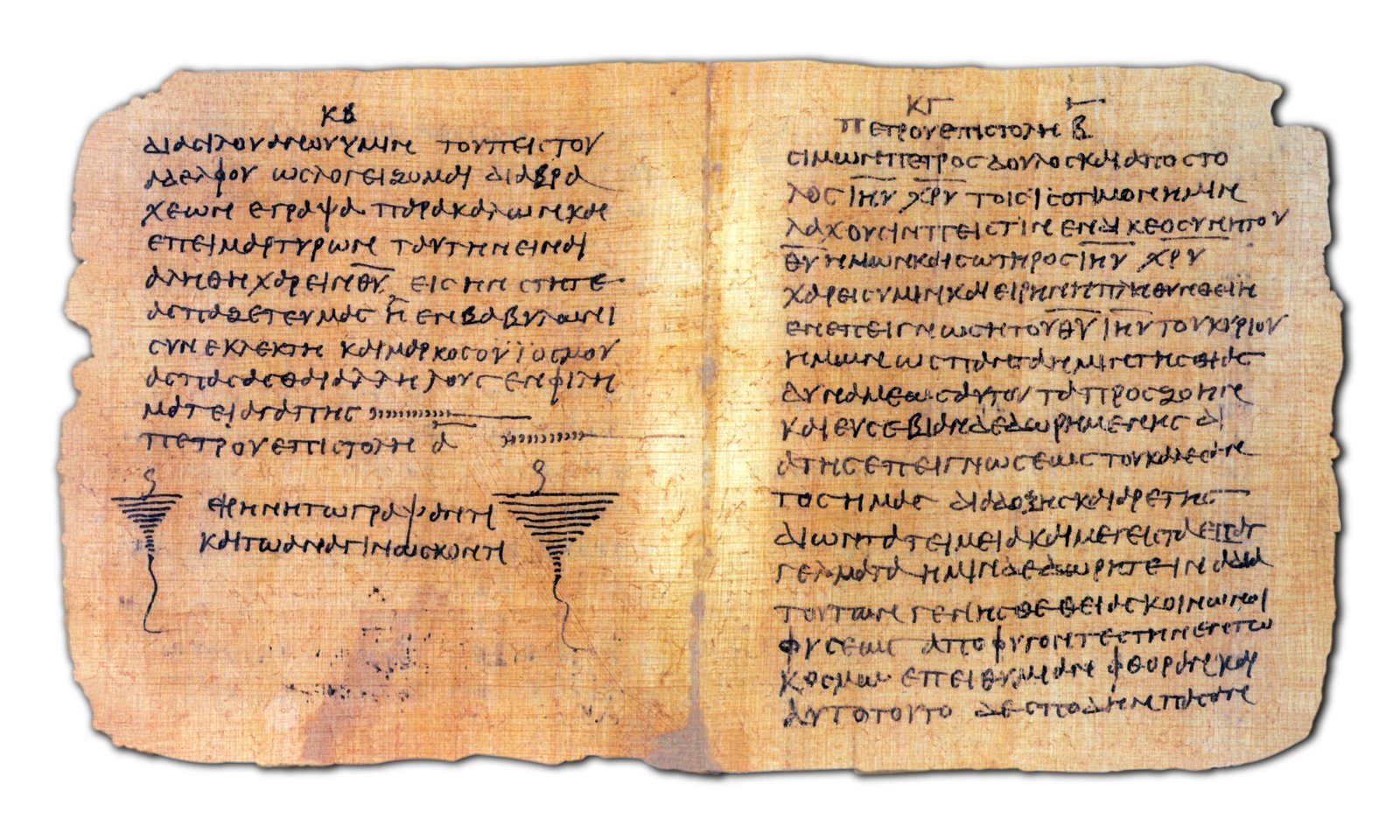
𝔓72 — Bodmer Papyrus VII–VIII
Also called P72, P. Bodmer VII–VIII.
Reflection
𝔓72 is the earliest copy we have of 1 Peter, 2 Peter, and Jude — three letters that the early church wrestled with longer than any other New Testament books. Their canonical status was debated into the 4th century. Eusebius classified 2 Peter and Jude among the disputed writings — recognized but not yet universally received. 𝔓72 is the manuscript that shows us how the disputed letters were actually being read.
The codex is a private devotional anthology. Bound together in the same book are 1 Peter, 2 Peter, Jude, two psalms, an ode of Solomon, Melito of Sardis's Homily on the Passover, and several other texts of varying canonical status. This is not an authorized edition produced for public liturgical reading. This is what one Egyptian Christian — or one Egyptian Christian community — kept on their shelf for prayer and study. The fact that 1 and 2 Peter and Jude are present, copied carefully, and treated as scripture by their inclusion in such a collection, tells us that long before Athanasius's 367 canon list, ordinary Christians were already reading these letters as God's Word.
The text of 𝔓72 has its own peculiarities. There are paraphrases. There are theological clarifications added by the scribe — for example, an explicit reference to "Christ our God" in 1 Peter that does not appear in later manuscripts. These are not errors of corruption; they are evidence of a community thinking pastorally as it copied. For the believer today, 𝔓72 is a witness that the warnings of 2 Peter against false teachers, the reminder of Jude that we contend earnestly for the faith once delivered, and the call of 1 Peter to live as exiles in a hostile world — all of it was being read, prayed, and taught in the Egyptian church when persecution was a daily threat. They needed Peter and Jude. So do we. The Word stands.
Why this manuscript matters
- Earliest copies of 1 and 2 Peter and Jude
- Private devotional codex
- Mixed canonical and non-canonical content