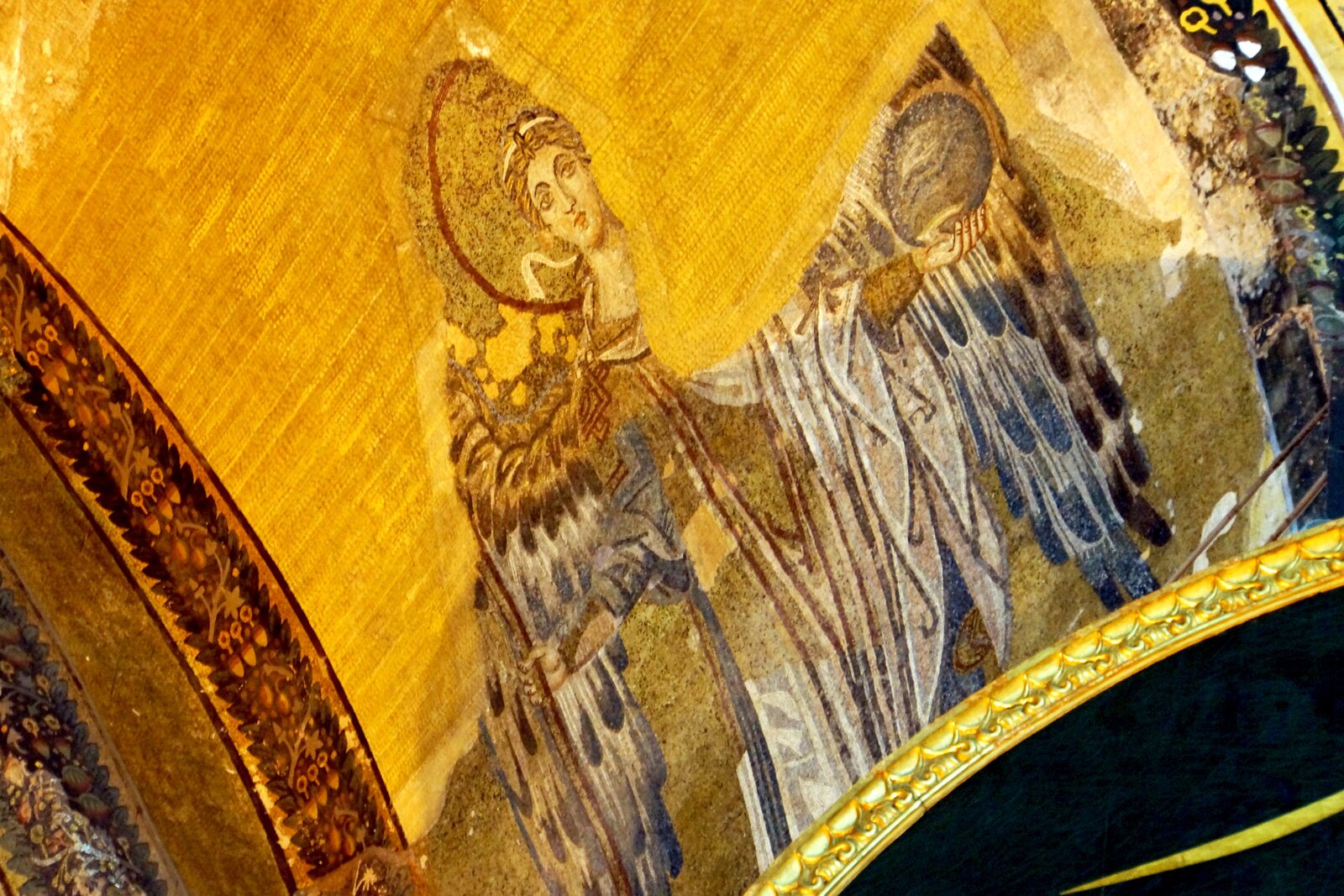
Archangels Gabriel and Michael
Bema Arch Mosaics, Hagia Sophia (9th century)
Doctrinal reflection
They are servants of the throne.
The two archangels in the bema arch of Hagia Sophia — Gabriel (south side, viewer's right) and Michael (north side, partly destroyed) — flank the great apse Theotokos (corpus #25) in a coordinated 9th-century post-iconoclasm program. The archangels are full-length, dressed in court garments rather than warrior armor, holding orbs and staffs. They are not fighting. They are attending. They face inward toward the Theotokos and the Christ-child she holds, taking the iconographic position of imperial courtiers — the celestial cubicularii on either side of the throne.
This is the right way to picture archangels biblically. Hebrews 1:14 names angels precisely: "Are they not all ministering spirits, sent forth to minister for them who shall be inherit salvation?" Ministering — Greek leitourgika, the same root as liturgy. Sent forth — they are dispatched, not enthroned. The archangels in the bema arch are doing what scripture says angels do: standing at the throne, attending the King, dispatched by him to minister to humans.
Gabriel and Michael are the only archangels named in canonical scripture. Gabriel appears in Daniel 8:16 and 9:21 (interpreting Daniel's visions) and Luke 1:19, 26 (announcing the births of John the Baptist and Christ). Michael appears in Daniel 10:13, 21 and 12:1 (warring against the prince of Persia and standing for the people of Israel), Jude 9 (disputing with the devil over the body of Moses), and Revelation 12:7 (warring against the dragon). Two named archangels. That is the canonical inventory.
The Eastern tradition names seven — adding Raphael (from Tobit, deuterocanonical), Uriel (from 2 Esdras, deuterocanonical), and three others (Sealtiel, Jegudiel, Barachiel) from extra-canonical sources. We affirm only Michael and Gabriel by name. The deuterocanonical archangel-naming tradition is not biblically warranted; we decline to expand the canonical list.
What the Hagia Sophia program teaches is the right relation. The Theotokos with the Christ-child sits in the apse; the archangels stand on either side; the worshipper looks up. The eye is drawn to the apex (Christ in his mother's arms). The archangels are not the destination of the gaze; they are the frame. They direct attention by their posture toward the One they serve.
We do not pray to Michael. We do not pray to Gabriel. Colossians 2:18 forbids angel-worship explicitly, naming it as disqualifying false humility. Revelation 22:8–9: when the apostle John tries to worship the angel showing him the heavenly visions, the angel rebukes him — "see thou do it not, for I am thy fellowservant... worship God." If a canonical angel rebukes John for attempting to worship him, the apostolic warrant against angel-veneration is decisive.
Angels minister; they do not mediate. Christ alone mediates (1 Timothy 2:5). The archangels in the bema arch are doing their proper work — attending the throne, dispatched as messengers, standing at the King's command. That is the angelic ministry. They do not stand between humans and God; they pass between God and humans, carrying messages in one direction and reports in the other.
When you preach the angels, preach what scripture says they are: ministering spirits, sent forth. Don't lift them above their post.