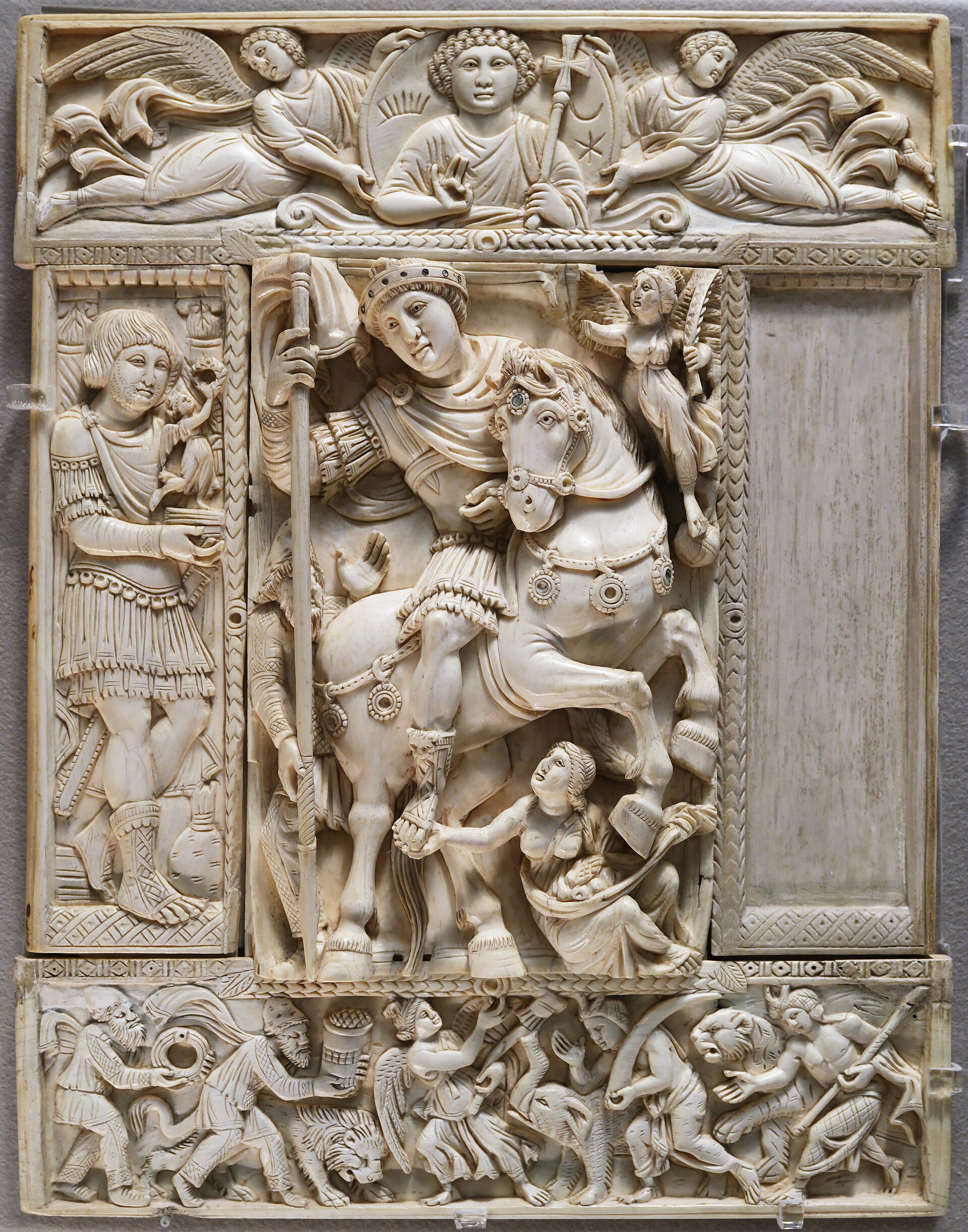
Barberini Ivory
Doctrinal reflection
The Barberini Ivory is a large five-part consular or imperial diptych leaf carved in Constantinople, dated to the early sixth century AD, most plausibly to the reign of Justinian I (527–565 AD), though some scholars have proposed an earlier Anastasian dating. It is housed in the Département des Objets d'Art at the Louvre, Paris (inv. OA 9063). The central panel depicts a mounted emperor in heroic triumphal pose, rendered in the tradition of Roman adventus and triumph iconography; he is crowned by a Victory figure and receives submission from a barbarian at his horse's flank. The upper register shows Christ enthroned in a mandorla flanked by angels, bestowing heavenly legitimation upon the earthly ruler below — a programmatic conflation of Roman imperial ideology and Christian theology of sovereignty that characterizes Justinianic court art. The lower register presents barbarian delegations bearing tribute, situating the emperor within a cosmic and universal dominion. A lateral panel depicts a military commander or consul. The ivory demonstrates exceptional technical command of high-relief carving and perspectival recession characteristic of late antique Constantinopolitan workshops. Scholarly debate persists over the precise identity of the emperor — Justinian, Anastasius I, and Zeno have all been proposed — and whether the occasion commemorates a specific military victory. The object is paradigmatic for discussions of the Christianization of imperial ideology and the survival of classical sculptural traditions in early Byzantine court production. Sources: Delbrueck, R., Die Consulardiptychen (1929); Cutler, A., The Craft of Ivory (1985); Dumbarton Oaks Papers, various issues on late antique ivories.