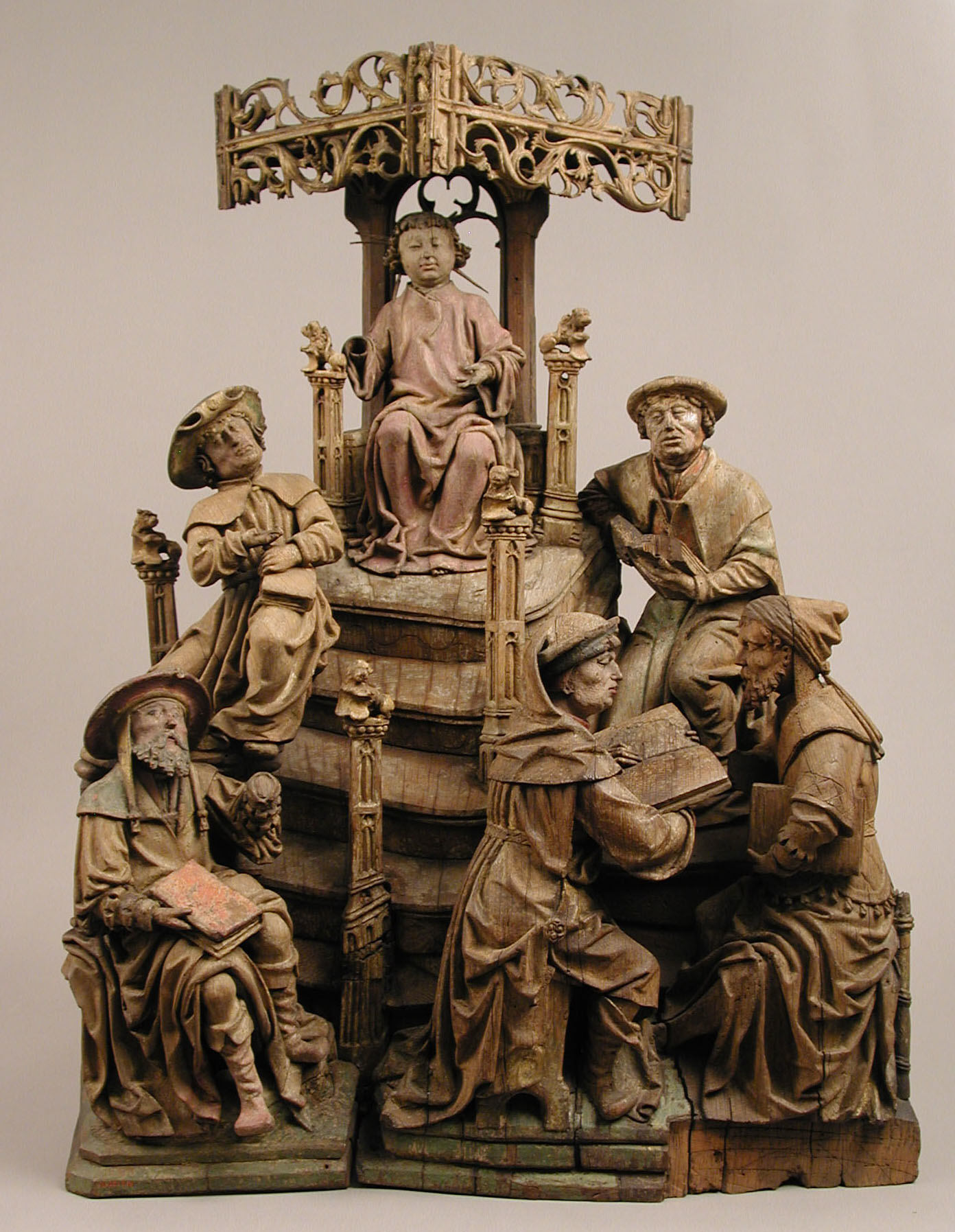
Christ among the Doctors
Doctrinal reflection
This entry presents a significant challenge for the Scriptorium archive: the object in question—a German oak relief with polychromy and gilding, dated to the early sixteenth century—falls outside the canonical parameters of Byzantine art production. The work is a product of late Gothic Central European workshop tradition, not the Eastern Mediterranean Byzantine sphere, and cannot be meaningfully classified within the early, middle, or late Byzantine periodization. Nevertheless, the iconographic subject, Christ among the Doctors (Luke 2:41–52), carries deep resonance in both Eastern and Western medieval visual programs. In Byzantine iconography, this scene appears as part of the Dodekaorton cycle and is occasionally rendered in middle and late Byzantine manuscripts and frescoes, emphasizing the child Christ's divine wisdom confounding the temple elders. The Western relief tradition treats the same episode with characteristically Gothic narrative dynamism—figures gesticulating, books opened, spatial recession implied through carved relief planes. The Metropolitan's example, gifted by J. Pierpont Morgan in 1916, exemplifies the collector's interest in medieval applied arts. Its oak support, polychrome surface, and gilding are consistent with Rhenish or South German altarpiece production of the 1500–1520 period. Scholarly interest lies in the transition from Gothic to early Renaissance formal conventions visible in such German workshop pieces. For the purposes of this archive, the entry is recorded with the caveat that its classification fields have been applied by closest available analogy rather than direct genre correspondence. Sources: Metropolitan Museum of Art Bulletin; Baxandall, Michael, The Limewood Sculptors of Renaissance Germany (Yale University Press, 1980); Williamson, Paul, Gothic Sculpture 1140–1300 (Yale University Press, 1995).