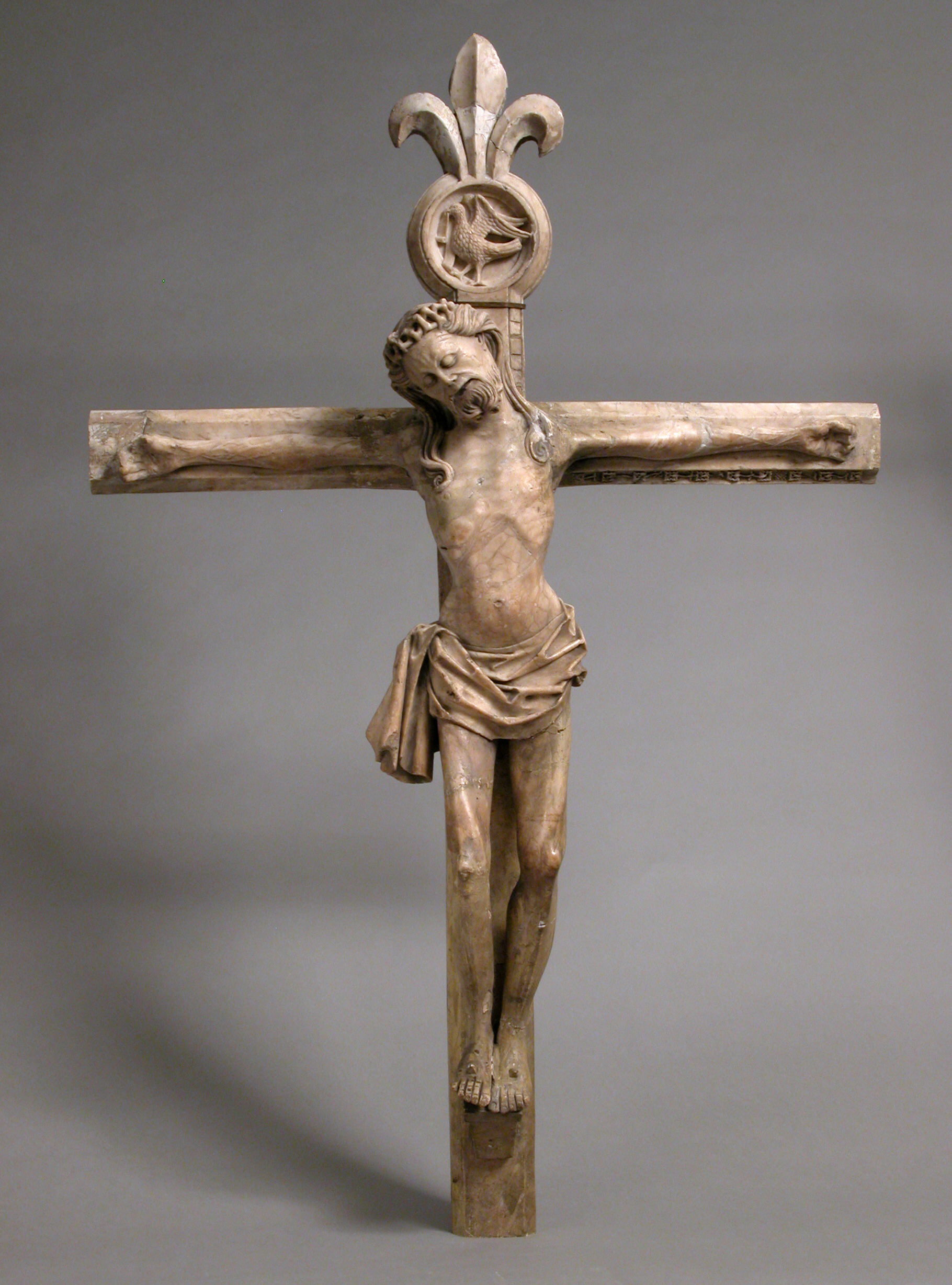
Crucifix
Doctrinal reflection
This entry presents a challenge for the Scriptorium archive, as the described object — a South Netherlandish alabaster, wood, and plaster Crucifix of circa 1450 AD, held in the Medieval Art collection of the Metropolitan Museum of Art (Gift of J. Pierpont Morgan, 1916) — falls outside the strict parameters of Byzantine production. It is a Western European devotional sculptural object, likely produced in the Low Countries during the late Gothic period, and does not conform to the Byzantine iconographic tradition in medium, stylistic language, or theological program. Byzantine crucifixion imagery, by contrast, is typically rendered in mosaic, fresco, or panel icon, employing hierarchical frontality, gold ground, and Greek inscriptions such as IC XC and NIKA. The Western alabaster crucifix tradition emphasizes naturalistic suffering, individualized anatomy, and affective pathos consistent with Latin devotional movements such as the Devotio Moderna. No Byzantine workshop attribution, Greek liturgical context, or Eastern iconographic schema is discernible from the available metadata. Archival integrity requires that this entry be flagged as non-Byzantine and outside the scope of this Scriptorium collection. Scholars seeking comparative crucifixion typology across Eastern and Western medieval traditions may consult the relevant literature below. Sources: Hamburger, J. F., 'The Visual and the Visionary,' Zone Books, 1998; Williamson, P., 'Gothic Sculpture 1140–1300,' Yale University Press, 1995; Belting, H., 'Likeness and Presence,' University of Chicago Press, 1994.