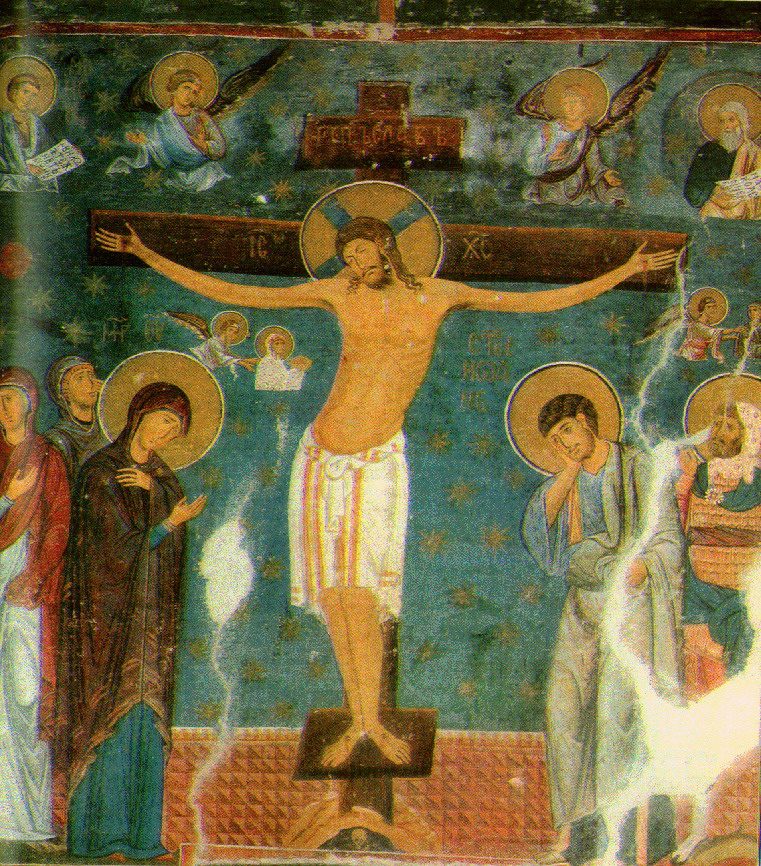
The Crucifixion (Studenica)
Doctrinal reflection
The Crucifixion fresco at Studenica Monastery, dated to AD 1208/1209, occupies the western wall of the Church of the Virgin (Bogorodičina crkva) and represents one of the earliest and most significant monuments of Serbian medieval monumental painting. Executed under the patronage of Stefan Nemanja's son Stefan the First-Crowned and likely overseen by ecclesiastical authorities connected to Saint Sava, the composition exemplifies the Byzantine painterly tradition as transmitted to the Serbian court milieu in the immediate post-Komnenian period. The technique employs lime-based intonaco with pigments applied in the Byzantine fresco secco and buon fresco manner characteristic of late twelfth- and early thirteenth-century workshops active across the former Komnenian sphere. Iconographically, the scene adheres to established Byzantine Crucifixion typology: Christ is depicted on the cross with a pronounced lateral curve (the so-called 'Gothic sway' anticipated in late Komnenian art), flanked by the Virgin and the Evangelist John, with secondary figures of soldiers and lamenting women disposed symmetrically. The rendering of grief—particularly in the contorted postures of mourning figures—reflects the expressive emotionalism developed in Komnenian monumental painting at sites such as Nerezi (AD 1164). Theological emphasis falls on Christ's sacrificial death as Incarnate Logos, with the lance and sponge episodes evoking Eucharistic typology. The Studenica Crucifixion is pivotal for understanding the formation of a distinctly Serbian royal patronage tradition assimilating Byzantine theological and aesthetic programs during the Raškan dynasty's consolidation of ecclesiastical identity. Sources: Zbornik za likovne umetnosti Matice srpske; Cahiers archéologiques; Dumbarton Oaks Papers.