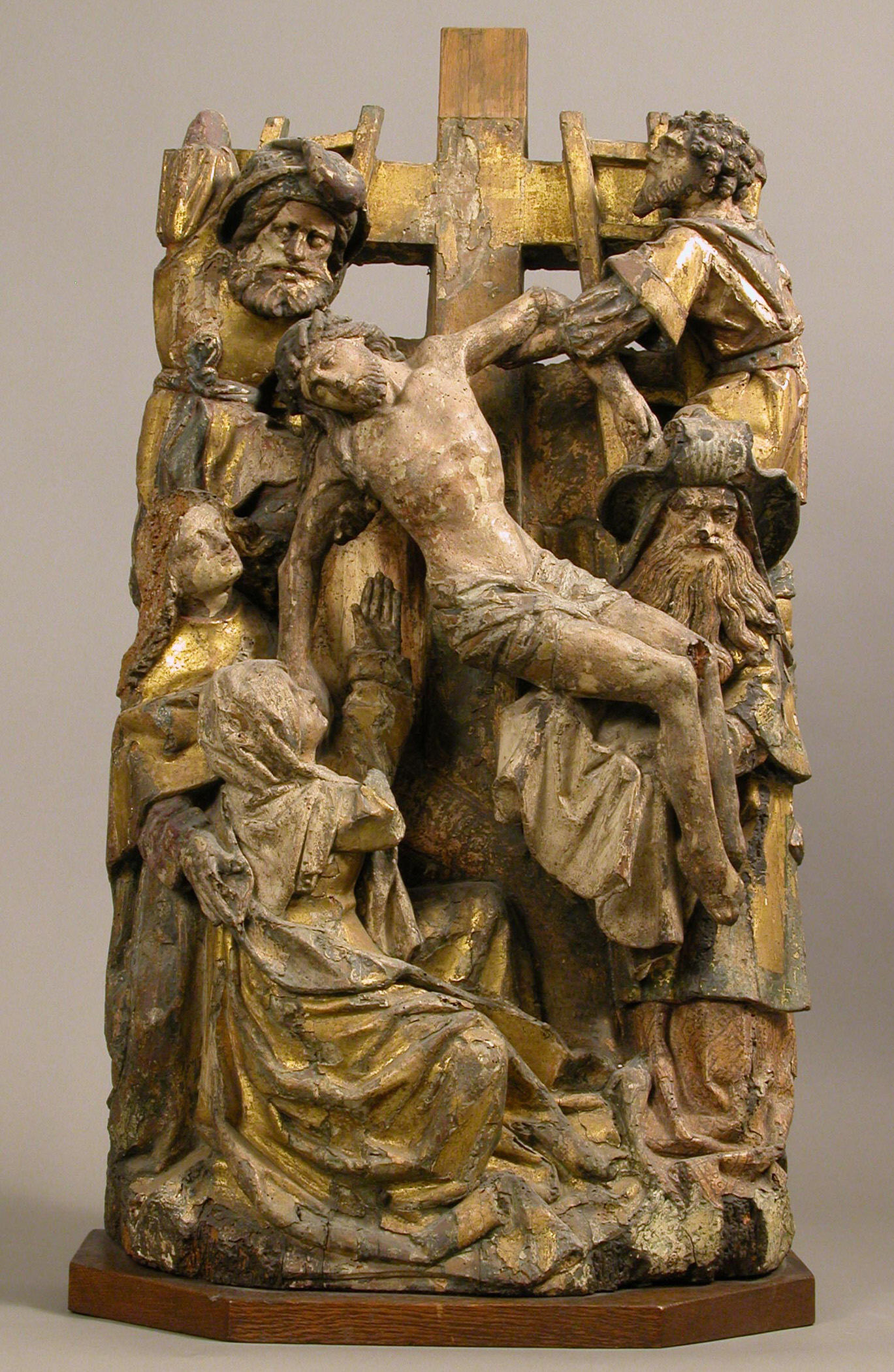
Descent from the Cross
Doctrinal reflection
This entry presents a challenge to the Scriptorium archive's Byzantine mandate: the object in question is a South Netherlandish oak relief with polychromy and gilding, dateable to the late fifteenth century AD, and held in the Medieval Art galleries of the Metropolitan Museum of Art (Gift of J. Pierpont Morgan, 1916). It is not a Byzantine artifact. However, the Descent from the Cross (Depositio Crucis) as an iconographic subject maintains deep continuities between Eastern and Western medieval traditions. The Byzantine Apokathilosis—the taking-down of Christ's body from the Cross—appears in Middle Byzantine monumental programs (e.g., the Nerezi fresco, AD 1164) and informs the Western Deposition tradition via shared liturgical and textual sources, including pseudo-Epiphanius and the Gospel of Nicodemus. The Netherlandish relief likely depicts Joseph of Arimathea and Nicodemus lowering Christ's body, with the Virgin, Saint John, and the Maries present. Polychromy and gilding serve both devotional and hierarchical functions, elevating sacred figures. Sculptural Depositions proliferated in the fifteenth-century Low Countries as altarpiece components, reflecting Devotio Moderna piety and manuscript illumination influence. Scholarly assessment must note the object falls outside Byzantine jurisdiction; its iconographic genealogy, however, traces partly through Byzantine intermediaries transmitted via Italian Trecento painting. The Metropolitan's collection contextualizes this piece within broader medieval Christian visual culture rather than strictly Eastern Christian art. Sources: Bulletin of the Metropolitan Museum of Art; Corpus of Late Medieval Netherlandish Sculpture studies; Maryan Ainsworth et al., From Van Eyck to Bruegel (1998).