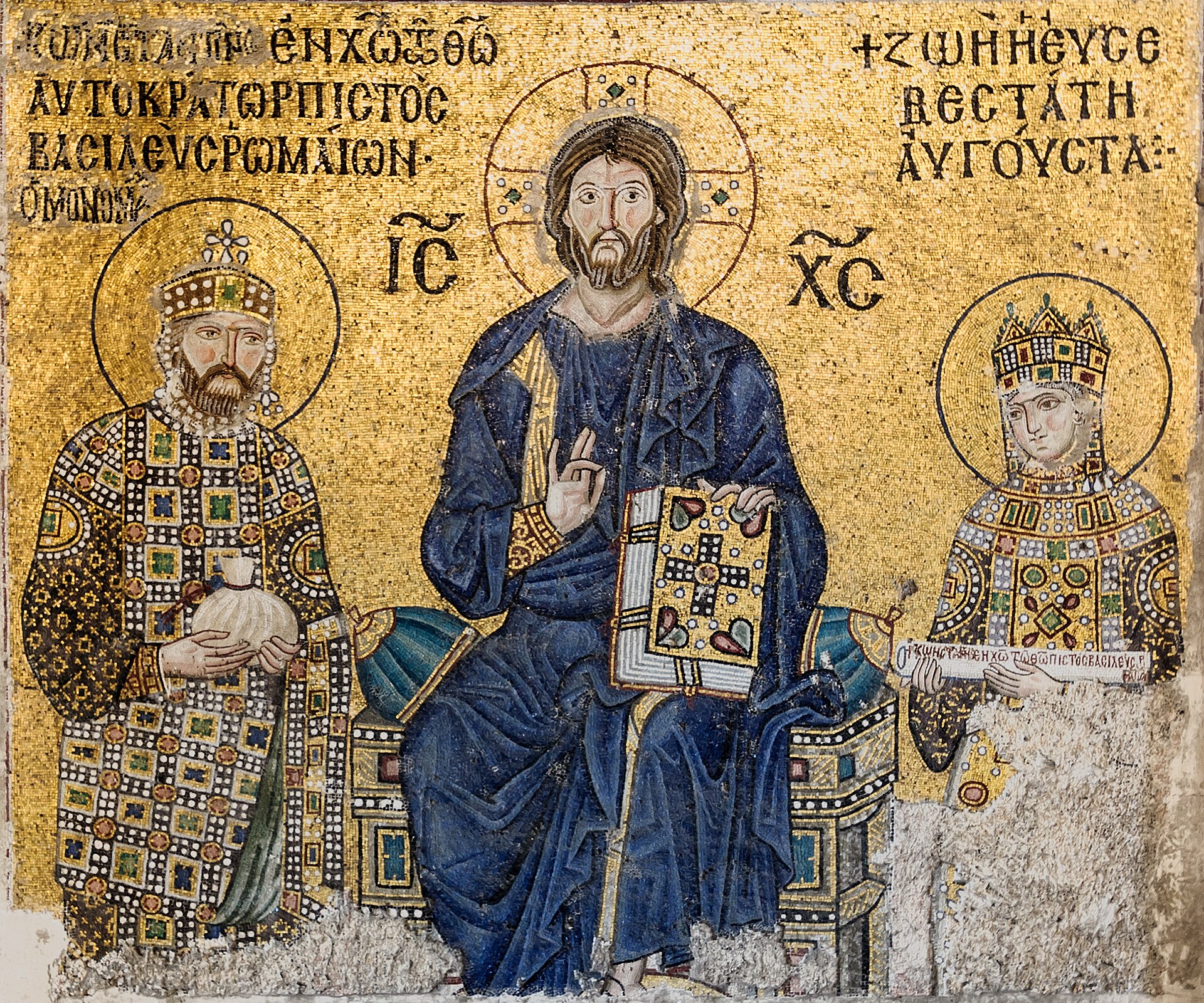
Empress Zoe Panel, Hagia Sophia
Doctrinal reflection
The Empress Zoe mosaic panel, located in the south gallery of Hagia Sophia, Istanbul, dates to the mid-eleventh century AD and stands as one of the most consequential surviving examples of Middle Byzantine imperial donor imagery. Executed in fine tesserae of glass and gold ground, the composition presents Christ Pantokrator enthroned frontally in a jeweled mandorla, his right hand raised in benediction and his left holding the Gospels. Flanking him are Emperor Constantine IX Monomachos (r. 1042–1055 AD) and Empress Zoe (d. 1050 AD), each presenting votive gifts—a money bag and a chrysobull—symbolic of imperial largesse directed toward the divine sovereign. The theological program articulates a Constantinopolitan ecclesiology of sacral kingship: temporal authority derives from and remains answerable to the Pantokrator, whose cosmic dominion over all rulers is visually enacted through the flanking arrangement. Critical to the panel's scholarly significance is the palimpsestic alteration of heads and inscriptions, detectable through tesserae disruption, reflecting Zoe's three successive marriages and the consequent substitution of imperial portraits. This makes the mosaic an unusually transparent document of Byzantine dynastic politics inscribed within liturgical space. Iconographically, Christ's frontal, hieratic posture recalls Justinianic prototypes while the rendering of drapery and physiognomy anticipates the more expressive middle Comnenian style. The panel has been foundational in discussions of Byzantine image theology, court ceremonial, and the intersection of political legitimacy with visual representation in the sacred precinct. Sources: Dumbarton Oaks Papers; Byzantine and Modern Greek Studies; Cahiers archéologiques.