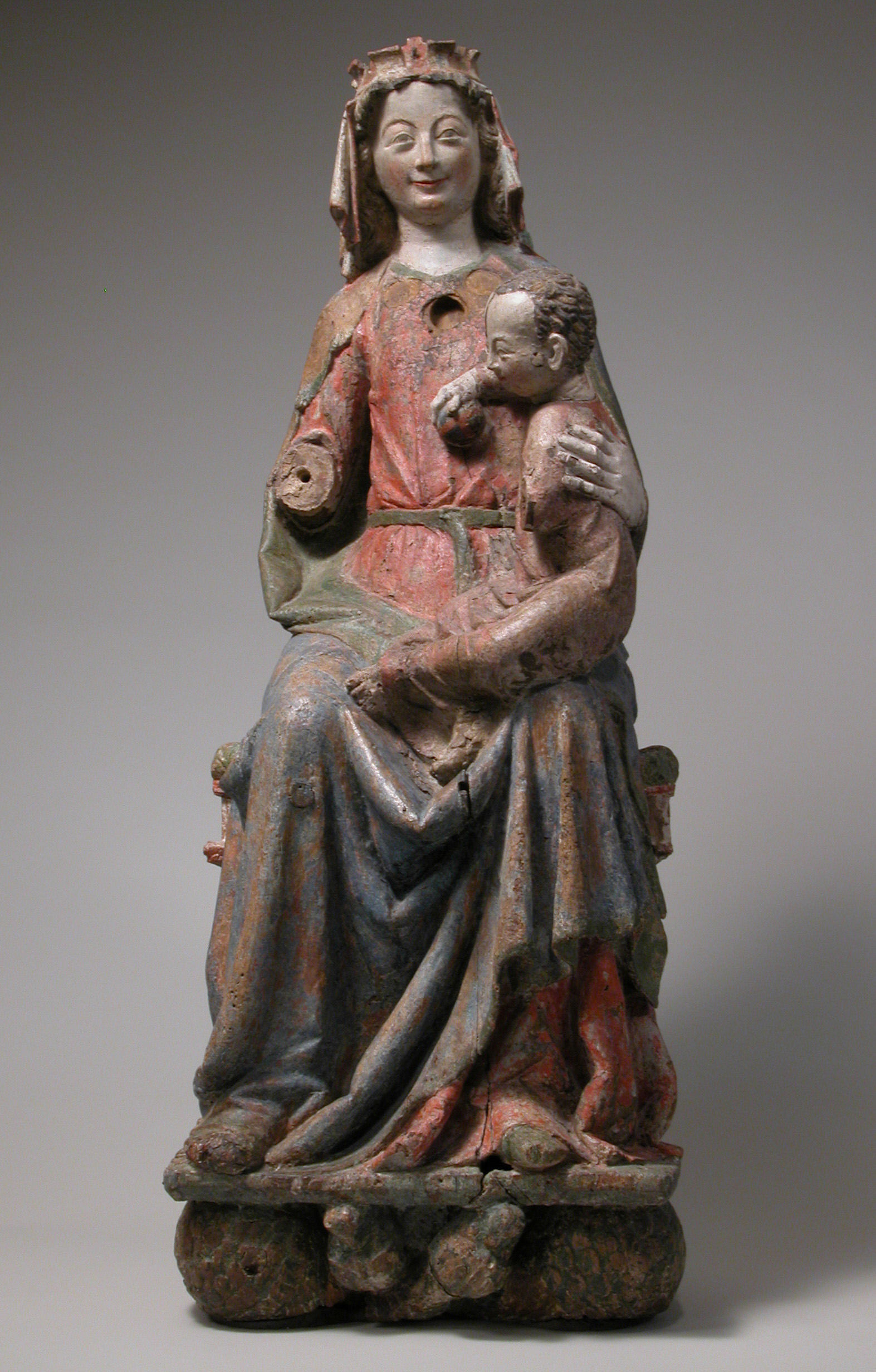
Enthroned Virgin and Child
Doctrinal reflection
This entry presents an Enthroned Virgin and Child in carved and painted oak, produced in Germany circa 1280 AD, now held in the Medieval Art collection of the Metropolitan Museum of Art (Gift of J. Pierpont Morgan, 1916). While the object is a three-dimensional wooden sculpture rather than a two-dimensional Byzantine pictorial medium, it belongs to the broader Theotokos iconographic tradition that Byzantine art disseminated westward through liturgical, diplomatic, and crusading channels. The Sedes Sapientiae (Throne of Wisdom) type — in which the Virgin sits frontally enthroned, presenting the Christ Child as a miniature adult upon her lap — derives demonstrably from Byzantine Hodegetria and Theotokos Nikopoia compositional programs, transmitted to Romanesque and early Gothic workshops via ivory carvings, manuscript illuminations, and portable icons. In this German example, the hierarchical scaling of figures, the frontal axiality of the Virgin, and the blessing or book-holding gesture of the Child reflect conventions codified in middle Byzantine practice (843–1204 AD) and subsequently adopted by Western sculptors. The polychrome surface treatment — now largely lost or restored — would have heightened the devotional and theological legibility of the work. Scholarly attention has focused on the typological function of such sculptures within Marian theology: the Virgin as throne-bearer of the Incarnate Logos, evoking the Ark of the Covenant and Solomonic Throne typologies. The circa 1280 dating places the work within the High Gothic workshop tradition of the Rhineland or central German regions. Sources: Gesta: International Center of Medieval Art; Arte Medievale (CISAM); Zeitschrift für Kunstgeschichte.