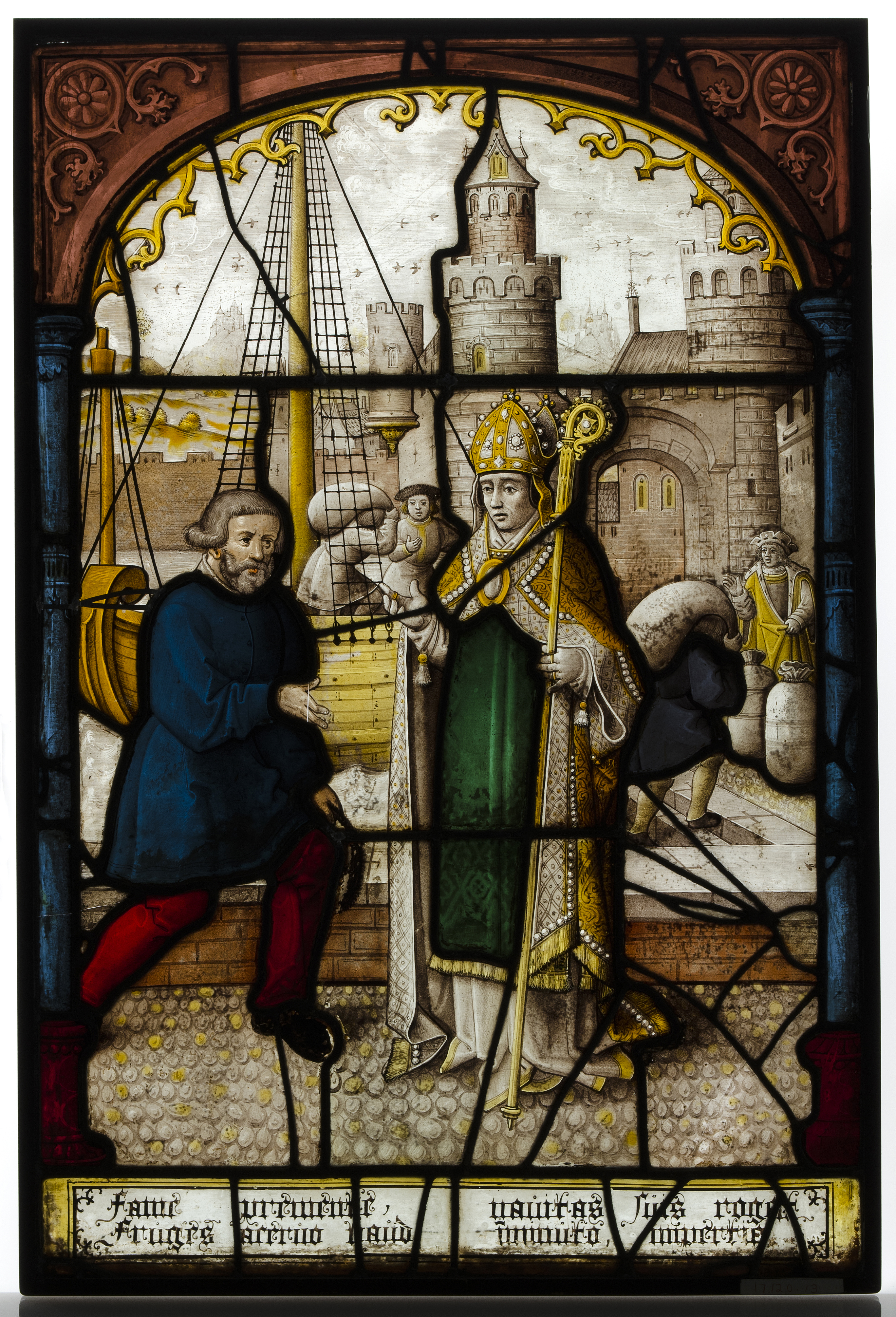
Glass Panel of Saint Nicholas
Doctrinal reflection
This glass panel depicting Saint Nicholas presents an immediate classificatory challenge for a Byzantine archive: the work is Netherlandish in origin, dateable to the sixteenth century AD, and executed in pot-metal glass with vitreous paint—a medium and provenance firmly within the Western European stained-glass tradition rather than the Byzantine pictorial canon. Nevertheless, the panel warrants examination within a comparative hagiographic framework. Saint Nicholas of Myra (died c. AD 343), bishop and wonder-worker, generated one of the most robust iconographic traditions spanning both Eastern and Western Christianity. In Byzantine contexts, Nicholas is typically rendered frontally in episcopal vestments—omophorion, polystavrion, and sakkos—holding a Gospel book, occasionally flanked by medallions of Christ and the Virgin. The Netherlandish panel would retain residual Byzantine iconographic conventions filtered through Romanesque and Gothic intermediaries: episcopal regalia, the codex attribute, and possibly the three golden spheres referencing the dowry miracle (cf. Voragine's Legenda Aurea). Pot-metal glass, colored in the melt and refined with vitreous paint fired onto the surface, represents the Western translucent medium with no direct Byzantine equivalent, though Byzantine enamelwork shares comparable chromatic intensity. The sixteenth-century Netherlandish context situates the panel amid late Gothic and nascent Renaissance stylistic hybridization. Scholarly significance lies in tracing how Nicolan iconography migrated from fourth-century Lycian origins through Byzantine transmission into Northern European workshop practice. The Metropolitan Museum's accession via the Fletcher Bequest, 1917, places it among foundational medieval collections. Sources: Cormack, R., Byzantine Art (Oxford University Press, 2000); Pentcheva, B., Icons and Power (Penn State UP, 2006); Gesta: International Center of Medieval Art.