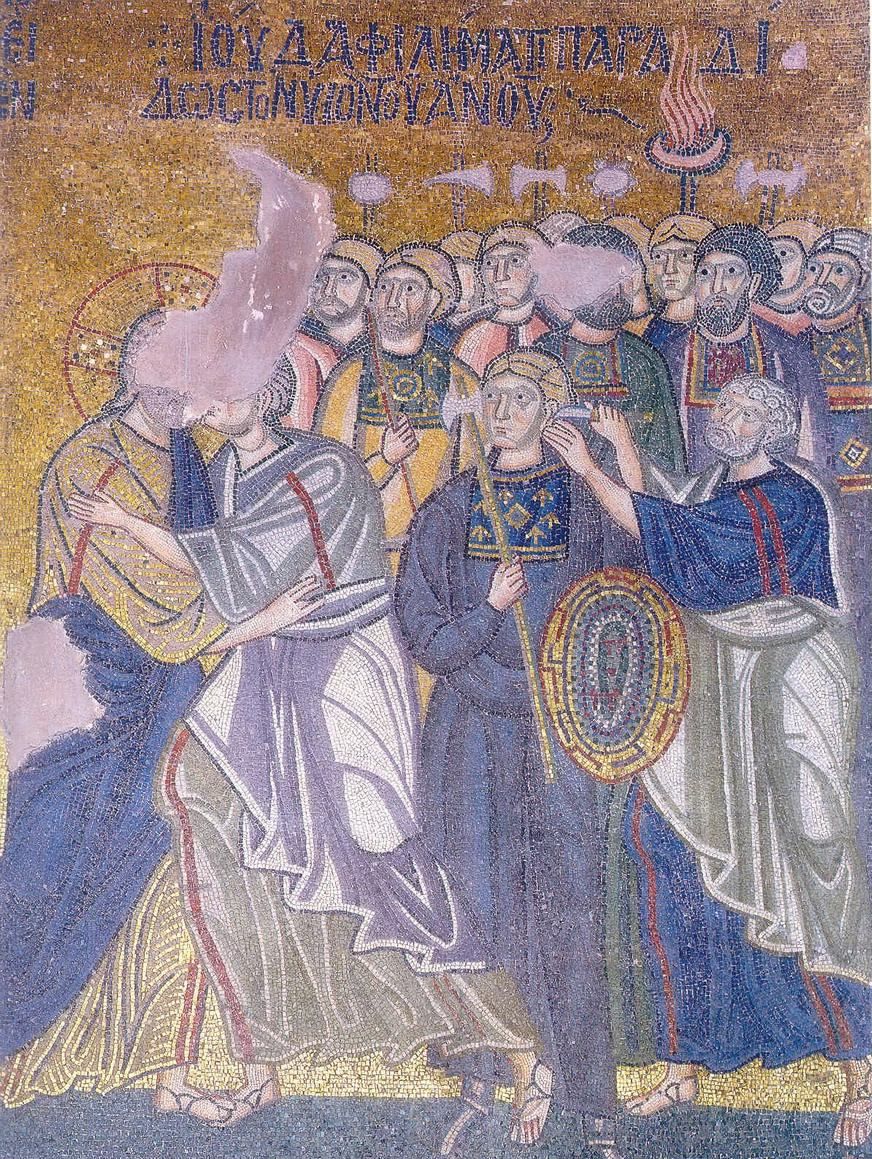
The Kiss of Judas (Nea Moni, Chios)
Doctrinal reflection
The Kiss of Judas at Nea Moni on Chios is among the most celebrated examples of Middle Byzantine monumental mosaic art, dateable to approximately AD 1049–1055 under the patronage of Emperor Constantine IX Monomachos. The scene occupies a squinch or arched panel within the katholikon's narthex cycle, forming part of a comprehensive Christological narrative program executed by a Constantinople-trained workshop of exceptional technical sophistication. The mosaic employs the opus vermiculatum tradition with tesserae of glass, gold, and stone arranged to articulate spatial depth and psychological intensity through controlled chromatic gradation rather than illusionistic modeling. Compositionally, Judas advances toward Christ in a dynamic forward thrust, his mantle enveloping Christ in the titular embrace while soldiers and disciples crowd the flanking zones; Peter's severing of Malchus's ear is typically rendered in the background register, compressing sequential Gospel narrative into a single visual field. Christ's frontality and impassive expression within the assault of surrounding figures encode the theological doctrine of voluntary Passion: the Logos permits rather than suffers betrayal. The gold ground dematerializes the setting, situating the event outside historical contingency and within liturgical anamnesis. Nea Moni's mosaics are considered the finest surviving ensemble of the mid-eleventh-century Constantinopolitan court style outside the capital itself, and the Kiss panel in particular has attracted sustained scholarly attention for its synthesis of dramatic narrative tension with hieratic theological statement. Significant damage from the 1822 Ottoman reprisals and the 1881 earthquake makes preservation documentation especially critical. Sources: Dumbarton Oaks Papers; Byzantinische Zeitschrift; Cahiers Archéologiques.