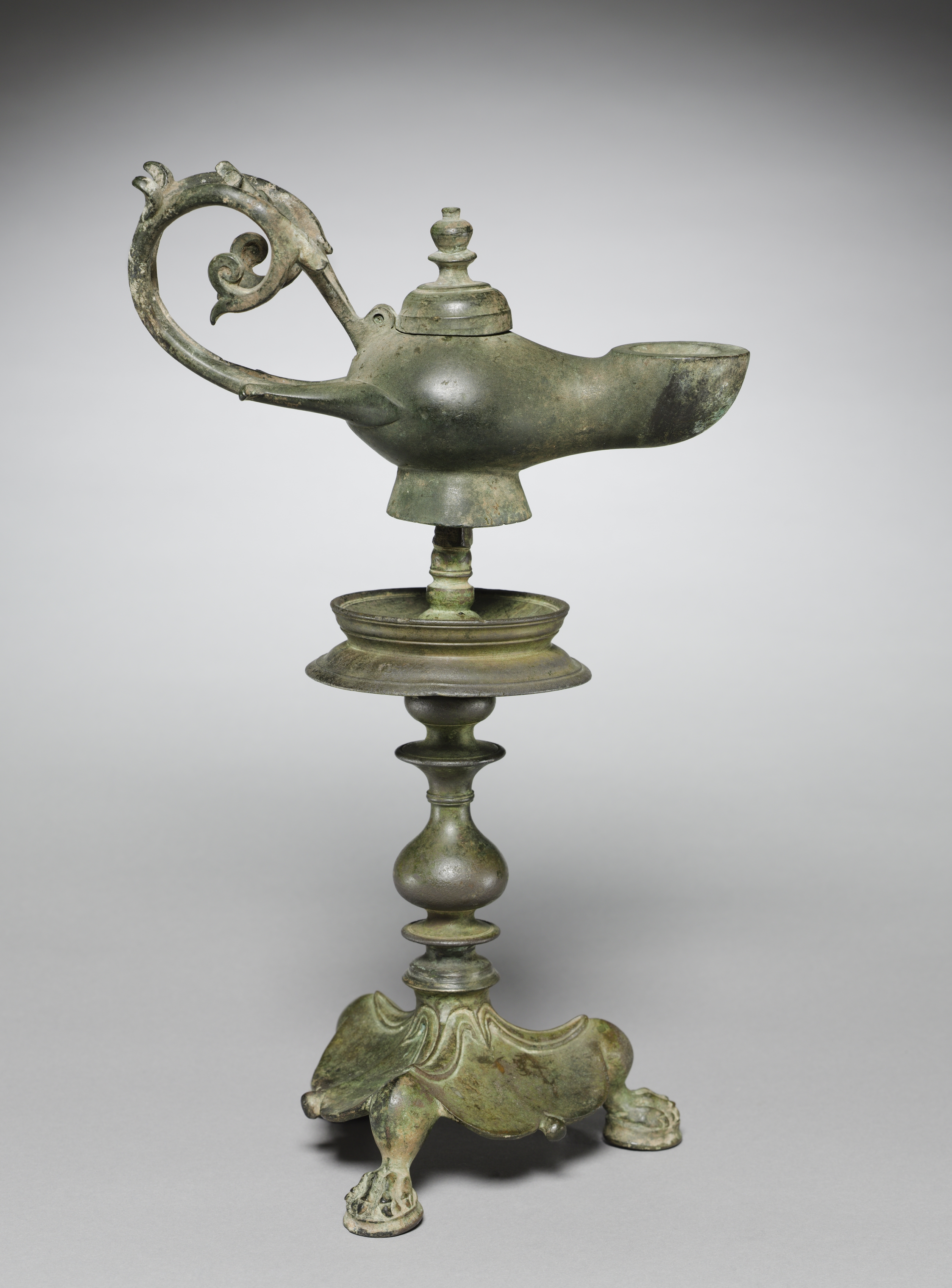
Lamp and Stand
Doctrinal reflection
This early Byzantine bronze oil lamp, dateable to the fifth century AD and housed in the Cleveland Museum of Art, represents a category of liturgical metalwork produced for ecclesiastical use during the consolidation of Christian material culture following the Theodosian settlement. The object is cast in the form of a griffin—a hybrid creature with leonine body and aquiline head—a motif inherited directly from Greco-Roman antiquity and repurposed within a Christian apotropaic vocabulary. Griffins functioned as guardians in antique iconographic tradition, and their adoption into Byzantine church furnishings reflects the broader typological absorption of pagan protective imagery into the service of Christian sacred space, particularly relevant given the substantial portable wealth housed in early Byzantine ecclesiastical interiors. The handle bears a Christogram (likely a Chi-Rho or related monogram), which unambiguously signals the lamp's intended liturgical function and situates it within a Christian dedicatory context. Technically, the piece is cast bronze, a medium consistent with late antique workshop production across the eastern Mediterranean. Lamps of this functional class were deployed either on standing supports or suspended via chains, illuminating both practical liturgical need and the symbolic theology of divine light elaborated in patristic sources and evoked by Gospel passages on the lamp set upon a stand. The lamp thus participates in a well-documented early Byzantine visual program that conflates physical illumination with theological enlightenment. Scholarly attention to such metalwork has grown through studies of late antique minor arts and liturgical furnishings. Sources: Dumbarton Oaks Papers; Journal of Roman Archaeology; Age of Spirituality catalogue (Metropolitan Museum of Art, 1979).