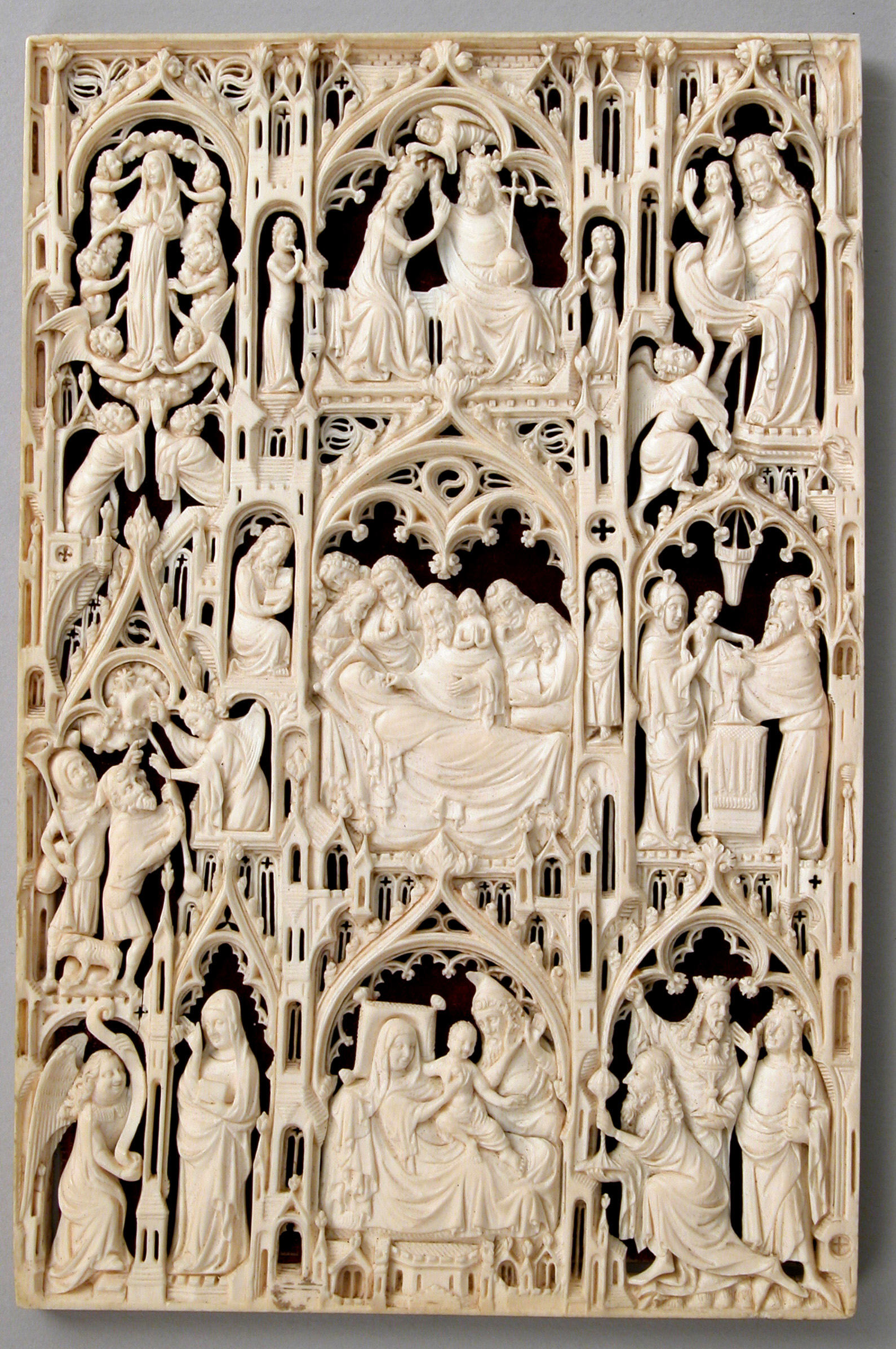
Leaf from a Diptych with the life of the Virgin
Doctrinal reflection
This mid-to-late fourteenth-century AD ivory diptych leaf, gifted to the Metropolitan Museum of Art by J. Pierpont Morgan in 1917, is carved from elephant ivory and belongs to a well-documented category of Gothic devotional objects produced in northern France or England during the Palaiologan-contemporary period in Western medieval art. Diptych leaves of this type were portable private devotional objects, typically hinged in pairs, and the Marian narrative cycle they carry draws heavily not from canonical Scripture but from the second-century apocryphal Protoevangelium of James, which supplied episodes such as the birth and presentation of Mary, her upbringing in the Temple, and the Dormition — none of which appear in the New Testament. The carver would have followed iconographic programs standardized in Gothic ateliers, likely including the Annunciation (Luke 1:26-38), the Visitation (Luke 1:39-56), the Nativity (Luke 2:1-20), the Presentation of Christ (Luke 2:22-38), and the Dormition or Coronation of Mary — the last two being medieval doctrinal traditions, not biblical narrative. The Dormition is Eastern in origin; the Coronation of the Virgin developed in twelfth-century Western theology and is absent from Scripture. The medium — elephant ivory in thin relief plaques — reflects the luxury trade goods accessible to French Gothic workshops from West African and Asian sources. The theological program presents Mary as central mediating figure, a framing GLM documents as medieval devotional tradition rather than biblical teaching; 1 Timothy 2:5 identifies Christ alone as mediator. Scholarly assessment of comparable pieces appears in Koechlin's corpus and Williamson's Gothic Ivory Carvings studies. Sources: Paul Williamson, Gothic Ivory Carvings (V&A, 1982); Raymond Koechlin, Les ivoires gothiques français (Paris, 1924); Danielle Gaborit-Chopin, Ivoires médiévaux (Paris, 1978).