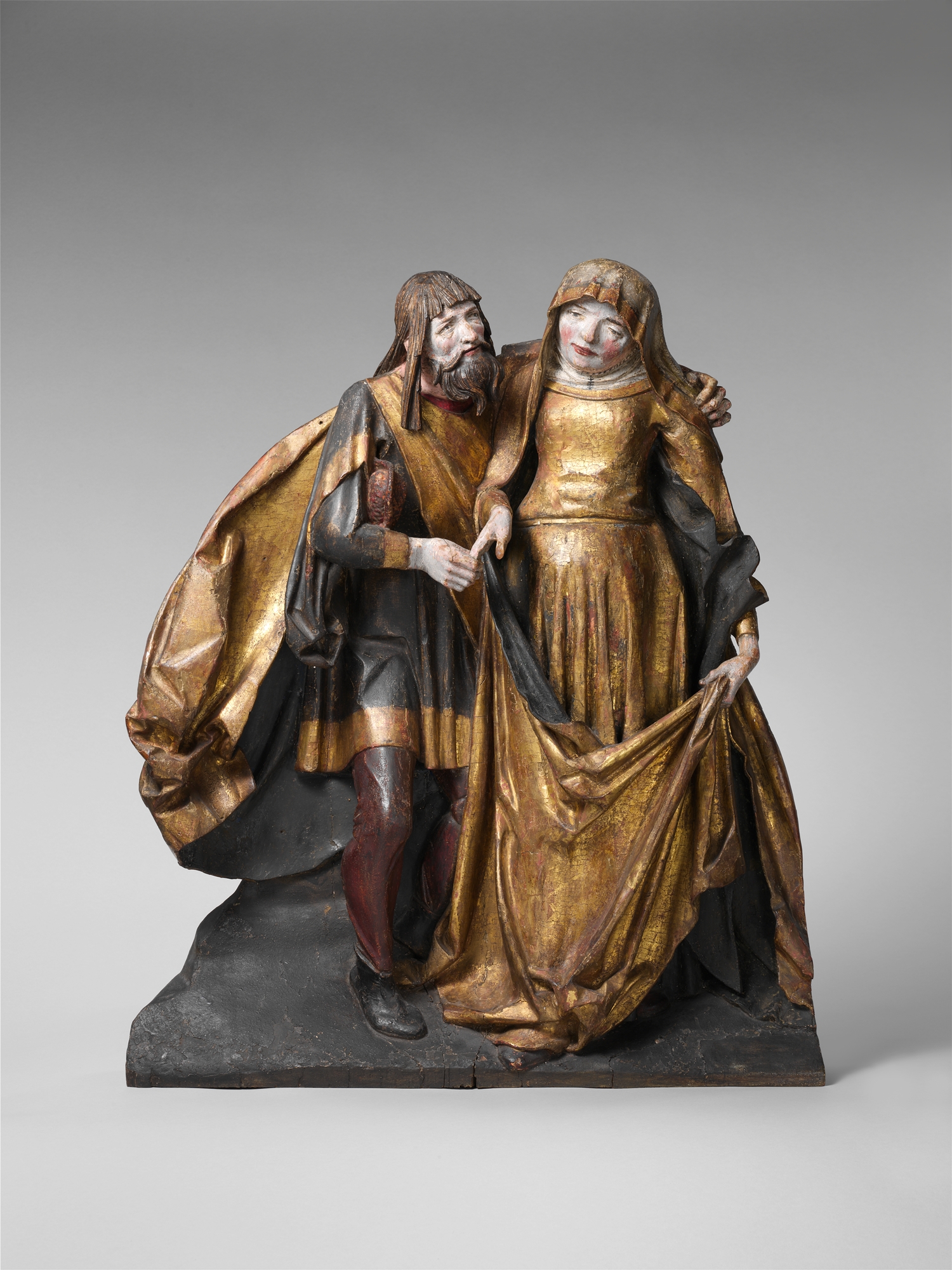
Meeting of Saints Joachim and Anne at the Golden Gate
Doctrinal reflection
This relief depicting the Meeting of Joachim and Anne at the Golden Gate is a North German carved oak panel with polychromy and gilding, dated circa AD 1515–1520, held in the Medieval Art collection of the Metropolitan Museum of Art (Gift of J. Pierpont Morgan, 1916). The subject does not come from Scripture. The Bible says nothing of Mary's parents — the names Joachim and Anne appear first in the Protoevangelium of James, a second-century apocryphal text, and the story was popularized for the medieval West by the thirteenth-century Legenda Aurea: Joachim's offering rejected at the Temple, his retreat to the wilderness, the angelic promise that barren Anne would conceive, and the couple's embrace at Jerusalem's Golden Gate. By the later Middle Ages, Catholic tradition had come to read that embrace as the moment of Mary's conception free from inherited sin — the doctrine of the Immaculate Conception, hotly debated by the scholastics and formally defined by Rome only in 1854. That is what this panel teaches; it is not what Scripture teaches. The biblical record presents Mary as a faithful young woman of Nazareth, 'highly favoured' (Luke 1:28), whose own song confesses God as 'my Saviour' (Luke 1:47). The panel remains a fine document of its world: the polychromy and gilding are characteristic of Rhenish and Lower Saxon workshop practice of the early sixteenth century, when narrative relief panels of this kind served altarpiece wings and devotional retables, Gothic formal conventions persisting alongside early Northern Renaissance sensibilities. Its provenance through the Morgan gift placed it among the foundational Marian devotional objects of the Met's medieval holdings. Sources: Metropolitan Museum of Art Bulletin; Corpus of Medieval Narrative Relief Sculpture; Zeitschrift für Kunstgeschichte.