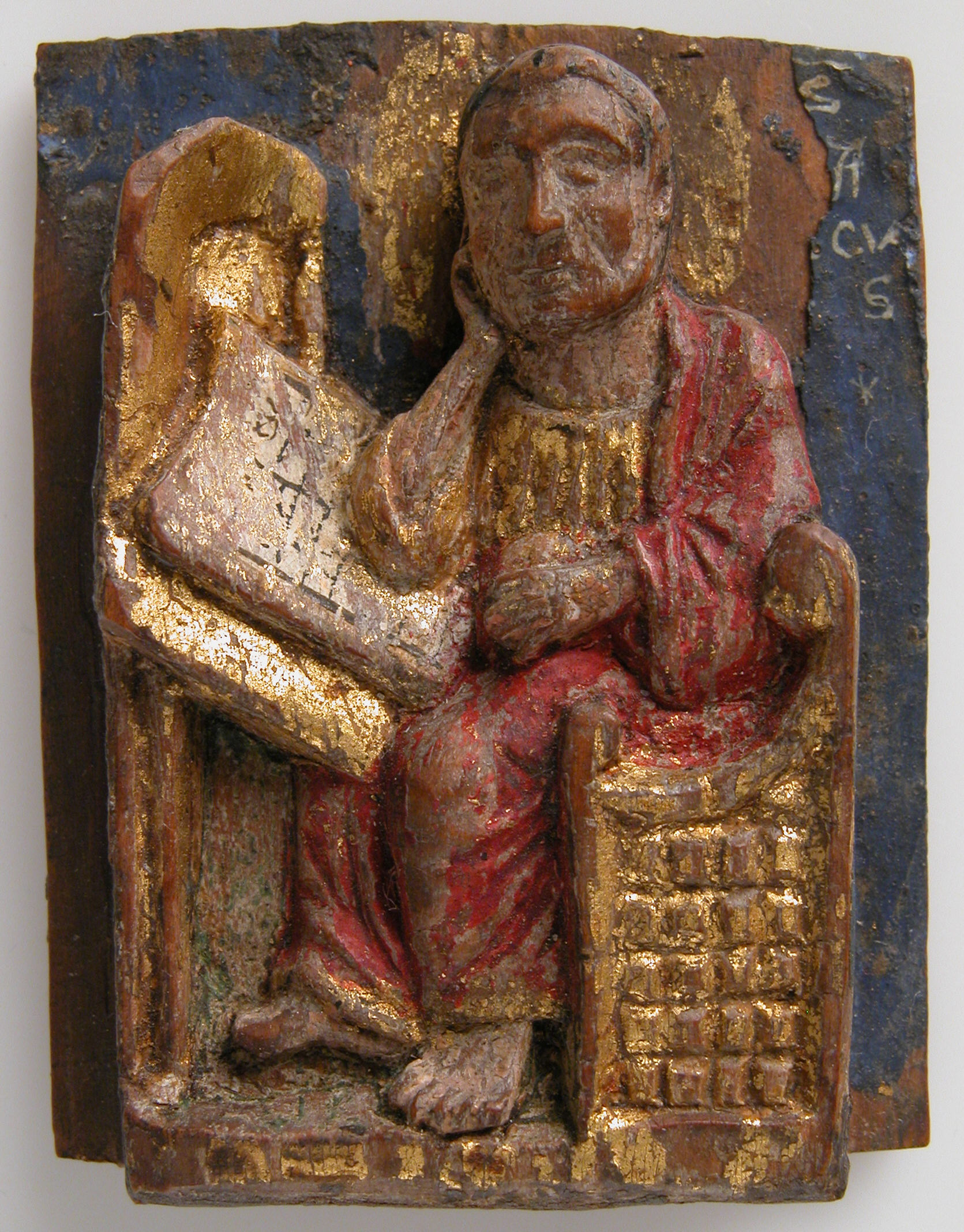
Miniature Relief of Saint Mark at His Writing Table
Doctrinal reflection
This small German polychrome and gilded wood relief, dated ca. 1200–1225 AD and now held in the Medieval Art collection of the Metropolitan Museum of Art (Bequest of George Blumenthal, 1941), depicts the Evangelist Mark seated at his writing table — a standard compositional type for Evangelist portraiture that was well established in Carolingian and Ottonian manuscript illumination before migrating into three-dimensional decorative arts. The relief almost certainly functioned as a component of a portable altar, book cover, reliquary, or liturgical furnishing, object classes in which German Romanesque workshops excelled during this period. Mark is typically identifiable by the lion symbol drawn from Ezekiel 1:10 and Revelation 4:7, associated with the Evangelists in patristic exegesis from Irenaeus onward; if the lion appears here as an attribute, it follows that longstanding iconographic convention. The figure's posture — bent over a codex or scroll — places him within the writerly type derived ultimately from late antique author portraits, adapted in the medieval West to frame the Evangelists as divinely inspired scribes. The polychromy and gilding are characteristic of Rhenish and Mosan workshop production of the High Romanesque period, and the small scale suggests intimate devotional or liturgical use rather than monumental display. Scholarly interest in this object centers on its place within the typology of German Romanesque relief carving and the transmission of Evangelist iconography from two-dimensional to sculptural media. The Gospel of Mark itself opens without an infancy narrative, beginning with John's baptismal ministry (Mark 1:1–4), a textual austerity occasionally reflected in the directness of Mark's artistic representations. Sources: Lasko, Peter, Ars Sacra 800–1200 (Yale UP, 1994); Swarzenski, Hanns, Monuments of Romanesque Art (Faber, 1954); Metropolitan Museum of Art Bulletin, Medieval acquisitions issues.