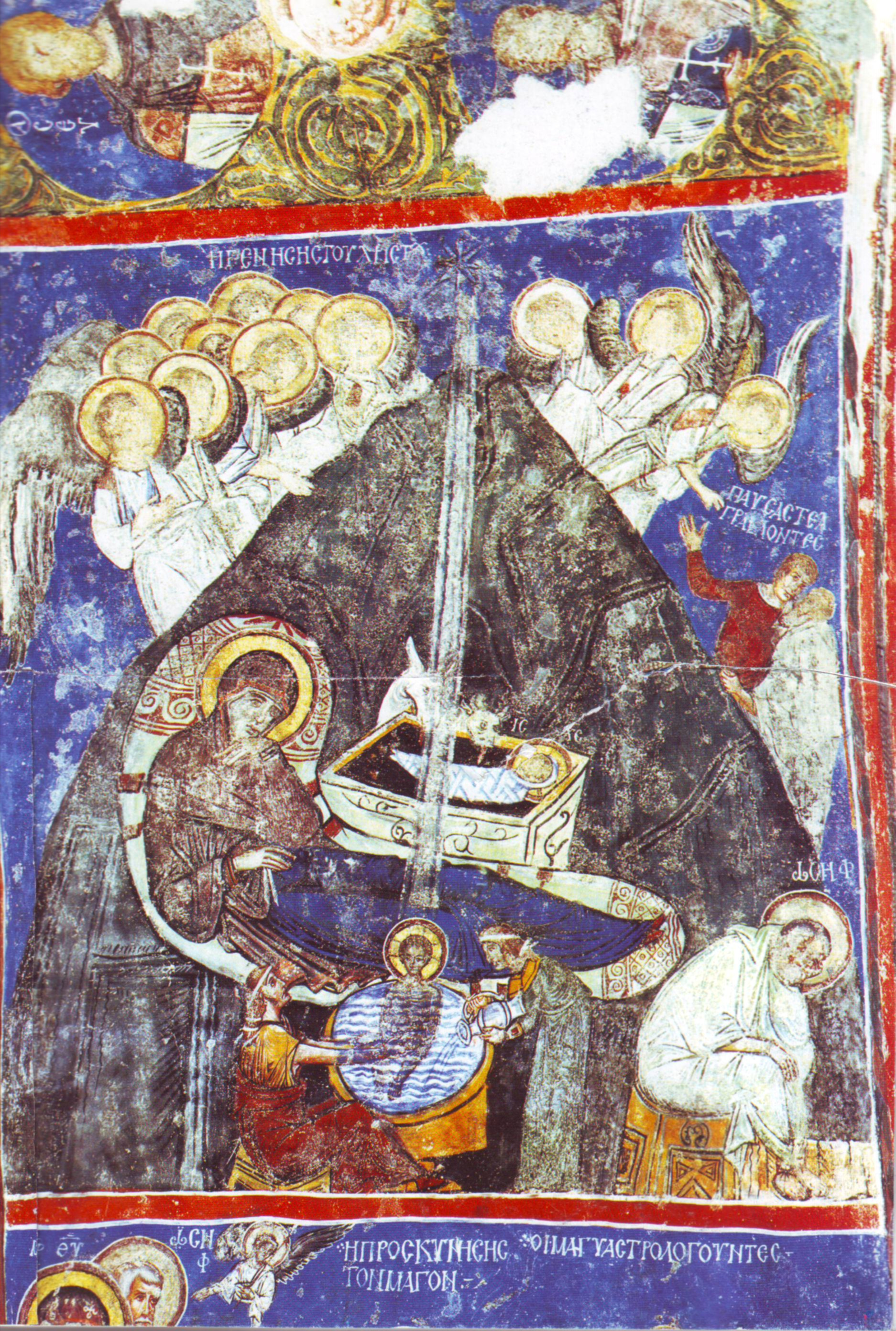
The Nativity (Cappadocia)
Doctrinal reflection
This Nativity fresco, dateable to the 10th–11th century AD, survives within one of the rock-cut churches of the Göreme valley in Cappadocia, a region whose volcanic tufa landscape was extensively carved and painted under the middle Byzantine monastic and parish communities of central Anatolia. The composition exemplifies the fully codified Byzantine Nativity recension: the Virgin reclines on a red mattress set against a steep rocky hillside, the swaddled Christ Child lies in a manger flanked by the ox and ass, angels gesture upward toward a stellar ray, and a group of shepherds receives the angelic announcement at the lower register. A subsidiary scene of the bathing of the Child by midwives, derived from the Protevangelium of James and patristic elaboration rather than the canonical Gospels, frequently occupies a lower corner, evidencing the integration of apocryphal tradition into the liturgical program. The deep blue ground characteristic of Cappadocian middle Byzantine painting intensifies the hieratic solemnity of the scene. Iconographically the image participates in the hymnographic theology of the Kontakion of Romanos the Melodist and the Christmas homilies of Gregory of Nazianzus, reading the Incarnation as cosmic paradox: the Creator contained within a cave. Scholars have situated these Cappadocian cycles within broader debates on provincial workshop practice, the diffusion of Constantinopolitan models, and the function of painted programs in small monastic foundations outside the imperial capital. The rock-cut churches collectively constitute a primary archive for understanding middle Byzantine fresco technique and theological iconography beyond metropolitan centers. Sources: Dumbarton Oaks Papers; Cahiers archéologiques; N. Thierry, Nouvelles églises rupestres de Cappadoce.