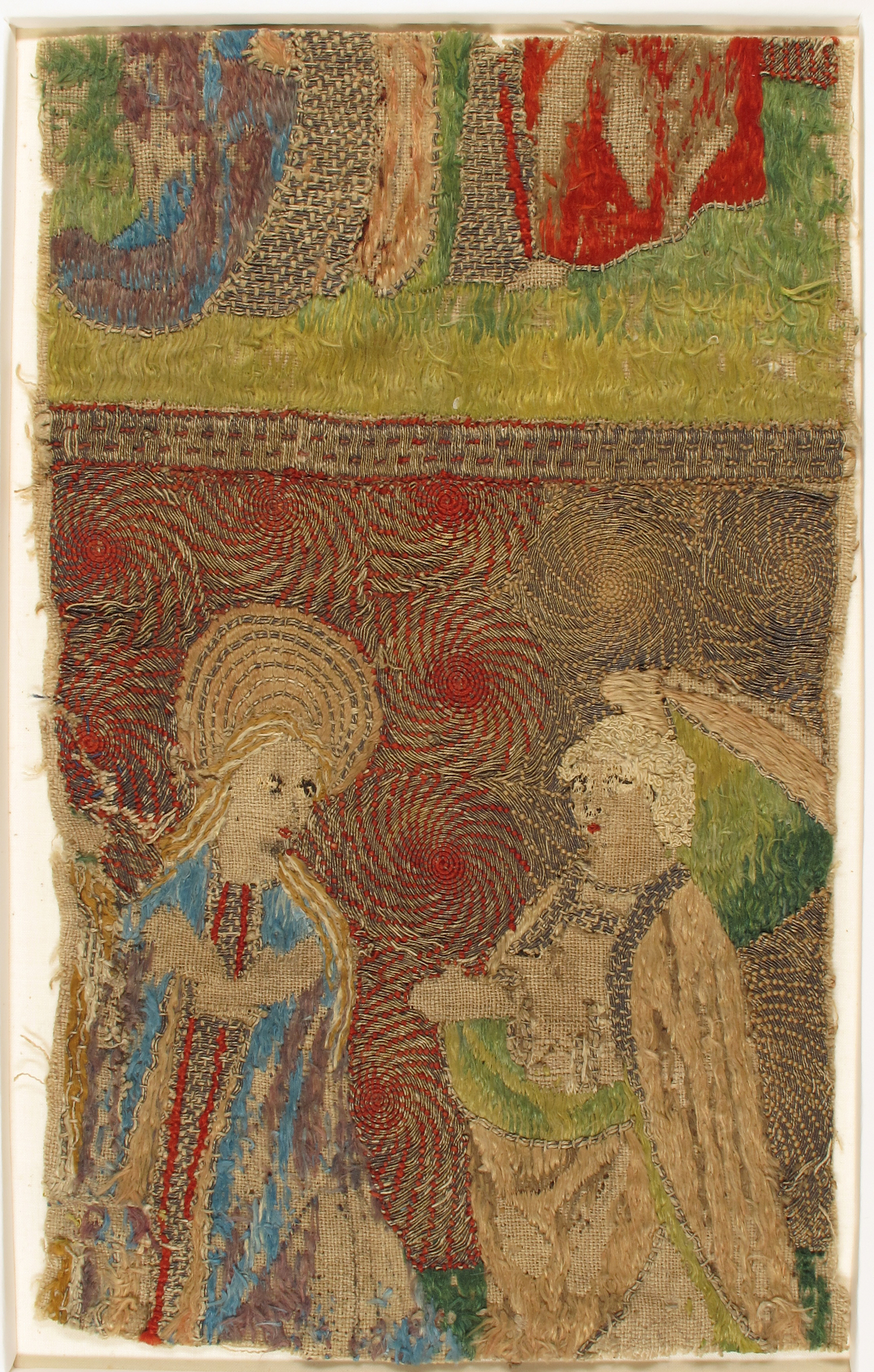
Panel with the Virgin and Gabriel Annunciate
Doctrinal reflection
This panel depicting the Virgin and Gabriel Annunciate is a fifteenth-century German textile work, executed in silk on linen, and held in the Medieval Art collection of the Metropolitan Museum of Art (Rogers Fund, 1914). While the entry falls under the broader rubric of medieval Christian iconography, it is categorically a Western European embroidered or woven textile rather than a Byzantine artifact in the strict sense; nonetheless, its iconographic program draws on a visual tradition that intersects with and was shaped by Byzantine formulations of the Annunciation scene. The composition likely presents the Archangel Gabriel in a gesturing posture of annunciation opposite the Virgin Mary, who may be shown in an attitude of acceptance or mild recoil—a typology traceable through Byzantine models transmitted westward via liturgical objects, manuscript illumination, and ivory carving from the tenth century onward. German late-medieval textile production in the fifteenth century frequently employed such Annunciation imagery for altar frontals, antependia, and devotional hangings, drawing on the theological program of the Incarnation as pivot of salvation history. The choice of silk on linen as support reflects the luxury material culture of late-medieval German ecclesiastical workshops, including Cologne and the Rhine Valley centers. Scholarly assessment of this object must account for its transitional character—Gothic formal conventions combined with iconographic schemata of older Byzantine derivation—making it relevant to studies of cross-cultural transmission in medieval sacred art. Conservative dating to the fifteenth century is consistent with stylistic parallels in contemporary German embroidery. Sources: Metropolitan Museum of Art Bulletin; Textile History; Journal of the Walters Art Museum.