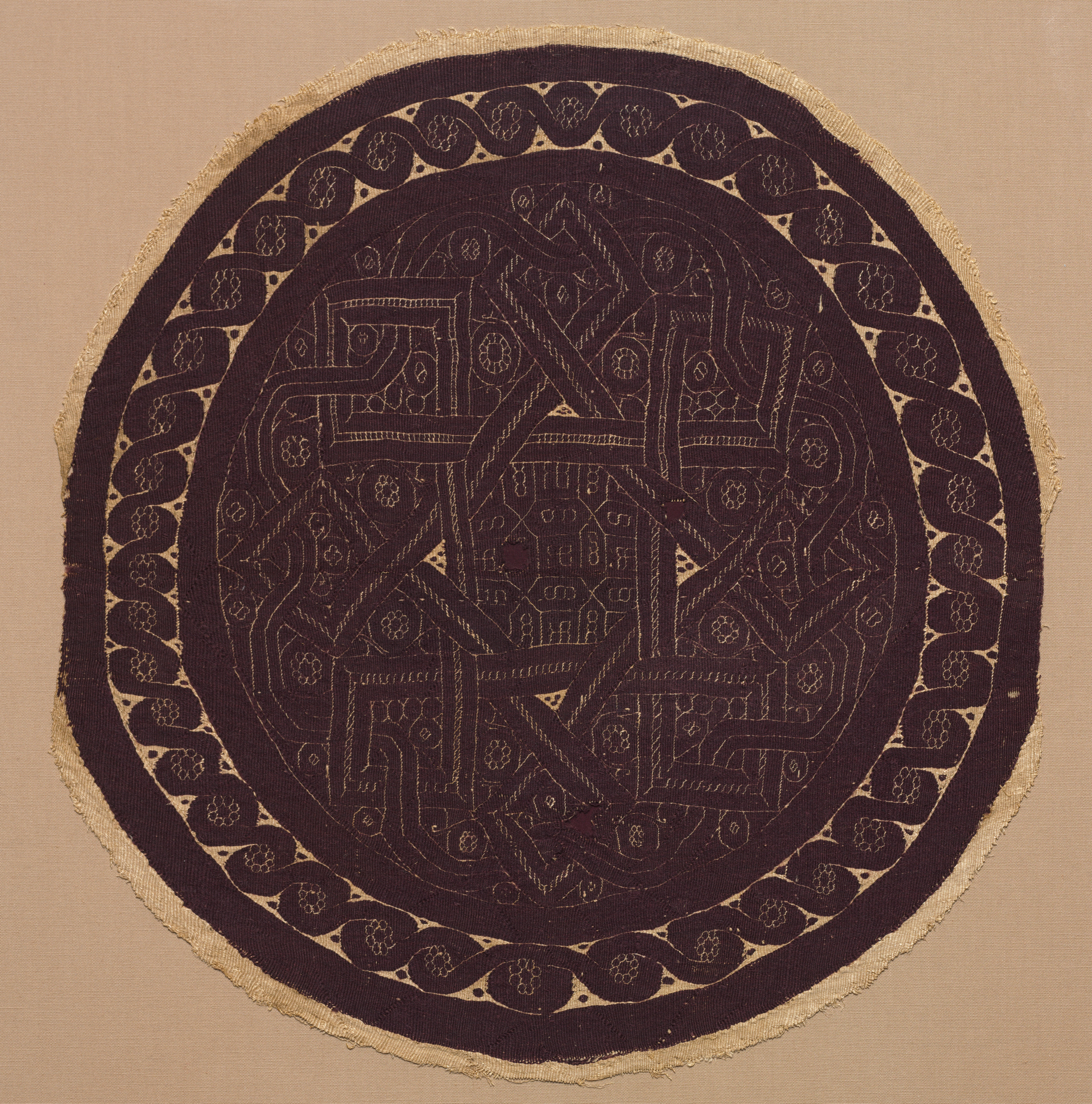
Roundel from a Curtain
Doctrinal reflection
This textile roundel, dated to the fourth century AD and attributed to Byzantine-period Egypt, represents a category of domestic and ecclesiastical furnishing textile that has received sustained scholarly attention in recent decades. Executed in plain weave linen ground with tapestry weave and supplementary weft-wrapping in dyed wool, the piece exemplifies the technically sophisticated Coptic-Egyptian workshop tradition that supplied households, theatrical spaces, and Christian churches alike with modular hanging elements. The central motif—a perfectly interlaced knot—belongs to a broad apotropaic vocabulary well attested across late antique material culture, appearing on amulets, architectural decorations, and floor mosaics. The interlace or 'Solomon's knot' form carries a complex semiotic charge: simultaneously a pre-Christian protective symbol and, in ecclesiastical contexts, a figure readily assimilated into Christian apotropaic theology, invoking divine protection over liminal thresholds such as doorways and chancel screens. Roundels of this type functioned as focal points within larger hanging compositions, their circular framing echoing the medallion conventions of Hellenistic and Roman textile art while concentrating apotropaic intention at a single visual node. The Cleveland Museum of Art's holding is consistent with comparable fourth-century examples in the Abegg-Stiftung (Riggisberg) and the Metropolitan Museum of Art, which collectively demonstrate regional workshop coherence across upper and lower Egypt. Scholarly significance lies in the piece's evidence for the continuity of non-figural protective imagery within early Christian material culture, complicating narratives of sharp rupture between pagan and Christian visual systems. Sources: Dumbarton Oaks Papers; Journal of Coptic Studies; Textile History.