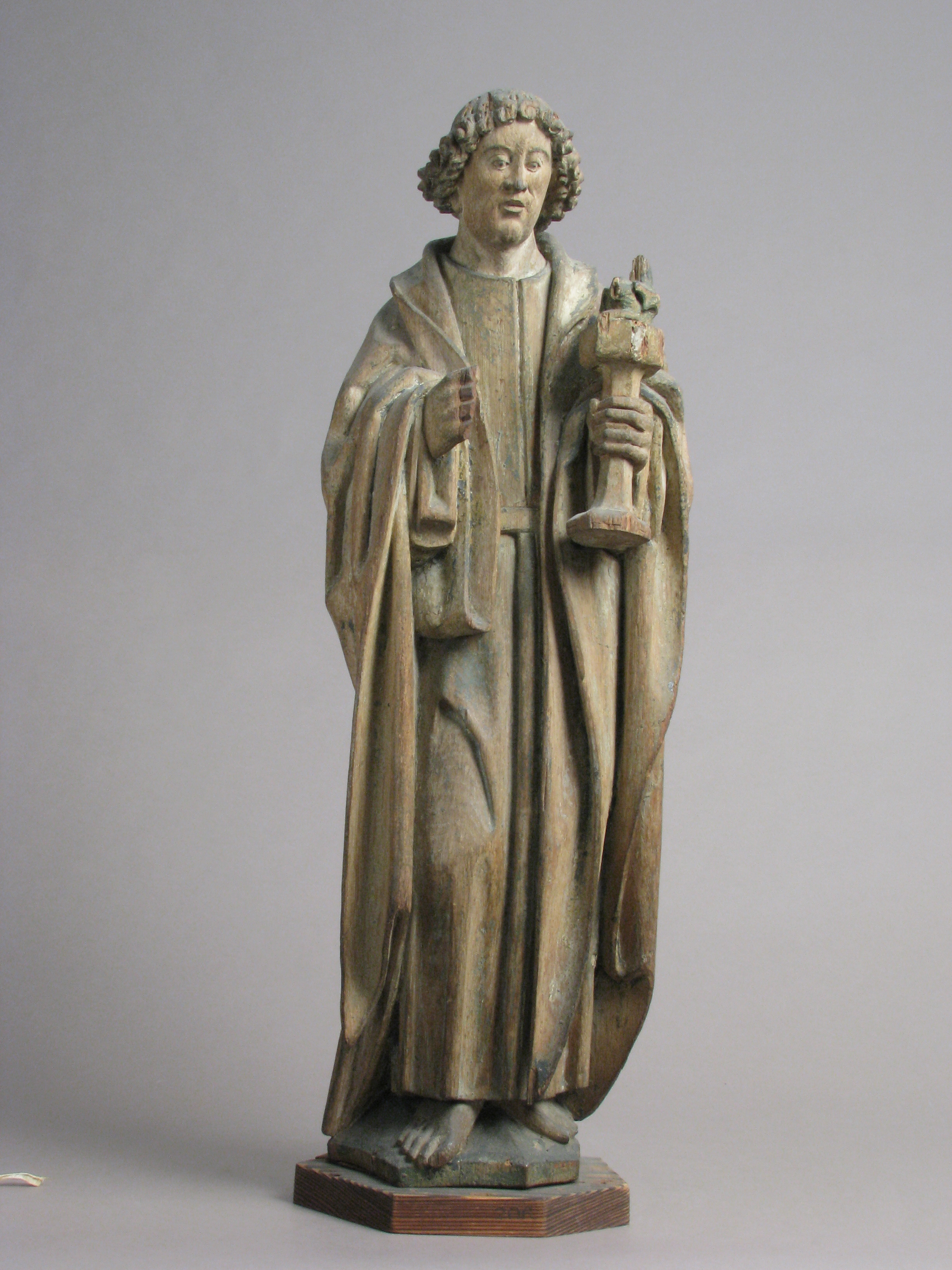
Saint John, Apostle and Evangelist
Doctrinal reflection
This entry presents a challenge: the work described is a North Netherlandish oak statuette of Saint John the Apostle and Evangelist, dated to approximately AD 1500, gifted by J. Pierpont Morgan to the Metropolitan Museum of Art in 1916. While catalogued under 'Medieval Art,' this object falls outside the Byzantine artistic tradition — it is a product of late Gothic Northern European sculpture, not Byzantine icon, mosaic, fresco, or manuscript production. The medium (carved oak with traces of polychromy and gilding) and provenance (North Netherlandish, ca. AD 1500) place it firmly within the Latin West, post-dating the fall of Constantinople (AD 1453) and reflecting Flemish or Dutch workshop conventions entirely distinct from Byzantine theological and iconographic programs. Iconographically, Saint John in Byzantine tradition is rendered as the Theologian (ὁ Θεολόγος), typically depicted in a half-length or standing format holding the Gospel codex, often in deep philosophical repose; the three-dimensional sculptural statuette format has no meaningful counterpart in Byzantine practice. Scholarly treatment of this object belongs to Gothic sculpture studies rather than Byzantine art history. Accordingly, a rigorous Scriptorium Byzantine archive entry cannot responsibly be generated for this item without misrepresenting its cultural, geographic, and theological context. The entry is flagged as outside the defined corpus. Sources: Gothic and Late Medieval Sculpture in the Metropolitan Museum of Art (MMA Bulletin); Williamson, P., Gothic Sculpture 1140–1300 (Yale, 1995); Steyaert, J., Late Gothic Sculpture: The Burgundian Netherlands (Ghent, 1994).