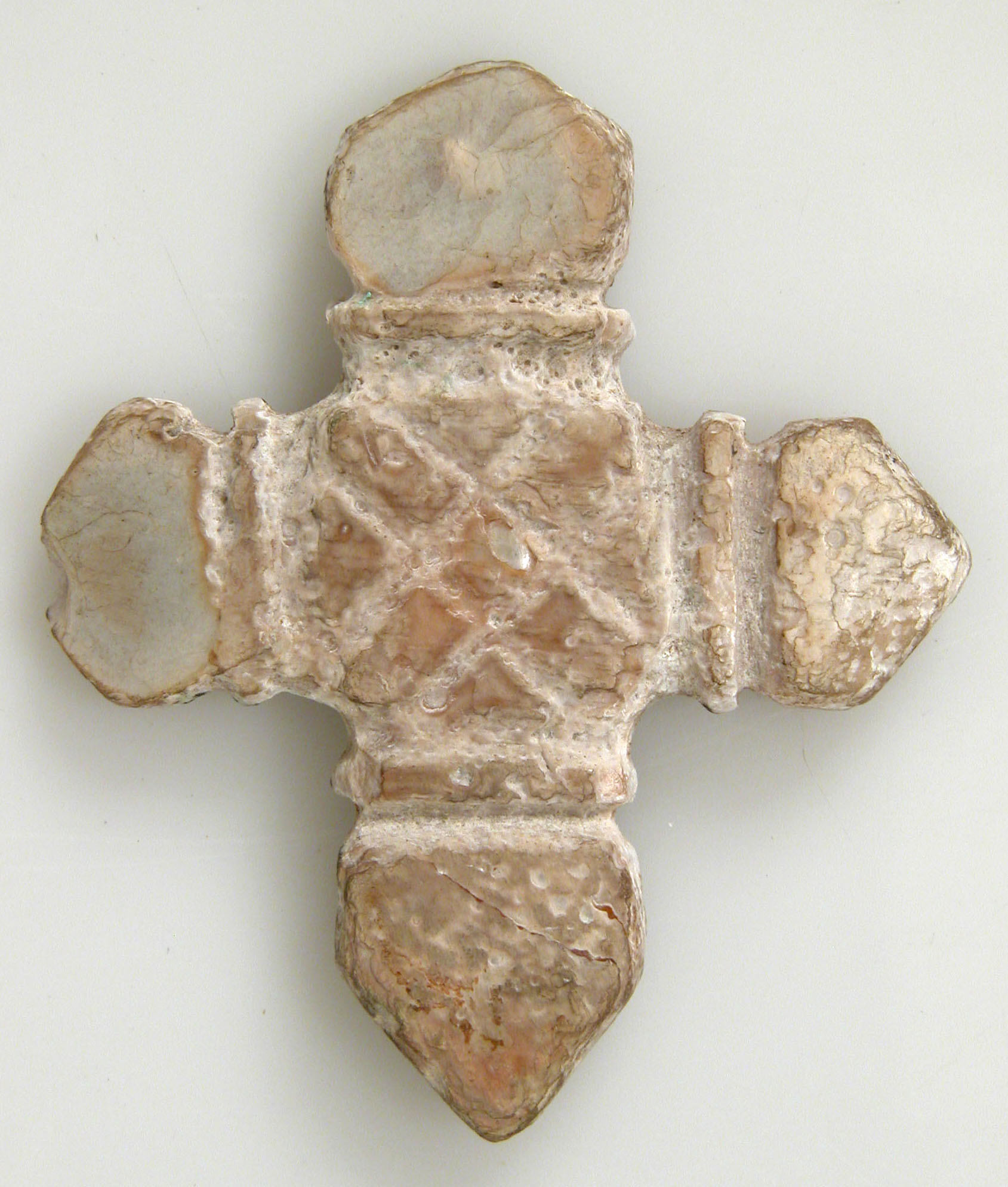
Shell Cross
Doctrinal reflection
The Shell Cross is a small devotional or apotropaic object dated broadly to approximately AD 300–700, attributed to a northern French workshop, and now held in the Medieval Art collection of the Metropolitan Museum of Art (New York), having entered the collection through the 1917 gift of J. Pierpont Morgan. The object is catalogued under the Byzantine designation, reflecting the widespread diffusion of late antique and early Byzantine artistic and religious conventions across the post-Roman West during this period. The medium — a shell carved or incised in cross form — situates the piece within a category of portable personal objects that served both symbolic and possibly liturgical functions in early Christian communities. The cross form itself became the dominant Christian symbol following the Constantinian settlement of the fourth century AD, accelerating through the fifth and sixth centuries as imperial and ecclesiastical patronage normalized its display across objects of all scales and materials. Shell as a material carried layered significance in late antiquity: associations with water, baptism, and pilgrimage are attested in archaeological contexts, though direct iconographic programs on objects of this type are minimal. The broad date range of AD 300–700 reflects genuine scholarly uncertainty; stylistic comparison with contemporaneous Merovingian and sub-Roman craft traditions in northern Gaul remains the primary dating tool. No specific biblical narrative is depicted, but the cross form evokes the Pauline theology of the crucifixion as salvific event (1 Corinthians 1:18; Galatians 6:14) and functions as a material confession of that theological center. The Morgan provenance gives the object substantial collection history, though pre-Morgan documentation is sparse. Sources: Metropolitan Museum of Art object files; Hahnloser & Brugger-Koch, Corpus der Hartsteinschliffe; Ager, Late Antique Jewellery (British Museum Press).