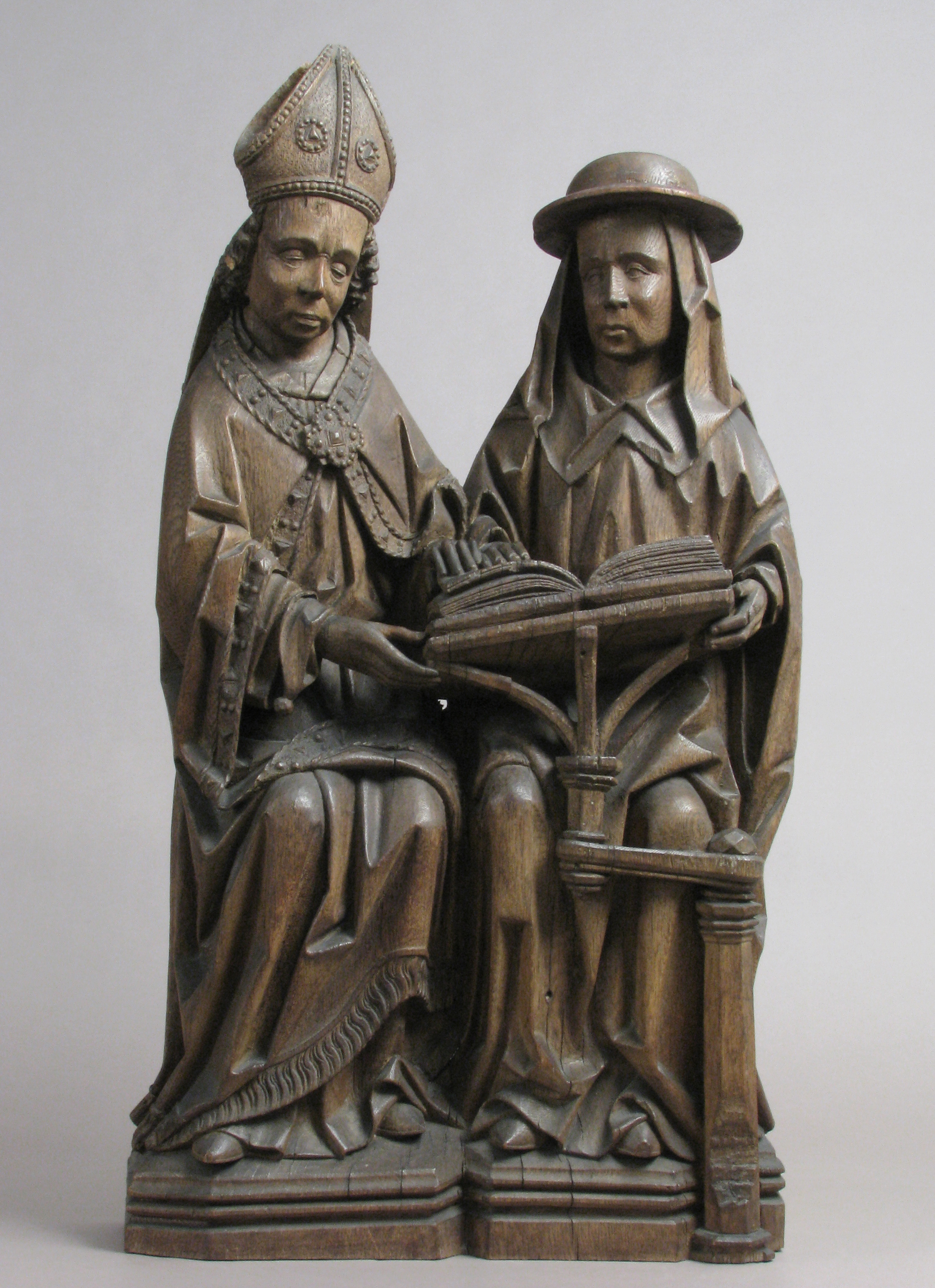
St. Augustine (or St. Ambrose) and St. Jerome
Doctrinal reflection
This entry presents a methodological boundary case for the Scriptorium archive. The object in question—a paired German oak statuette group depicting either St. Augustine (or St. Ambrose) alongside St. Jerome, dateable to the early sixteenth century AD—is a Northern European wooden sculpture, not a Byzantine artwork in any technical or cultural sense. The medium is carved polychrome or plain oak, a characteristically Western Gothic or early Renaissance sculptural tradition associated with German workshops of the Rhine, Swabia, or Bavaria, operating well outside the Byzantine iconographic and material tradition. The pairing of Latin Doctors of the Church (Augustine or Ambrose with Jerome) reflects a Western ecclesiological program emphasizing patristic authority, scriptural translation, and theological synthesis—themes central to pre-Reformation German devotional culture. Iconographically, Jerome would likely be rendered with his cardinal's attributes (hat, lion) and Vulgate scroll, while Augustine or Ambrose would carry episcopal insignia and a book or heart. No Byzantine formal vocabulary—gold-ground technique, hierarchical frontality governed by Middle Byzantine canon, or Greek inscriptional convention—is operative here. The Morgan gift provenance (1916) situates this firmly within the Met's medieval Western holdings. Scholarly treatment belongs to the corpus of German Late Gothic sculpture rather than Byzantine studies. Assigning Byzantine-period categories to this object would constitute a categorical error. The archive entry is flagged as out-of-scope for the Byzantine Scriptorium framework. Sources: Journal of the Walters Art Museum; Gesta (International Center of Medieval Art); Zeitschrift für Kunstgeschichte.