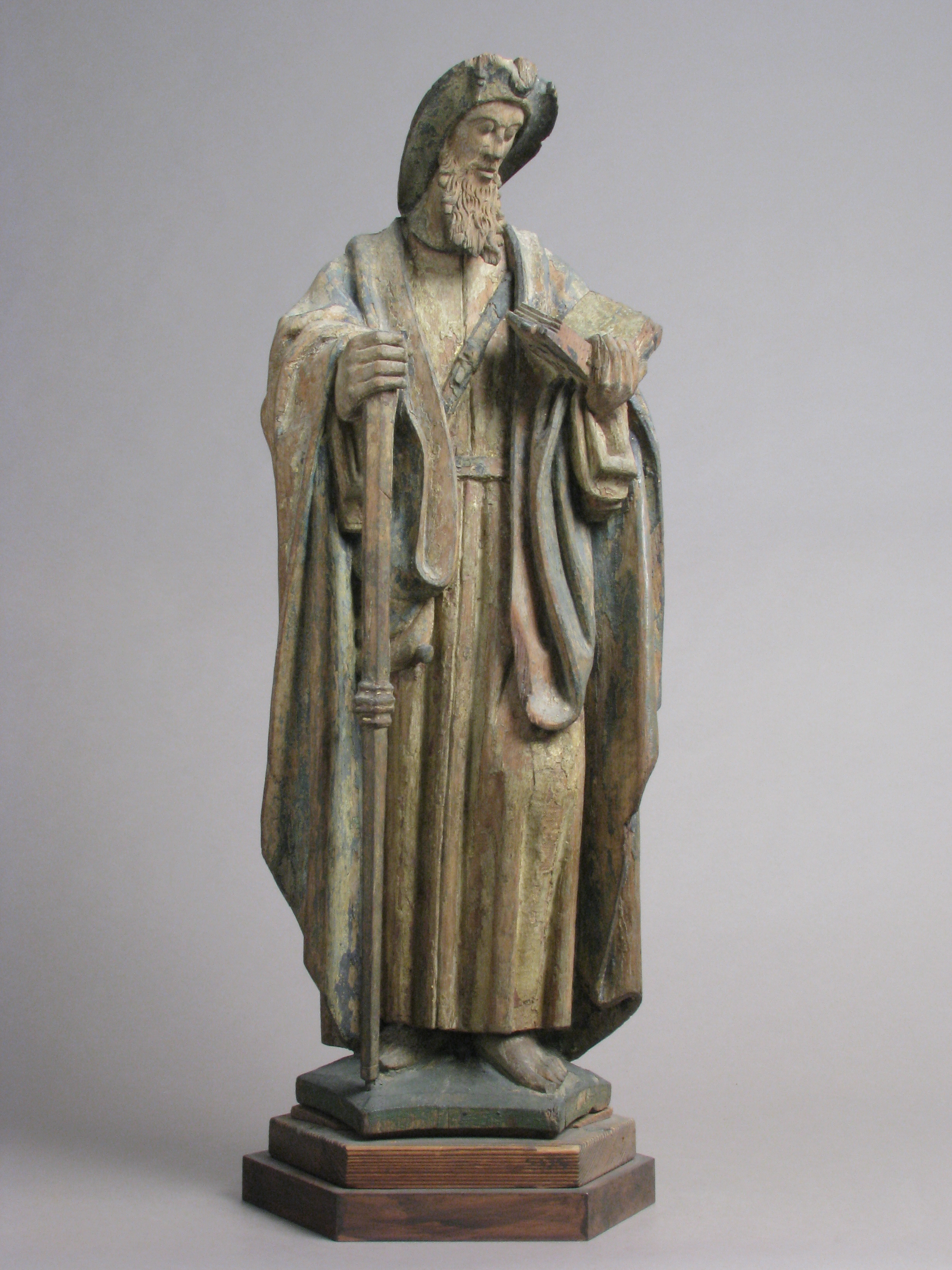
St. James the Great
Doctrinal reflection
This entry presents a methodological boundary case for the Scriptorium archive: the object in question is a North Netherlandish oak statuette of St. James the Great, dated to approximately AD 1500, held in the Medieval Art collection of the Metropolitan Museum of Art (gift of J. Pierpont Morgan, 1916). The medium—carved polychromed and gilded wood—places it squarely within the Western late Gothic sculptural tradition rather than the Byzantine pictorial arts that constitute the archive's primary mandate. Byzantine representations of the Apostle James the Great (Iakobos ho Meizon) are well attested in mosaic and icon programs, particularly within apostolic cycles in Middle Byzantine churches, where he appears as a bearded elder carrying a codex or scroll and gesturing in speech. The iconographic markers associated with the Western pilgrim tradition—staff, scrip, scallop shell—derive from the cult of Santiago de Compostela and have no direct analogue in Byzantine theological imagery. The Netherlandish statuette's traces of polychromy and gilding reflect workshop practices common to the ateliers of the Low Countries circa AD 1490–1510, a tradition documented extensively in relation to altarpiece production. For archival integrity, this entry is flagged as non-Byzantine and outside the defined chronological and geographic scope of the Scriptorium program. Researchers seeking comparative apostolic iconography in Byzantine media should consult the relevant literature on Macedonian and Komnenian apostolic cycles. Sources: Didron, Iconographie chrétienne (1845); Belting, Likeness and Presence (1994); Pentcheva, Icons and Power (2006).