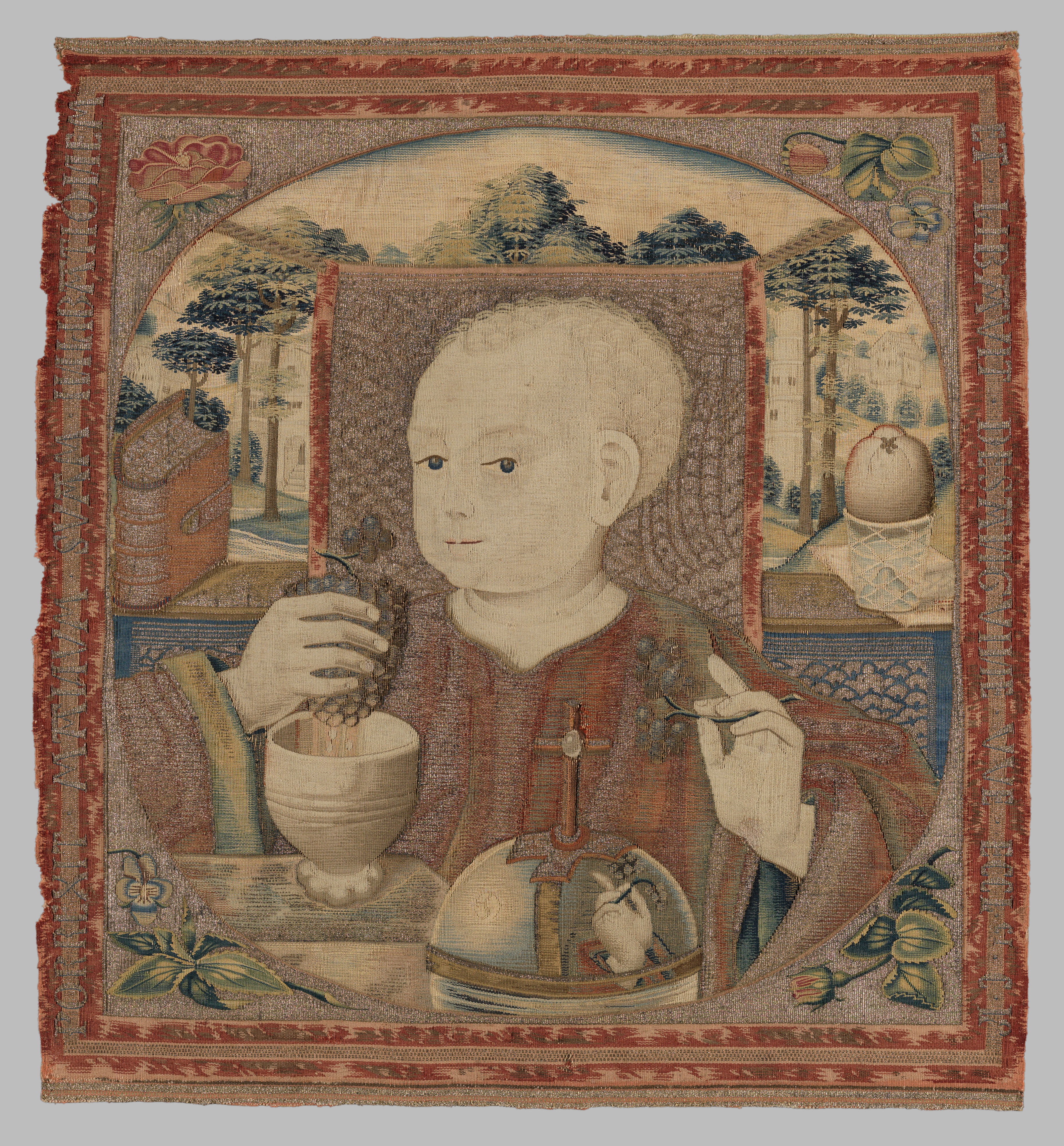
The Christ Child Pressing the Wine of the Eucharist
Doctrinal reflection
This entry presents an editorial challenge for a Byzantine-focused Scriptorium archive: the object in question is a South Netherlandish tapestry of ca. 1500 AD, now in the Metropolitan Museum of Art (Bequest of Benjamin Altman, 1913), executed in linen warp with wool, silk, and gilt weft yarns. It does not belong to the Byzantine tradition and falls outside the temporal, geographic, and technical parameters of this archive (Byzantine art, AD c. 330–1453, primarily mosaics, frescoes, icons, and illuminated manuscripts from the Eastern Mediterranean and its cultural sphere). The subject—the Christ Child treading the winepress as a prefiguration of the Eucharist and Passion—is a typological theme with deep roots in both Eastern and Western medieval theology, drawing on Isaiah 63:3 and Revelation 19:15, and paralleled in Byzantine iconography through the Amnos (Lamb of God) and Melismos (the infant Christ displayed on the altar disk) compositions. However, the tapestry's Flemish manufacture, late Gothic visual idiom, and Western liturgical context situate it firmly within the Latin tradition, beyond the scope of Byzantine art history. Inclusion in this archive would misrepresent the object's cultural origin. Scholars interested in eucharistic iconography bridging Eastern and Western medieval traditions may consult comparative studies linking the Byzantine Melismos to Western mystical-press imagery. Sources: Forsyth, W. H., 'The Monastic Scriptorium,' Metropolitan Museum Bulletin; Belting, H., Likeness and Presence (Chicago, 1994); Maguire, H., Art and Eloquence in Byzantium (Princeton, 1981).