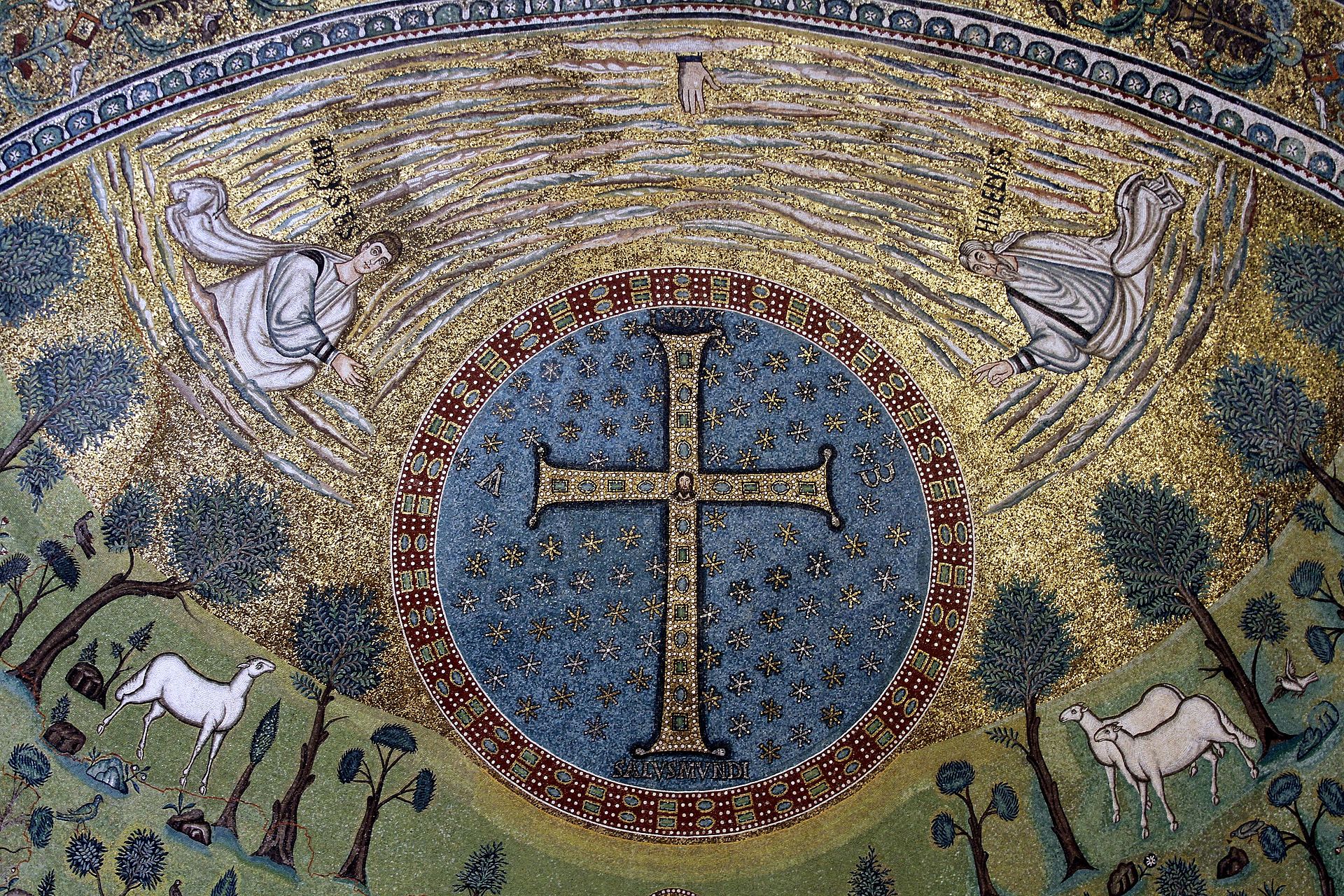
Transfiguration Apse (Sant'Apollinare in Classe)
Doctrinal reflection
The apse mosaic of Sant'Apollinare in Classe, Ravenna, executed c. 549 AD under Bishop Maximian and funded in part by the banker Julianus Argentarius, represents one of the most theologically sophisticated monuments of Justinianic art in the Latin West. Rather than depicting the Transfiguration in narrative terms, the composition encodes it through an elaborate allegorical register. At the apex, a jeweled cross set within a medallion bearing Christ's face occupies a dark blue, star-studded orb—an explicit cosmological statement linking the Transfiguration to cosmic theophany. The hand of God emerges from above while the busts of Moses and Elijah flank the medallion, referencing the Matthean account. Below, three sheep emerging from luminous clouds identify the apostolic witnesses Peter, James, and John. The lowest zone presents Sant'Apollinaris himself in orant posture amid a paradisiacal landscape of stylized flowering meadows, flanked by twelve sheep symbolizing his flock. This tripartite vertical structure—divine manifestation, apostolic witness, episcopal intercession—constitutes a coherent theological program asserting episcopal authority and the sanctifying mediation of the local martyr-bishop within a heavenly ecclesiology. The absence of a literal figural Transfiguration and its replacement with symbolic abstraction has been interpreted as reflecting both Eastern theological restraint and Western allegorical tendencies active simultaneously in Ravennate culture. The mosaic's chromatic brilliance, gold tesserae deployment, and hierarchical scaling conform to Justinianic court aesthetic standards documented across the empire. It remains a primary document for the study of sixth-century liturgical space and apse theology. Sources: Dumbarton Oaks Papers; Gesta; Journal of the Warburg and Courtauld Institutes.