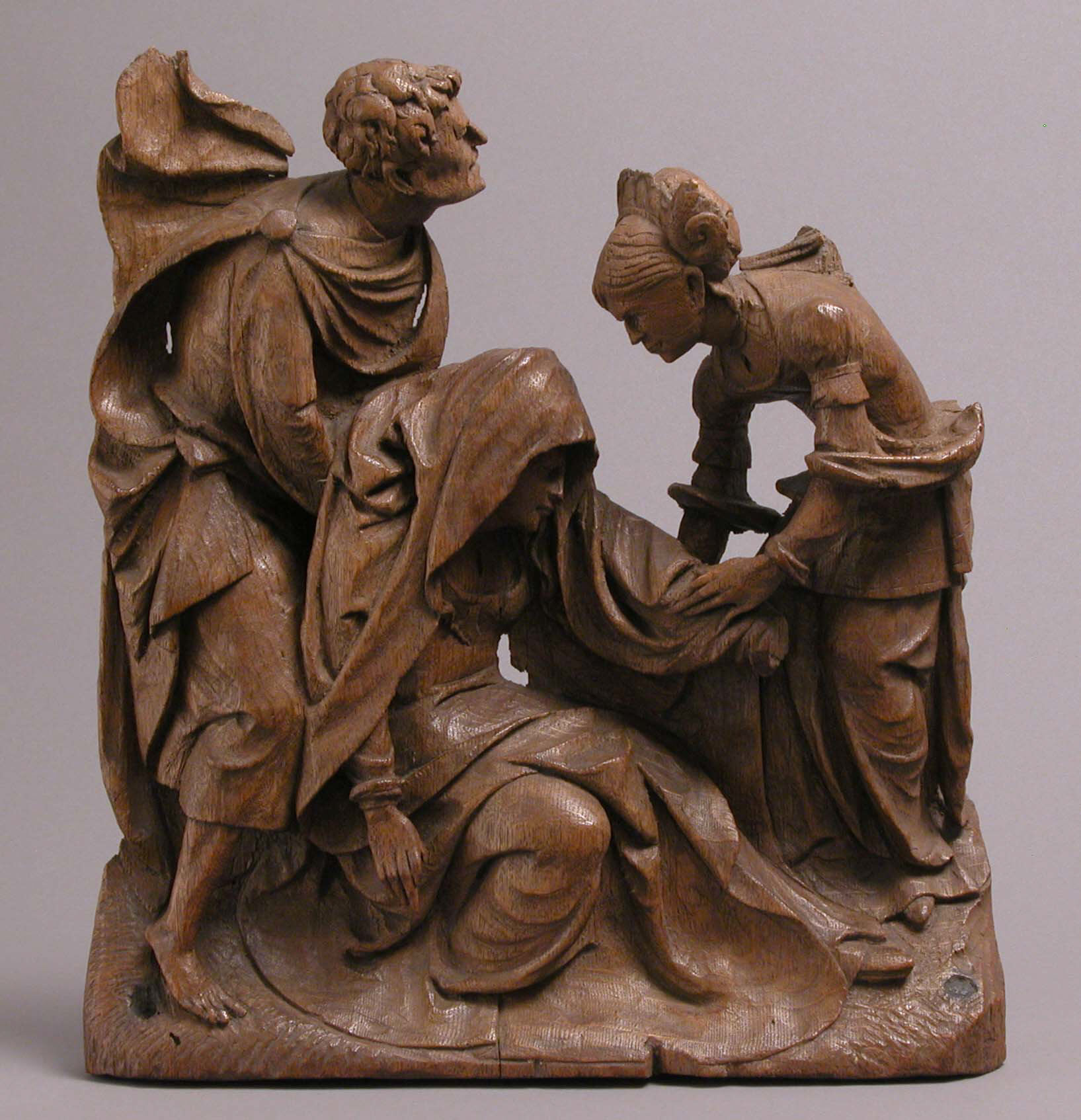
Virgin Fainting at the Cross
Doctrinal reflection
This entry presents an unusual cataloguing challenge: the submitted work—a South Netherlandish oak relief depicting the Virgin Fainting at the Cross, produced in Flanders in the early sixteenth century AD and held in the Metropolitan Museum of Art (Gift of J. Pierpont Morgan, 1916)—is a Western European late-Gothic or early Renaissance devotional sculpture, not a Byzantine artwork. The iconographic motif of the swooning or fainting Virgin (Latin: syncope Mariae; Greek: λιποθυμία τῆς Θεοτόκου) does, however, have a documented relationship with Byzantine and post-Byzantine pictorial tradition. In Byzantine Passion iconography, the Virgin is typically depicted standing upright beneath the Cross, supported by attendant women, as seen in middle- and late-period monumental programs. The more dramatic fainting posture—absent from canonical Byzantine formulations—entered Western art via Franciscan devotional literature and the Meditationes Vitae Christi (c. late thirteenth century AD), representing a significant divergence from Eastern theological restraint around Marian grief. Byzantine theologians resisted the motif as incompatible with the Theotokos's dignity and foreknowledge of the Resurrection. The Flemish oak relief, with its naturalistic rendering of bodily collapse and emotional expressivity, belongs squarely to the Western affective piety tradition rather than the Byzantine iconographic canon. Scholarly analysis of its technique, polychromy, and workshop attribution falls within the domain of Northern European medieval sculpture studies. No valid Byzantine archive entry can be generated for this object. Sources: Kirk Ambrose and Robert Maxwell, eds., Current Directions in Eleventh- and Twelfth-Century Sculpture Studies (2010); Sixten Ringbom, Icon to Narrative (1965).