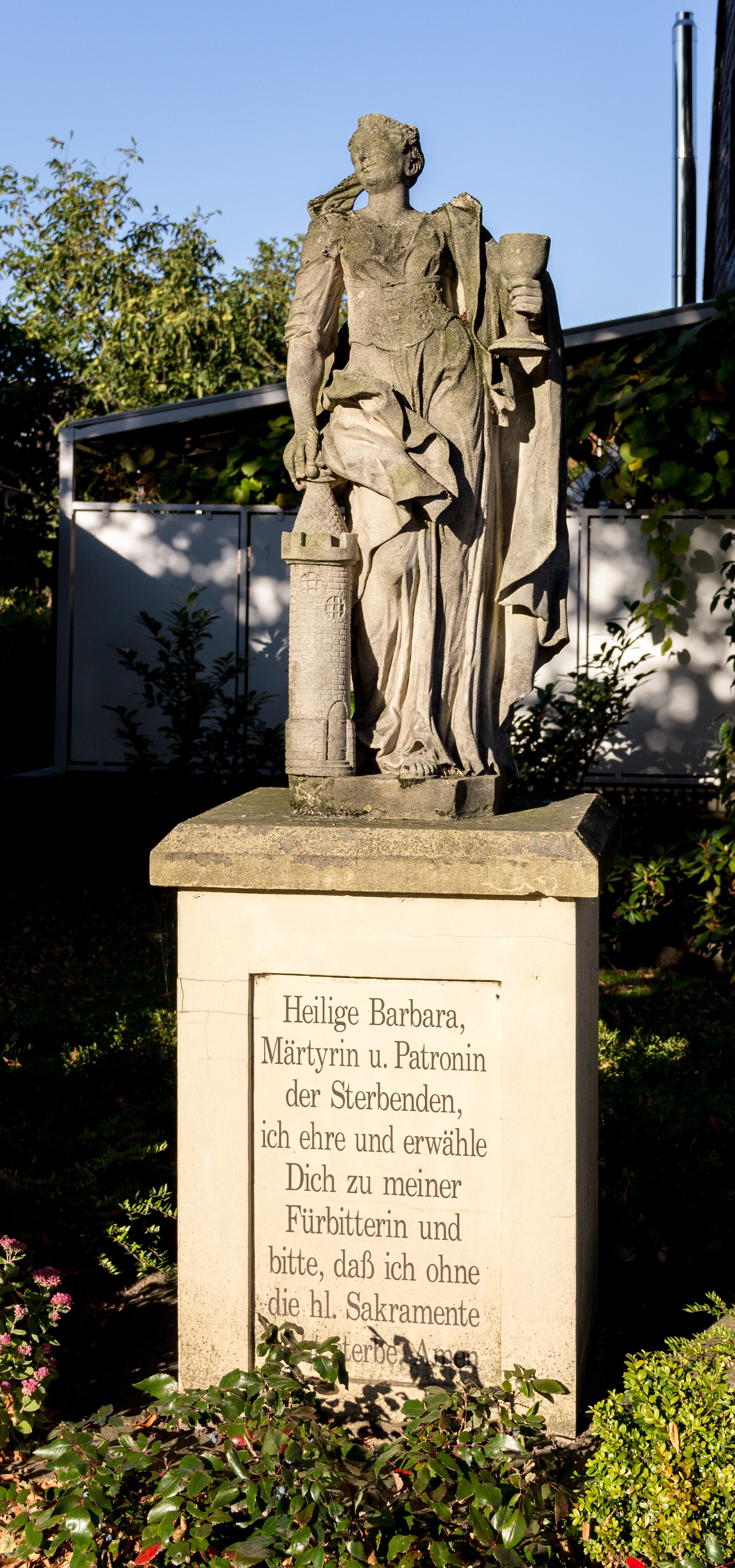
Barbara of Nicomedia
Life and Ministry
Barbara of Nicomedia is a figure venerated in both Eastern and Western Christian traditions as a virgin-martyr, though her historical existence cannot be established with certainty by modern critical scholarship. The hagiographic accounts, which circulated widely from late antiquity through the medieval period, situate her at Nicomedia or, in variant traditions, Heliopolis or Tuscany, during the reign of the emperor Maximinus or Diocletian, roughly the late third or early fourth century AD. The narrative core holds that Barbara was the daughter of a wealthy pagan named Dioscorus, who confined her in a tower to protect her from suitors. During her confinement, she converted to Christianity, allegedly perceiving the doctrine of the Trinity through her own reasoning when she requested that a bathhouse under construction be given three windows rather than two. Upon her conversion becoming known, Dioscorus denounced her to local authorities. She was subjected to torture and subsequently condemned to death. Her cult appears in martyrologies from at least the seventh century AD, and her veneration spread substantially through Byzantine, Latin, and Slavic ecclesiastical contexts across the medieval period. Because her Acts are generally regarded by hagiographers and historians as legendary rather than historically documentary, the Roman Catholic Church removed her from the Roman Calendar in the 1969 revision, though her cult remains officially recognized in Eastern churches. Her association with artillery, miners, and protection against sudden or unprovided death became pronounced in the medieval West. Sources: David Hugh Farmer, Oxford Dictionary of Saints (Oxford University Press); Hippolyte Delehaye, Les Légendes Hagiographiques (Société des Bollandistes); Butler's Lives of the Saints, revised edition (Burns and Oates).
Circumstances of Death
According to hagiographic tradition, Barbara was beheaded on the orders of the local Roman magistrate following her torture and refusal to recant her Christian faith. In the most widely circulated version of her Acts, the execution was carried out personally by her father, Dioscorus, who according to the narrative was subsequently struck dead by lightning, a detail understood within the tradition as divine retribution. The precise date assigned by tradition is December 4, though no contemporaneous documentation survives to corroborate these events.
Legacy
Barbara's cult achieved wide diffusion in both Eastern and Western Christianity by the early medieval period, and she was numbered among the Fourteen Holy Helpers in the Latin West, a group of saints invoked for specific intercessory needs. She remains a patron saint of artillerymen, miners, and military engineers, and is liturgically commemorated on December 4 in Eastern Orthodox and Eastern Catholic calendars. The Roman Catholic Church retains her in the Roman Martyrology while having removed her feast from the universal calendar in AD 1969 pending stronger historical verification.
Sources
["David Hugh Farmer, Oxford Dictionary of Saints, 5th ed. (Oxford University Press, 2003)", "Hippolyte Delehaye, Les L\u00e9gendes Hagiographiques (Soci\u00e9t\u00e9 des Bollandistes, 1905)", "Butler's Lives of the Saints, revised and supplemented edition, ed. Herbert Thurston and Donald Attwater (Burns and Oates, 1956)"]