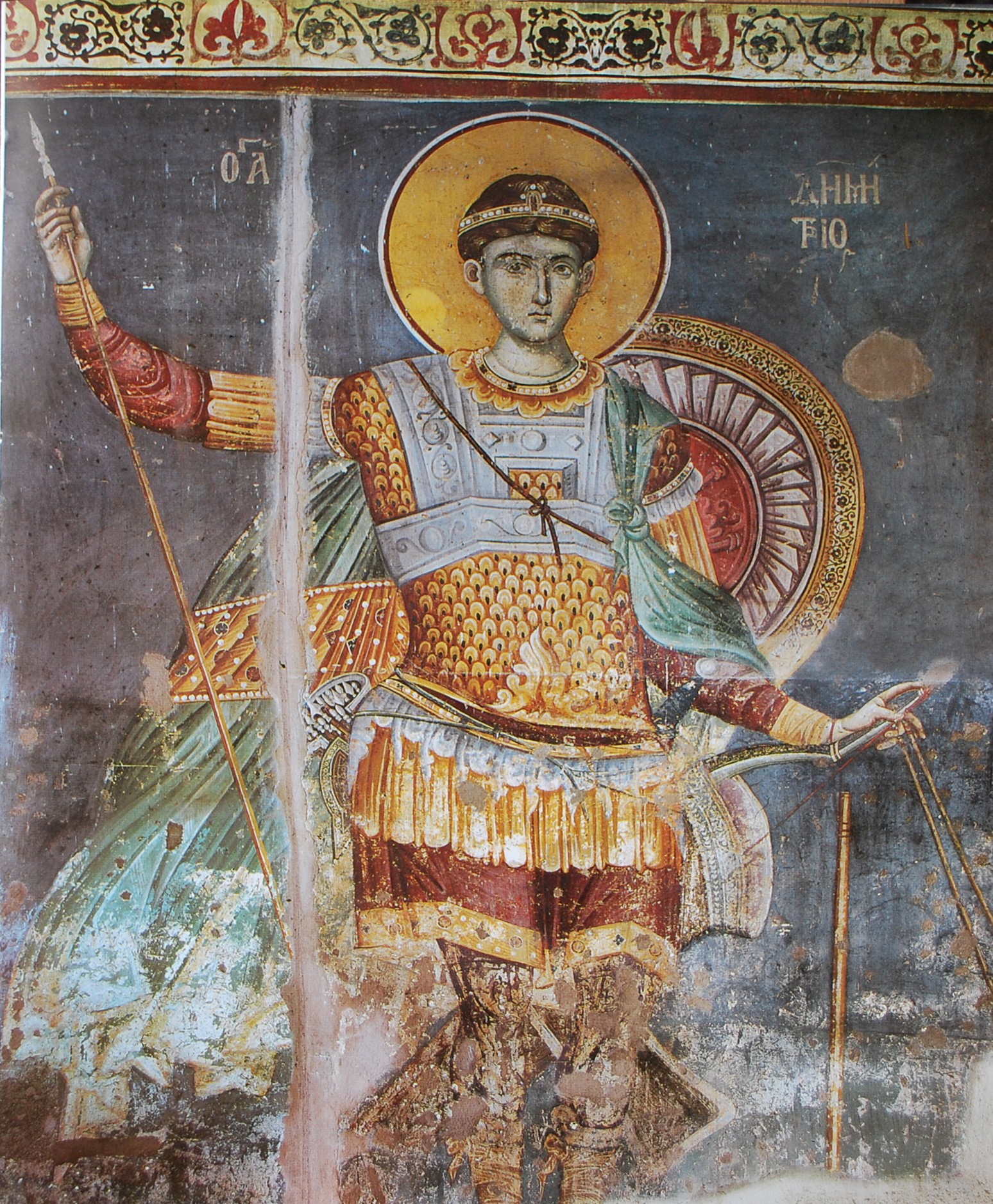
Demetrius of Thessaloniki
Life and Ministry
Demetrius of Thessaloniki is among the most venerated military saints of the Eastern Christian tradition, though the historical documentation surrounding his life is substantially limited and largely hagiographical in character. Scholarly consensus places his martyrdom in the early fourth century AD, most commonly during the reign of the emperor Maximian (r. 286–305 AD), though some sources associate his death with the Diocletianic persecutions of 303–305 AD. Ancient Thessaloniki, as a major administrative and military center of the Roman province of Macedonia, provides a credible geographical context for the execution of a Roman official or military figure who had converted to Christianity. Early sources describe Demetrius as a Roman proconsul or military officer of considerable rank who openly professed and taught the Christian faith within the city, an act that contravened imperial edicts against the religion. The earliest stratum of his cult appears to be firmly established by the late fourth and early fifth centuries AD, with a basilica constructed over the purported site of his imprisonment and death. The subsequent elaboration of his legend, including the attribution of miraculous military interventions on behalf of Thessaloniki during Slavic and Avar sieges in the late sixth and seventh centuries AD, significantly amplified his regional and pan-Orthodox importance. The miracle accounts, compiled in the Miracula Sancti Demetrii, constitute a historically valuable source for the social and military history of the Balkans in Late Antiquity and the early Byzantine period, independent of their hagiographical function. Sources: Oxford Dictionary of Byzantium (Oxford University Press, 1991); Hippolyte Delehaye, Les légendes grecques des saints militaires (1909); Paul Lemerle, Les plus anciens recueils des miracles de saint Démétrius (1979–1981).
Circumstances of Death
According to the dominant hagiographical tradition, Demetrius was arrested on the orders of Emperor Maximian following the emperor's return to Thessaloniki, presumably around 303–306 AD. He was imprisoned in a bath complex beneath the Roman arena. Imperial soldiers were dispatched to execute him by stabbing with lances while he remained in his cell. The body was reportedly recovered by his servant Lupus and subsequently interred near the site of his execution. The arena context and lance execution are consistent features across the principal manuscript traditions.
Legacy
Demetrius was formally recognized as a Great-Martyr in the Eastern Orthodox Church, a designation indicating singular honor within the martyrological hierarchy. His feast day is observed on 26 October in the Byzantine liturgical calendar. The Hagios Demetrios basilica in Thessaloniki, designated a UNESCO World Heritage Site, remains a major center of his veneration. He is accorded the epithet myrovlytes, meaning myrrh-streamer, owing to traditions of fragrant oil exuding from his relics. He functions as the patron saint of Thessaloniki and holds significant standing across Greek, Serbian, Bulgarian, and broader Orthodox traditions.
Sources
["Oxford Dictionary of Byzantium, ed. Alexander Kazhdan (Oxford University Press, 1991)", "Paul Lemerle, Les plus anciens recueils des miracles de saint D\u00e9m\u00e9trius, 2 vols. (CNRS, 1979\u20131981)", "Hippolyte Delehaye, Les l\u00e9gendes grecques des saints militaires (Paris, 1909)"]