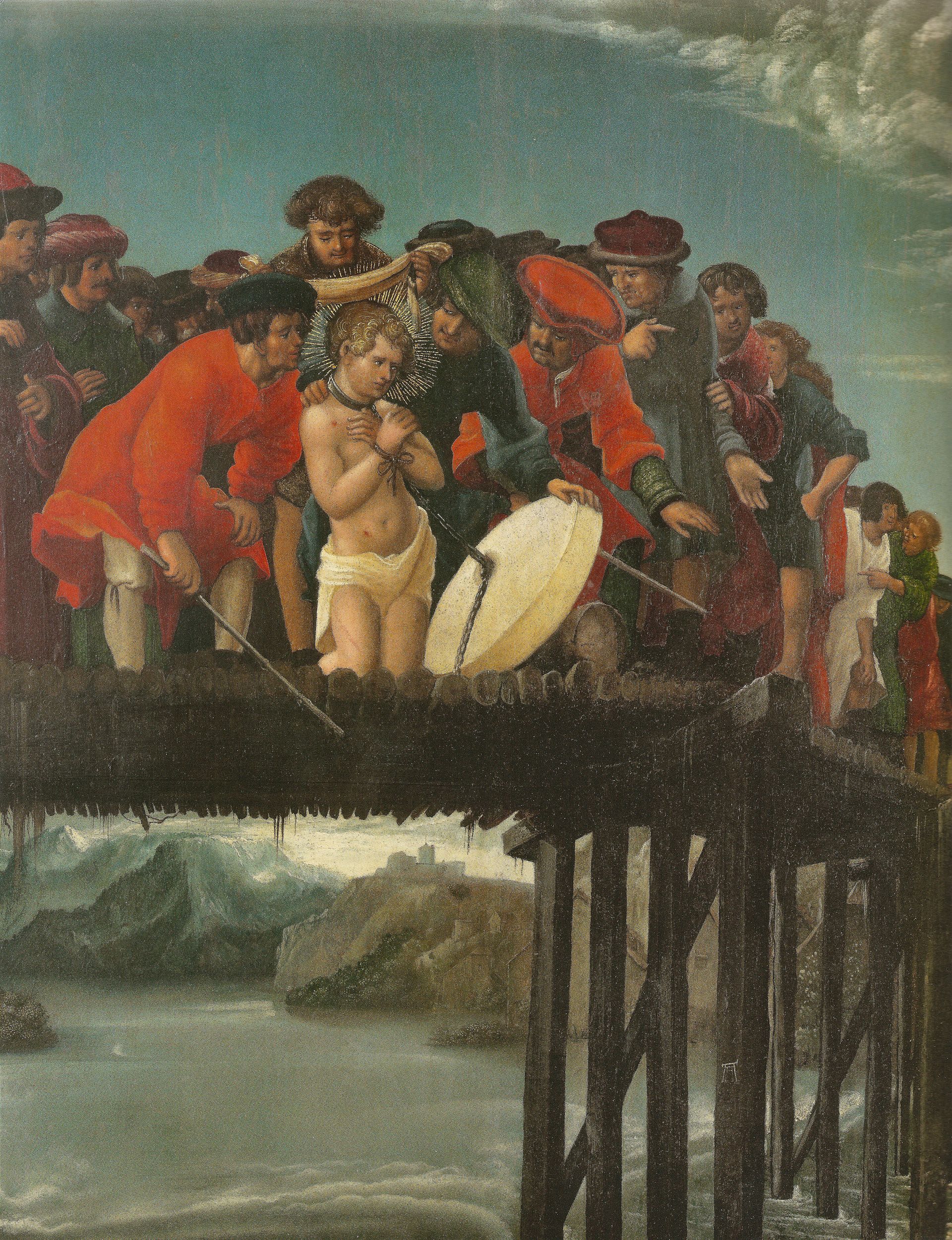
Florian of Lorch
Saint Florian
Life and Ministry
Florian of Lorch was a senior officer in the Roman imperial administration serving in the province of Noricum during the late third and early fourth centuries AD. Ancient sources identify him as holding the rank of princeps officii, placing him within the higher administrative and military bureaucracy stationed at Lauriacum, the legionary fortress situated at the confluence of the Enns and Danube rivers in what is now Upper Austria. His precise origins remain unclear in the extant record, though hagiographical tradition associates him with the locality of Aelium Cetium, modern Sankt Pölten. Florian came to official attention during the systematic persecution of Christians initiated under the Emperor Diocletian, whose edicts of 303–304 AD required the suppression of Christian communities and the compelled apostasy of Christian officials throughout the Roman Empire. When the provincial authorities under the prefect Aquilinus moved against the Christian community at Lauriacum, Florian voluntarily presented himself rather than remain concealed, openly declaring his Christian faith before the authorities. He refused successive demands to perform sacrifice and to renounce his religious affiliation, submitting instead to judicial punishment. Florian's case represents one of the better-documented martyrdoms from the Danubian frontier provinces in this period, partly because of the early development of his cult in the region and its subsequent entrenchment in both Roman and Bavarian ecclesiastical tradition. His martyrdom is generally assigned to the year 304 AD, consistent with the intensified phase of the Diocletianic persecution following the fourth edict. Sources: Acta Sanctorum, May vol. I (Bollandist corpus); Franz Lanzoni, Le diocesi d'Italia, vol. II (1927); Lexikon für Theologie und Kirche, 3rd ed., s.v. 'Florian.'
Circumstances of Death
Following his refusal to apostatize before the prefect Aquilinus at Lauriacum, Florian was subjected to scourging. He was subsequently taken to a bridge over the Enns river, where a millstone was fastened around his neck and he was thrown into the water and drowned. The execution took place in AD 304. His body was reportedly recovered and interred by a pious woman named Valeria, at a site later associated with the Augustinian monastery of St. Florian near Linz.
Legacy
Florian was venerated as a martyr from an early period in the Danubian provinces. His feast day, May 4, appears in Roman martyrologies, and Pope Lucius III formally confirmed his cult in the twelfth century. He became the patron saint of Poland and of Upper Austria, and is widely recognized in Catholic tradition as patron against fire and flood, a function attributed to legendary accounts of his intercession. He remains the patron saint of firefighters across much of Central Europe, and the Abbey of St. Florian in Upper Austria preserves continuous institutional memory of his cult.
Sources
["Acta Sanctorum, Maii Tomus I, edited by the Bollandist Society (Antwerp, 1680)", "Franz Lanzoni, Le diocesi d'Italia dalle origini al principio del secolo VII, vol. II (Faenza, 1927)", "Lexikon f\u00fcr Theologie und Kirche, 3rd edition, s.v. 'Florian von Lorch' (Herder, 1995)"]