Margaret of Antioch
Saint Marina
Life and Ministry
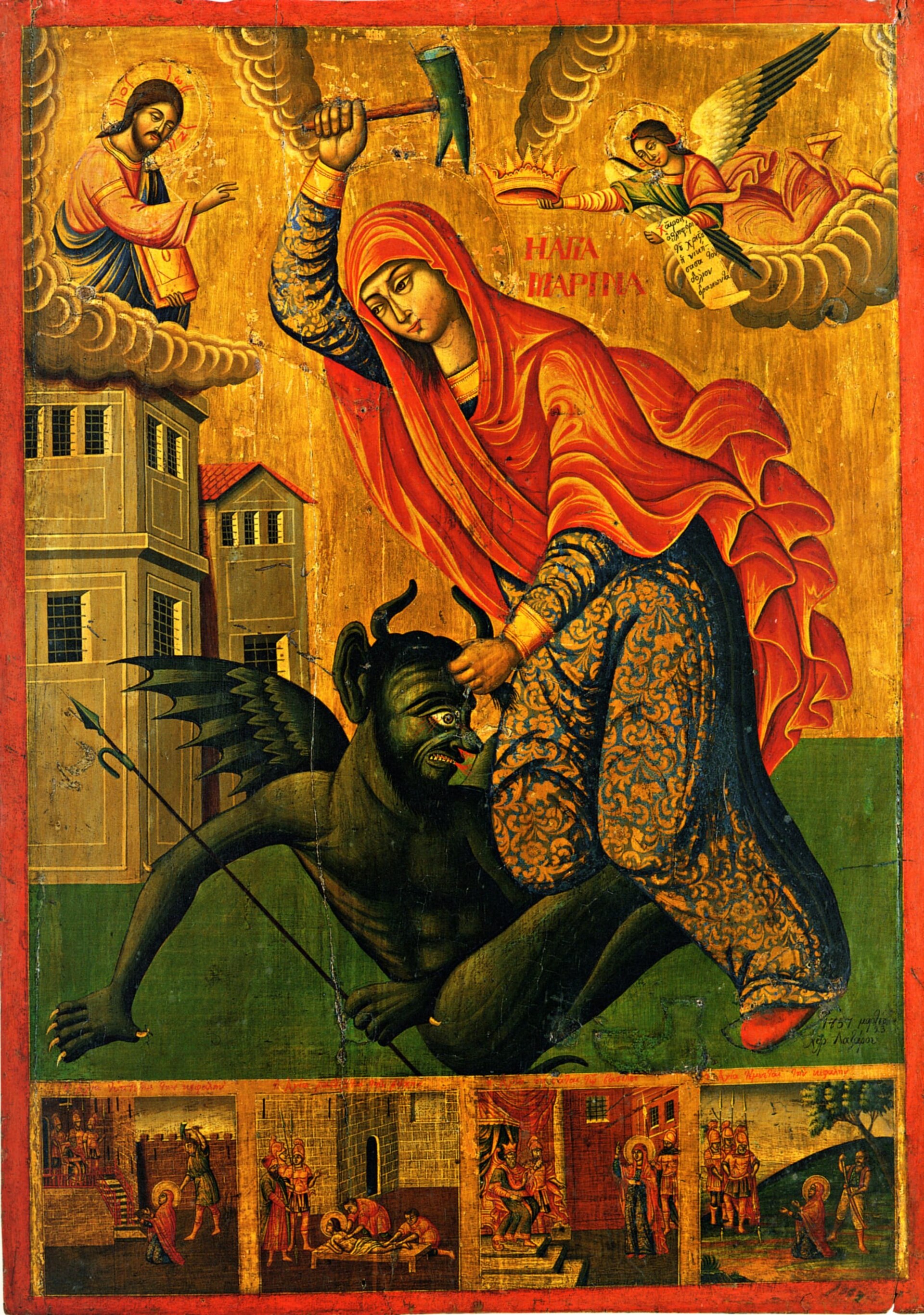
Margaret of Antioch, venerated in Eastern Christianity as Marina, is traditionally identified as a young woman who died c. AD 304 during the Diocletianic persecution at Antioch in Pisidia, a Roman colony in Asia Minor distinct from the more prominent Antioch in Syria. The historical evidence for her existence is extremely limited; Pope Gelasius I placed her among saints whose acts were considered apocryphal at the Roman synod of AD 494, and scholarly opinion consistently treats her narrative as hagiographic legend rather than recoverable biography. According to the passio tradition, she was the daughter of a pagan priest named Aedesius, raised in the Christian faith by a nurse following her mother's death, and subsequently disowned by her father when she refused to apostatize. The prefecture of the region, governed by a figure named Olybrius in the legend, sought her in marriage; her refusal and public profession of Christianity initiated a sequence of judicial torture. The dragon episode, central to her iconography, is universally regarded by scholars as legendary interpolation with possible allegorical function representing demonic temptation or eschatological conflict. Her cult expanded rapidly in the Latin West during the early medieval period, and she was formally incorporated among the Fourteen Holy Helpers, a grouping of saints invoked against specific diseases and dangers that achieved particular prominence in the Rhineland by the fourteenth century. Her association with childbirth, derived partly from dragon-swallowing and subsequent escape narratives, secured widespread popular devotion across medieval Europe. Sources: David Hugh Farmer, Oxford Dictionary of Saints (5th ed., 2004); Hippolyte Delehaye, The Legends of the Saints (1907; Eng. trans. 1962); Jacobus de Voragine, Legenda Aurea, analyzed in Sherry Reames, The Legenda Aurea: A Reexamination of Its Paradoxical History (1985).
Circumstances of Death
According to hagiographic tradition, Margaret was subjected to prolonged judicial torture ordered by the prefect Olybrius following her refusal to renounce Christianity and accept his marriage proposal. The passio describes burning, laceration, and immersion in water before her eventual execution by beheading, dated c. AD 304 and thus situated within the broader Diocletianic persecution. No contemporary documentary or epigraphic evidence corroborates these specific circumstances, and the account is classified by patristic and modern scholars as legendary composition rather than historical record.
Legacy
Margaret of Antioch was included in the Roman Martyrology and her feast was observed on 20 July in the Latin Church, though she was removed from the General Roman Calendar in the 1969 reform given the non-historical character of her acts. In Eastern Orthodoxy she is venerated as Marina the Great Martyr, commemorated on 17 July, with a continuous liturgical tradition. Her status as one of the Fourteen Holy Helpers, patroness of pregnant women, and subject of extensive medieval iconographic and literary production established her among the most culturally influential virgin-martyr figures of the Western Middle Ages.
Sources
["David Hugh Farmer, Oxford Dictionary of Saints, 5th ed. (Oxford University Press, 2004)", "Hippolyte Delehaye, The Legends of the Saints, trans. Donald Attwater (Fordham University Press, 1962)", "Sherry L. Reames, The Legenda Aurea: A Reexamination of Its Paradoxical History (University of Wisconsin Press, 1985)"]