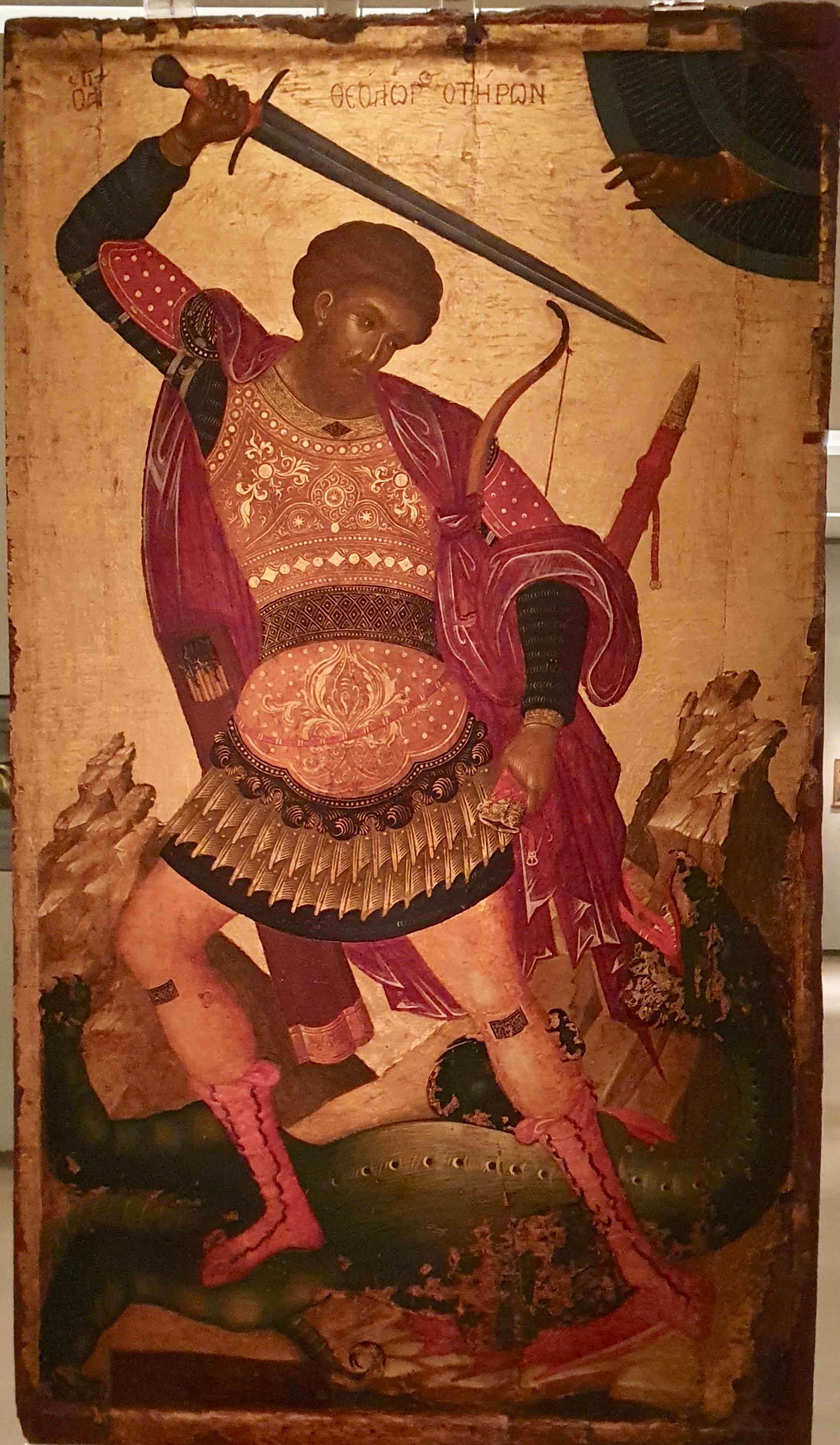
Theodore of Amasea
Theodore Tiron ('the Recruit')
Life and Ministry
Theodore of Amasea was a young recruit (Latin: tiro, Greek: tiron) in the Roman legions stationed at Amasea, the principal city of Pontus in northern Asia Minor. He is traditionally dated to the period of the Great Persecution initiated by the emperors Diocletian, Galerius, and Maximian, with his death placed at approximately AD 306. The primary hagiographical tradition, preserved in Greek passions of uncertain but early date, presents Theodore as a recent enlistee who openly confessed Christianity when pressured to participate in imperial cult sacrifices. According to the same tradition, he subsequently set fire to the temple of Cybele at Amasea, an act interpreted as a deliberate public repudiation of state religion. He was arrested, imprisoned, and subjected to extended interrogation and torture before being condemned to death by burning. The historical kernel of his story is consistent with the documented patterns of Galerian persecution in Pontus and the surrounding regions of Asia Minor, where Roman military units were subjected to particular pressure to demonstrate loyalty through cultic observance. Theodore belongs to a broader category of soldier-martyrs — including George, Demetrius, and Mercurius — who became culturally dominant in Eastern Christian devotion and military ideology from late antiquity onward. His cult is attested at Amasea from at least the fourth century, and Gregory of Nyssa delivered a panegyric in his honor circa AD 380, providing one of the earliest datable literary witnesses to his veneration. Sources: Hippolyte Delehaye, 'Les légendes grecques des saints militaires' (1909); Oxford Dictionary of Byzantium, ed. Kazhdan (1991); Gregory of Nyssa, 'Encomium on Theodore the Martyr.'
Circumstances of Death
Following his arrest for the arson of the Cybele temple at Amasea, Theodore was held in custody, tortured by Roman officials seeking recantation, and ultimately condemned to death. The consistent tradition across the Greek passion literature records his execution by burning, likely intended as a punishment reflecting the nature of his alleged offense. His death is conventionally assigned to approximately AD 306, during the active phase of the Galerian persecution in the diocese of Pontus.
Legacy
Theodore was canonized within both the Eastern Orthodox and Roman Catholic traditions. Gregory of Nyssa's panegyric of circa AD 380 confirms an established liturgical cult at Amasea within decades of his death. In Eastern Orthodoxy he is commemorated on 17 February and holds a distinctive place on the first Saturday of Great Lent, when a blessing of kolyva is associated with his intercession. He became one of the paradigmatic warrior-saints of Byzantine iconography, frequently depicted mounted and slaying a dragon or serpent, imagery that influenced subsequent military hagiography throughout the Christian East.
Sources
["Hippolyte Delehaye, 'Les l\u00e9gendes grecques des saints militaires' (Paris: Alphonse Picard, 1909)", "Alexander Kazhdan, ed., 'Oxford Dictionary of Byzantium', 3 vols. (Oxford University Press, 1991)", "Gregory of Nyssa, 'Encomium in Theodorum martyrem', in Patrologia Graeca vol. 46, ed. J.-P. Migne"]