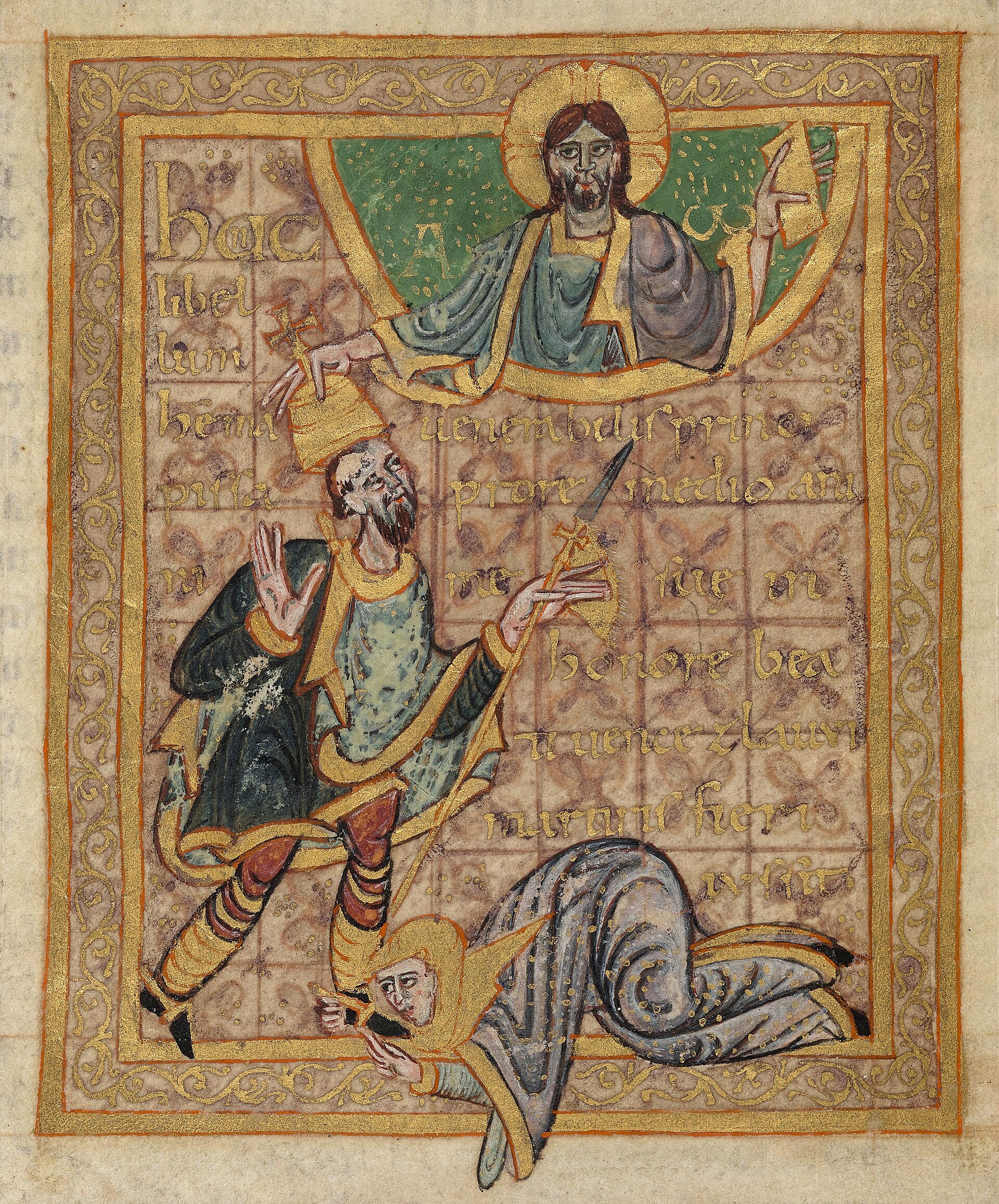
Wenceslaus of Bohemia
Svatý Václav ('Good King Wenceslas')
Life and Ministry
Wenceslaus I, Duke of Bohemia, was born approximately AD 907, the son of Duke Vratislaus I and Drahomíra, a princess of the Hevelli tribe. His paternal grandmother, Ludmila, supervised his early Christian education, instilling in him a literacy in Latin and Old Church Slavonic that distinguished him among Bohemian nobility of the period. Following his father's death around AD 921, Wenceslaus came to power initially under his mother's regency, a period marked by factional tension between pro-Christian and pagan aristocratic factions at the Přemyslid court. Ludmila was murdered in AD 921, an act widely attributed to agents of Drahomíra, and Wenceslaus assumed direct ducal authority thereafter. His rule was characterized by deliberate efforts to consolidate Christianity within Bohemia: he invited clergy from Bavaria and the German lands, promoted the construction of ecclesiastical buildings including a rotunda dedicated to Saint Vitus at Prague Castle, and maintained close political ties with the East Frankish kingdom under Henry I and later Otto I. This orientation toward the German sphere generated internal opposition from Bohemian nobles who resented both the cultural and political implications of his policies. Wenceslaus also reportedly ransomed captives and engaged in personal acts of charity, conduct that later hagiography amplified considerably. His younger brother Boleslav organized a conspiracy among dissatisfied nobles, culminating in the assassination of Wenceslaus in approximately AD 929 or 935, the precise year remaining a matter of scholarly debate. He was subsequently venerated as a martyr and became the central symbol of Bohemian Christian identity. Sources: David Kalhous, 'Anatomy of a Duchy' (2012); Dušan Třeštík, 'Počátky Přemyslovců' (1997); František Graus in 'Bohemia in History' (1998).
Circumstances of Death
Wenceslaus was assassinated at the door of the church of Saints Cosmas and Damian in Stará Boleslav, Bohemia, on a feast day morning, most likely in AD 929 or 935. His brother Boleslav invited him to the town under the pretext of celebrating the feast, then attacked him personally at the church entrance. Co-conspirators among the Bohemian nobility intervened to complete the killing. Ancient sources describe stab wounds inflicted by Boleslav and his retainers. The body was later transferred to Prague by Boleslav's own order.
Legacy
Wenceslaus was venerated as a martyr almost immediately after his death, with his cult centered at Saint Vitus Basilica in Prague. Pope John XIII confirmed his saintly status in AD 967 through formal recognition. He became patron saint of the Czech lands and the Bohemian state, his image appearing on royal seals and coinage throughout the medieval period. In the English-speaking world he is widely recognized through the nineteenth-century carol 'Good King Wenceslas,' composed by John Mason Neale in 1853, though that text has limited historical basis. His feast day is observed on 28 September.
Sources
["David Kalhous, 'Anatomy of a Duchy: The Bohemian P\u0159emyslids c.1031\u20131034' (Brill, 2012)", "Du\u0161an T\u0159e\u0161t\u00edk, 'Po\u010d\u00e1tky P\u0159emyslovc\u016f: Vstup \u010cech\u016f do d\u011bjin 530\u2013935' (Prague, 1997)", "Franti\u0161ek Graus, 'St. Wenceslas' in Mikul\u00e1\u0161 Teich, ed., 'Bohemia in History' (Cambridge University Press, 1998)"]