Archangel Ivory
Doctrinal reflection
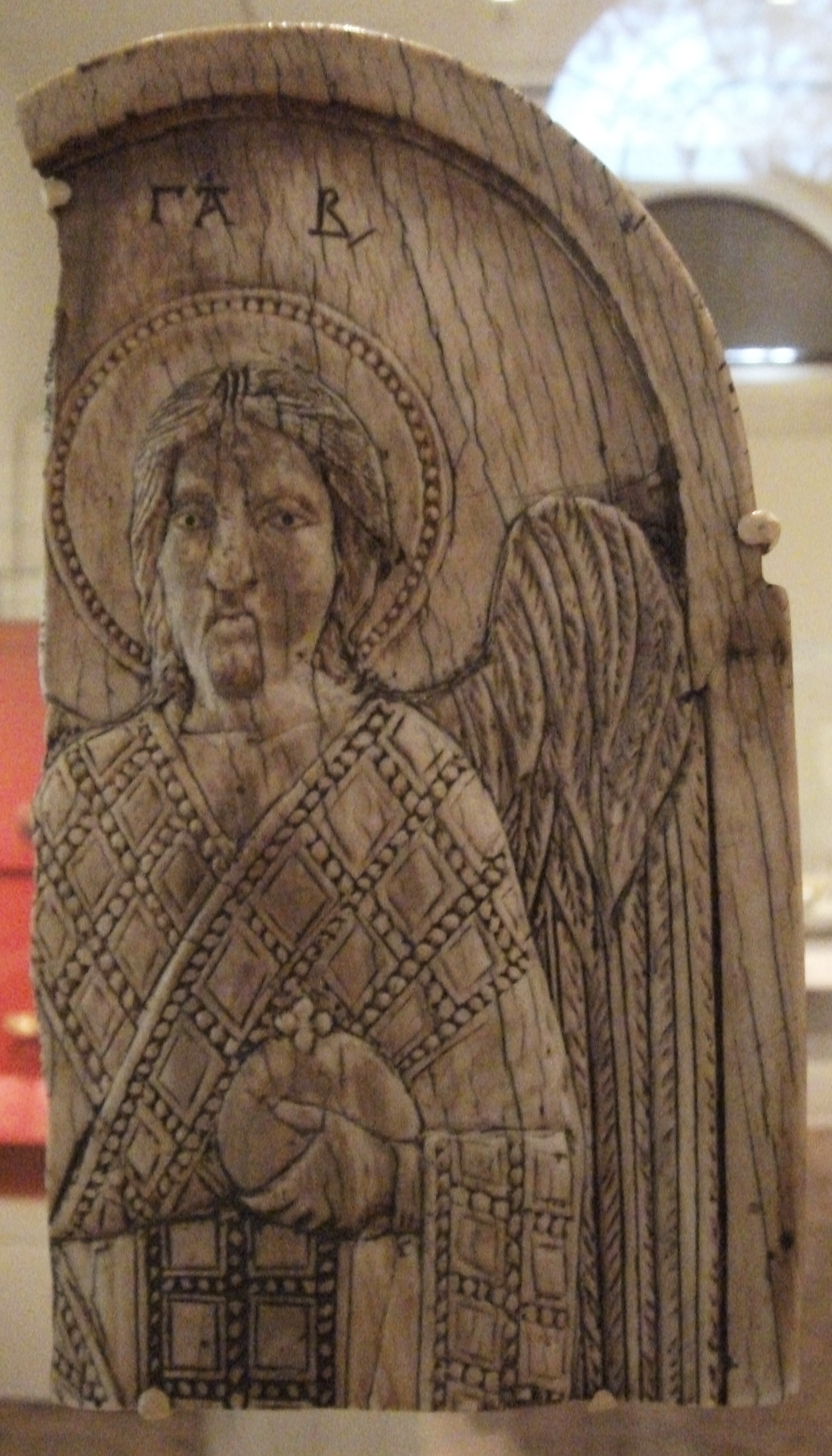
The Archangel Ivory (early 6th century AD, British Museum, London, inv. 1856,0623.1) is a diptych leaf in elephant ivory representing the Archangel Michael in full frontal hieratic pose, measuring approximately 42 × 14 cm. Carved in high relief with exceptional technical mastery, it belongs to a tradition of Constantinopolitan court workshops active under the early Justinianic dynasty, likely produced between circa 520 and 540 AD. The archangel stands within an elaborate classical architectural frame of acanthus-crowned columns supporting a shell-topped niche, a composition rooted in late antique apotheosis imagery repurposed for Christian angelology. Michael is rendered in the guise of an imperial dignitary: he wears a loros-derived chlamys, holds an orb surmounted by a cross in his left hand, and extends a scepter in his right, asserting his role as heavenly strategist and divine messenger. The inscription fragment at the top reads 'Receive these gifts and having learned the cause,' implying a dedicatory function, possibly as a diplomatic or liturgical presentation piece. The missing lower panel presumably depicted the recipient. Scholarly consensus situates the work within Constantinopolitan imperial workshops, and it is frequently compared to the Barberini Ivory in the Louvre for compositional grammar. The medium field has been corrected to 'icon' as the entry erroneously classified this carved ivory panel as manuscript; it functions as a devotional object analogous to panel icons in theological program. The piece is foundational for understanding the convergence of imperial and celestial iconography in pre-Iconoclast Byzantine art. Sources: Cutler, A., The Craft of Ivory (1985); Weitzmann, K., Age of Spirituality catalogue (Metropolitan Museum, 1979); Byzantium 330–1453, Royal Academy exhibition catalogue (2008).