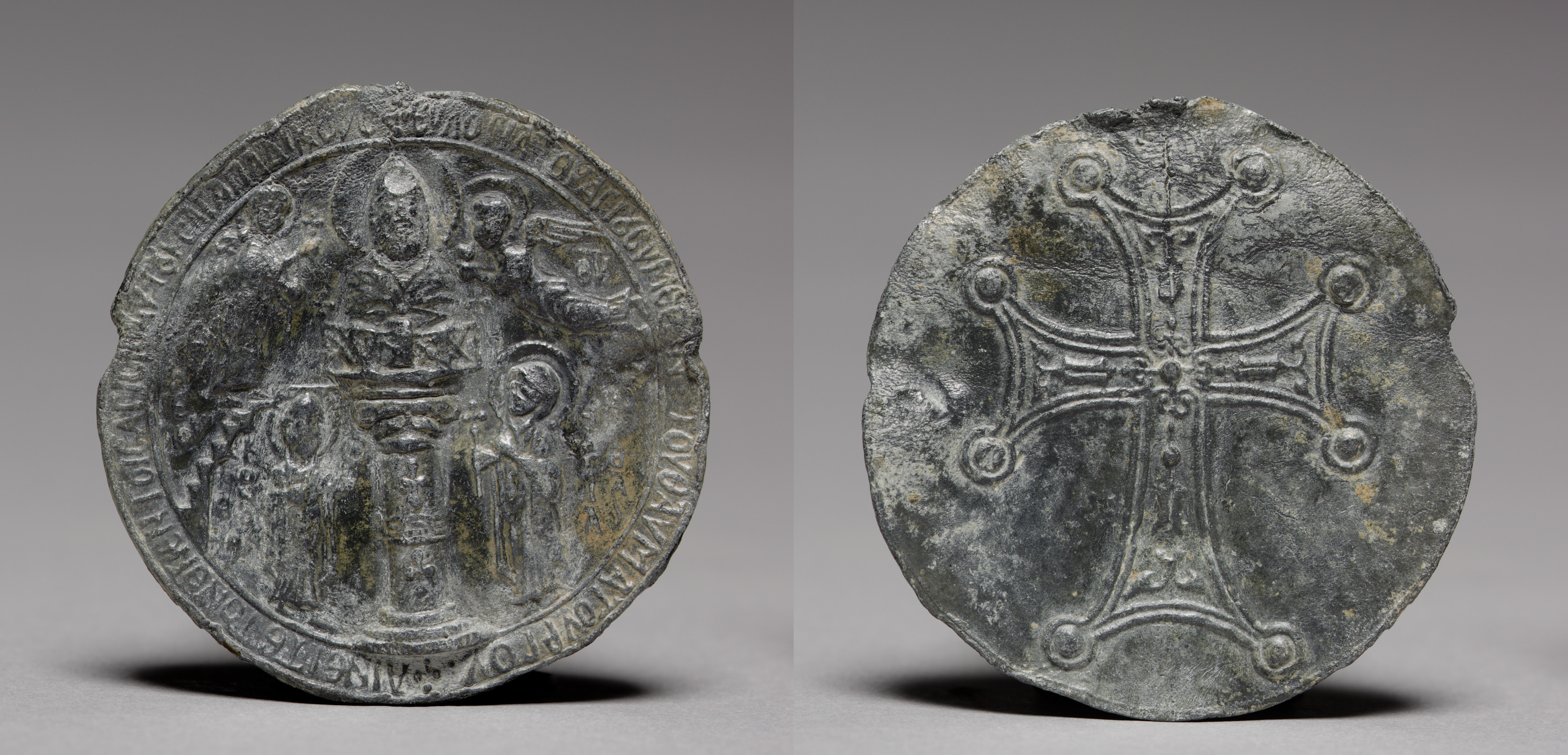
Pilgrim's Medallion with Saint Symeon the Younger
Doctrinal reflection
This lead pilgrim's medallion depicting Saint Symeon the Younger Stylites dates to approximately AD 1100 and originates from Byzantine Syria, likely produced at or near the sanctuary of Symeon on the Mons Admirabilis south of Antioch, where the saint lived atop his column from c. AD 521 until his death in AD 592. The Cleveland Museum of Art preserves this object as a representative example of the eulogia tradition—mass-produced devotional tokens distributed at or near sacred sites as portable blessings and apotropaic objects. The medallion belongs to a well-attested typological series depicting Symeon in the canonical orant or bust posture elevated upon a columnar plinth, occasionally flanked by supplicants or serpents, imagery that encodes his spiritual authority over demonic forces and his intercessory function. Iconographically, the column motif serves as both biographical fact and theological symbol: elevation above the earthly plane visualizes anachoretic transcendence and angelic approximation, a program elaborated in Syriac hagiographical literature including the Vita written by Nikephoros of Antioch. The medium—cast lead—reflects the industrial-scale production characteristic of Syrian pilgrimage economies from the fifth century onward, analogous to the Menas ampullae of Egypt and the Simeon the Elder tokens at Qal'at Sim'an. Scholarly attention has focused on the medallion's dual function as souvenir and phylactery, situating it within broader discussions of materiality and sacred contact in Byzantine devotional practice. The piece is securely placed in the middle Byzantine period by stylistic typology and regional production context. Sources: Byzantinische Zeitschrift; Dumbarton Oaks Papers; Journal of Roman Archaeology.