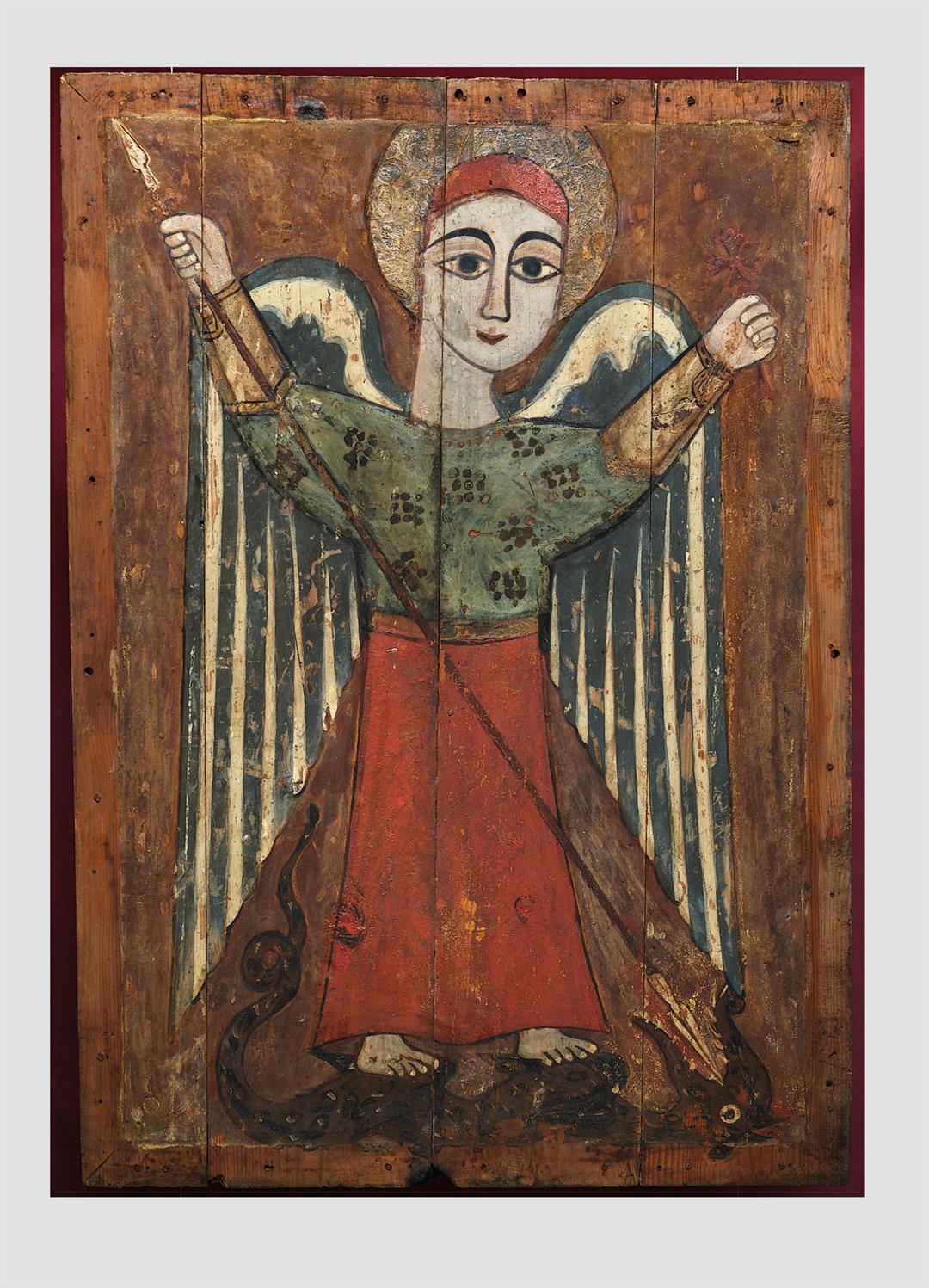
The Archangel Michael (Coptic Icon)
Doctrinal reflection
This Coptic icon of the Archangel Michael, held in the Byzantine and Christian Museum in Athens, belongs to the post-Byzantine phase of Coptic devotional painting, a tradition that preserved distinctively Egyptian Christian aesthetics long after the Arab conquest of Egypt in the seventh century AD and continuing well into the eighteenth and nineteenth centuries AD. The work depicts Michael in his capacity as warrior-champion of the heavenly host, shown in frontal hieratic stance with the serpent prostrate beneath his feet—an iconographic program rooted in the Revelation 12 narrative of the celestial battle and reinforced by the Danielic tradition of Michael as protector of God's people. Stylistically, the panel exemplifies the Coptic pictorial idiom: enlarged frontal eyes conveying spiritual intensity, flattened modeling of drapery rendered in bold unmodulated color zones, and a suppression of illusionistic depth in favor of symbolic presence. These features diverge markedly from middle and late Byzantine workshop conventions, reflecting instead a local tradition continuous with late-antique Nilotic painting. Michael's armor and lance or sword identify him with the warrior-angel typology also operative in Byzantine military icons, yet the Coptic hand transforms that shared iconography through its own formal vocabulary. The panel's presence in Athens suggests its acquisition or transfer during the modern period, when Coptic objects entered European and eastern Mediterranean collections. Scholarly assessment of post-Byzantine Coptic icons must balance questions of chronology, workshop provenance, and the persistence of autochthonous Egyptian Christian aesthetics against broader Chalcedonian artistic currents. Sources: Delacampagne & Hirmer, 'Icons'; Gabra & Eaton-Krauss, 'The Illustrated Guide to the Coptic Museum and Churches of Old Cairo'; Cormack, 'Byzantine Art' (Oxford).