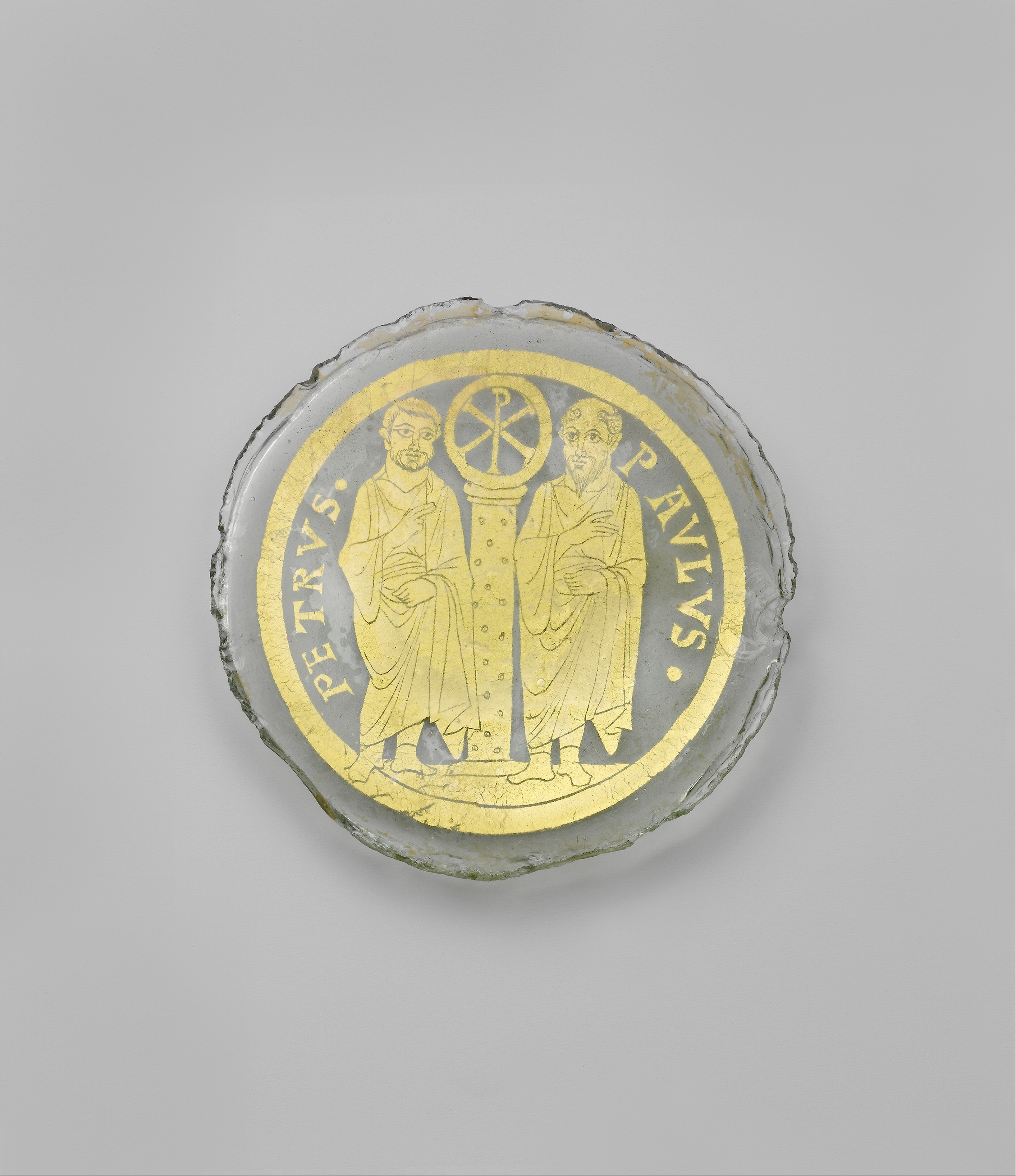
Bowl Base with Saints Peter and Paul Flanking a Column with the Christogram of Christ
Doctrinal reflection
This object is a fondi d'oro (gold-glass base), a Late Antique technique in which gold leaf imagery is sandwiched between two fused layers of glass. Dated to the late fourth century AD, it belongs to a well-attested corpus of Roman and early Byzantine gold-glass roundels, most densely concentrated in the catacombal and funerary contexts of Rome and its environs. The Metropolitan Museum of Art preserves this example as part of its Medieval Art holdings, acquired through the Rogers Fund in 1916. The composition presents the Apostles Peter and Paul in frontal or near-frontal poses flanking a column surmounted by the Christogram—the Chi-Rho monogram (☧), which gained imperial sanction following Constantine I's adoption of the symbol in the early fourth century AD. By the later fourth century the Christogram had become a standard emblem of Christological sovereignty in both public and private devotional contexts. The pairing of Peter and Paul as co-princes of the Apostolate (principes apostolorum) is a recurrent formula in Roman Christian iconography and carries ecclesiological weight affirming the authority of the Roman see. The column functions as an axis mundi or a surrogate for the cross, elevating the Christogram between the two foundational apostolic figures. Technically, the gold-leaf design was incised and then protected by fusing a second glass layer over it—a process associated primarily with Rome between the third and fifth centuries AD. Such objects were frequently embedded in catacomb wall-seals or used as eucharistic and commemorative vessels. This piece contributes to scholarship on transitional early Christian iconographic programs bridging pagan Roman and Byzantine visual theology. Sources: Grig, L., in Journal of Early Christian Studies; Whitehouse, D., Roman Glass in the Corning Museum of Glass; Morey, C.R., The Gold-Glass Collection of the Vatican Library.