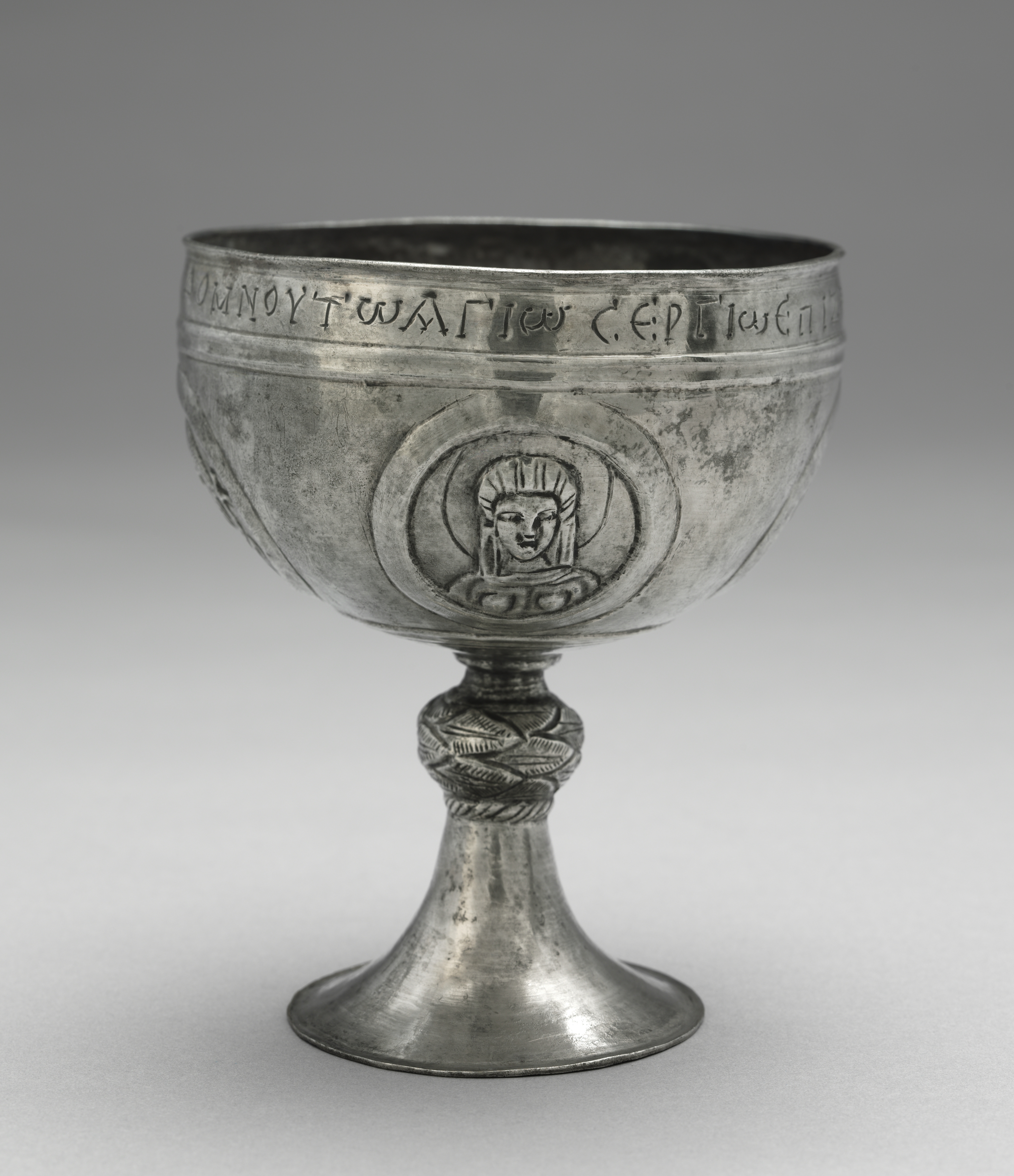
Chalice from the Beth Misona Treasure
Doctrinal reflection
The Beth Misona Treasure comprises four liturgical silver vessels—one paten and three chalices (Cleveland Museum of Art, acc. nos. 1950.378–81)—originating from the church of Saint Sergios in Beth Misona, a village in northern Syria. Dated broadly to the sixth or seventh century AD on stylistic and technical grounds, the group belongs to a well-documented category of Early Byzantine ecclesiastical silver hoards from Syria and Palestine, including the Kaper Koraon and Stuma treasures. The objects were most likely buried to conceal them from Persian or Arab incursions during the first half of the seventh century AD, a pattern paralleled across the region. The paten bears an engraved Latin cross at its center surrounded by a dedicatory inscription identifying the donor as Domnos and specifying its liturgical function within the church of Saint Sergios—a martyr whose cult was particularly vigorous in northern Syria. The chalices, designed to hold consecrated wine during the Eucharist, reflect the standard workshop conventions of provincial Byzantine silversmithing: plain or lightly ornamented bowls on spreading feet with dedicatory or apotropaic inscriptions. The treasure's theological program is fundamentally Eucharistic, directly materializing the sacrificial and communal dimensions of the liturgy. Scholarly attention to such hoards has centered on workshop attribution (Constantinople versus Syrian provincial centers), hallmarking practices under imperial control, and the social history of rural Christian patronage. The inscription naming a lay donor underscores the role of individual benefaction in equipping provincial churches. Sources: Mango, M. M., Silver from Early Byzantium (Walters Art Gallery, 1986); Boyd, S. A., and Mango, M. M., eds., Ecclesiastical Silver Plate in Sixth-Century Byzantium (Dumbarton Oaks, 1992).