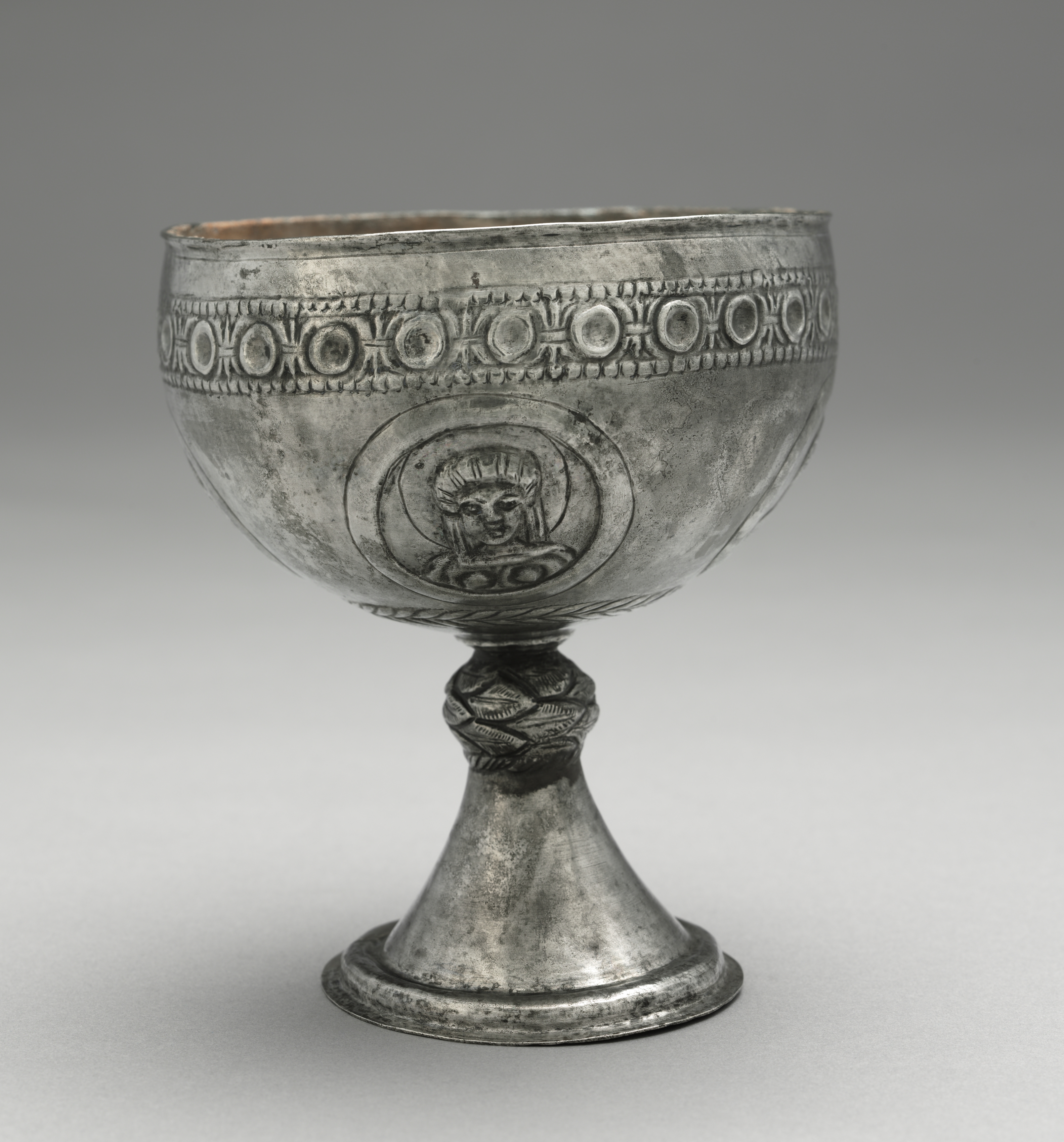
Chalice from the Beth Misona Treasure
Doctrinal reflection
The Beth Misona Treasure, housed at the Cleveland Museum of Art (accession nos. 1950.378–81), comprises four liturgical silver vessels—one paten and three chalices—datable on stylistic and technical grounds to the sixth or seventh century AD and assignable broadly to a Syrian or Constantinopolitan workshop. The treasure takes its name from Beth Misona, a Christian village in northern Syria, and the paten's dedicatory inscription explicitly names the donor Domnos and identifies the original liturgical context as the church of Saint Sergios in that community. The burial of the ensemble is most plausibly explained by the Persian campaigns of the early seventh century AD or the subsequent Arab conquests of the 630s AD, a pattern well documented across the so-called 'Syrian silver treasures.' The chalices are undecorated save for standard formal articulation—flaring foot-rings, knobbed stems, and hemispherical cups—consistent with Eucharistic vessels attested in Syrian hoards such as the Kaper Koraon and Riha treasures. The paten bears an engraved Latin cross within a circular inscription field, a decorative program that subordinates ornament to liturgical function and reflects the theological centrality of the Eucharistic sacrifice in late antique Syrian Christian practice. The treasure's significance lies in its epigraphic documentation of donor piety, parish-level liturgical patronage, and the manufacture of church silver outside the imperial capital, contributing to ongoing debates about regional versus metropolitan workshop traditions in early Byzantine metalwork. Sources: Dumbarton Oaks Papers; Journal of Roman Archaeology; M. Mundell Mango, Silver from Early Byzantium (1986).