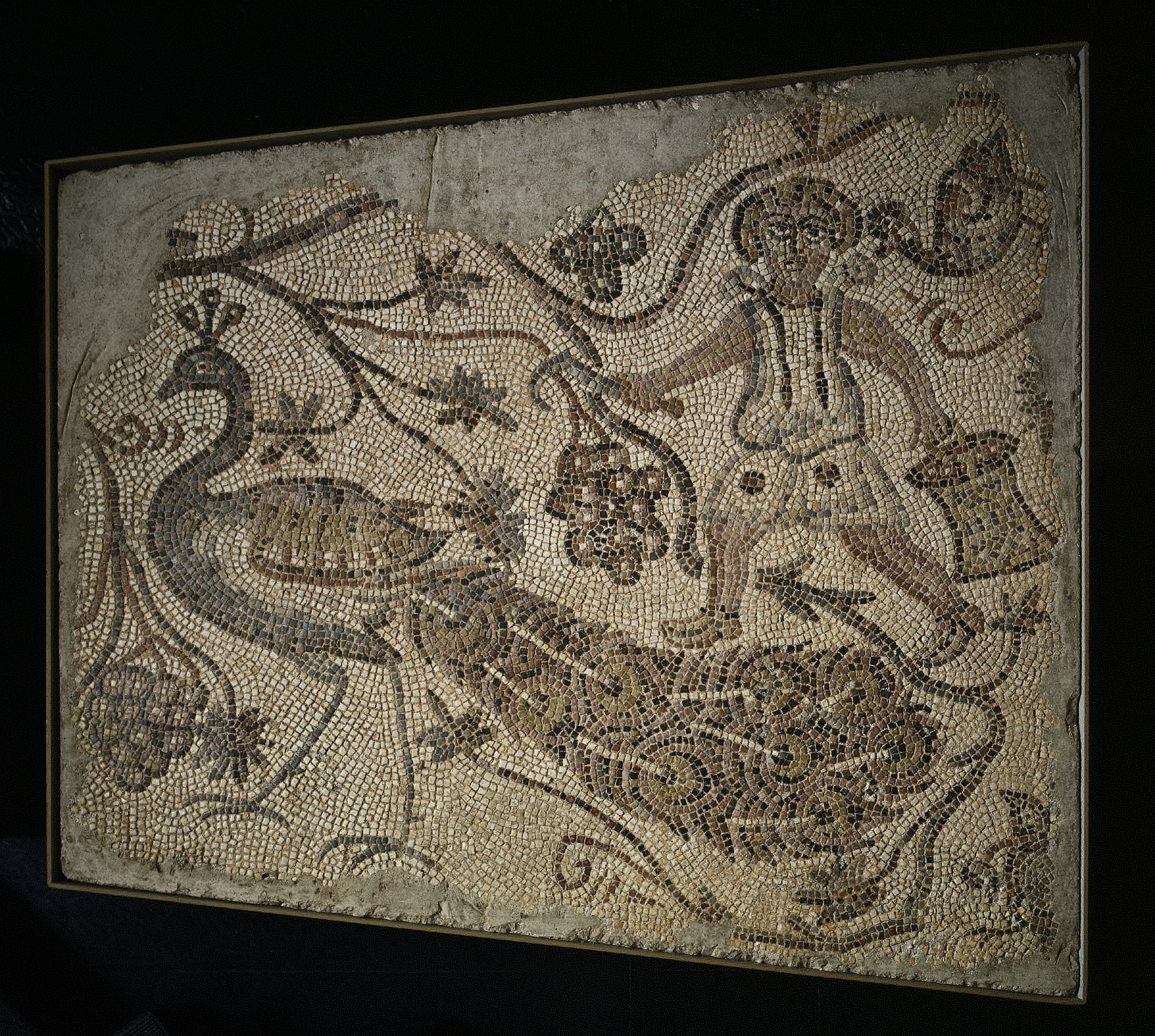
Floor Mosaic Panel: Grape Harvester with Peacock
Doctrinal reflection
This floor mosaic panel, dated to the fifth century AD and attributed to northern Syria—possibly the church site of Maaut El-Naaman—belongs to a pavement ensemble that likely decorated the nave or narthex of an early Christian basilica. Executed in marble tesserae, the panel depicts a grape harvester accompanied by a peacock, two motifs whose symbolic registers were well-established in late antique Christian iconography by this period. The harvesting of grapes carried explicit Eucharistic resonance: the vine and its fruit served as visual shorthand for the blood of Christ shed in the sacramental cup, drawing on the Johannine discourse of the True Vine (John 15:1–5) and its amplification in early liturgical theology. The peacock, whose flesh was believed in antiquity to resist decay, functioned as a standard emblem of immortality and bodily resurrection, a meaning consolidated in patristic writing by Augustine and others. Together these figures articulate a coherent soteriological program appropriate to a liturgical floor context, where the faithful would literally tread upon imagery encoding the promise of salvation. The companion panel depicting Adam and Eve with its Greek inscription from Genesis 3:7–8 suggests the broader pavement operated typologically, juxtaposing the Fall with the redemptive economy figured through the vine and resurrection symbolism. Northern Syrian ecclesiastical mosaic pavements of the fifth century AD, including those documented at sites such as Apamea and Antioch, provide close comparanda for both the figural style and the thematic organization seen here. The Cleveland panel is consequently significant for reconstructing provincial workshop practice and theological program in early Byzantine Syria. Sources: Dumbarton Oaks Papers; Journal of Early Christian Studies; Bulletin of the Cleveland Museum of Art.