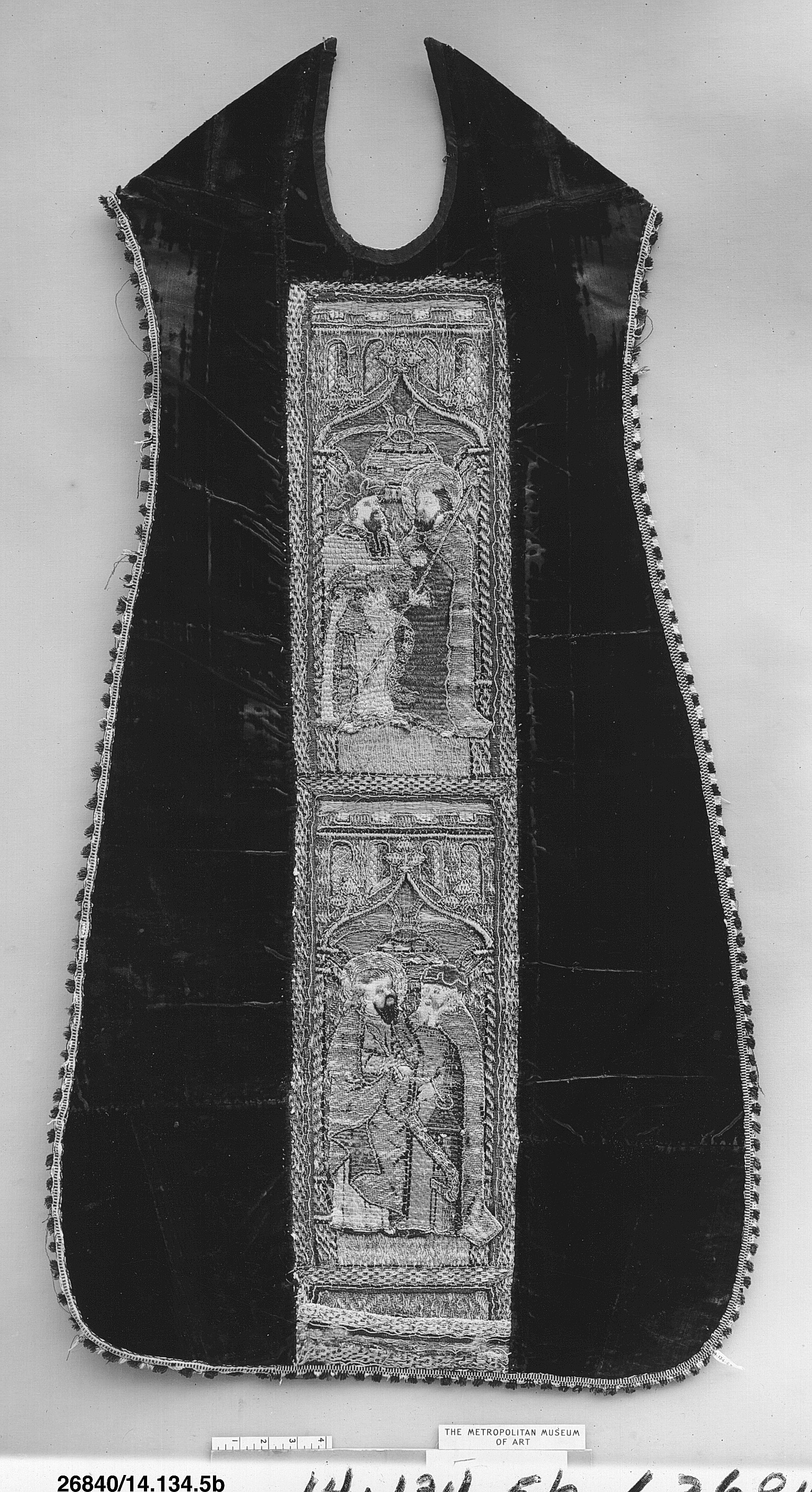
Chasuble with Virgin and Child, Apostles and Prophets
Doctrinal reflection
This fifteenth-century French chasuble, held in the Medieval Art collection of the Metropolitan Museum of Art (acquired via the Frederick C. Hewitt Fund, 1914), represents a significant example of late medieval ecclesiastical embroidery rather than strictly Byzantine pictorial art; however, its iconographic program—the Virgin and Child flanked by Apostles and Prophets—participates directly in the visual theological vocabulary shared between Western and Byzantine devotional traditions during the Palaiologan period. Executed in velvet, silk, and gold thread (likely opus anglicanum or its French cognate tradition), the work deploys hierarchical figural registers that mirror the deësis and prophetic typology common to Byzantine apse programs. The Virgin and Child motif at the compositional center enacts the Theotokos theology formalized at Ephesus (431 AD), while the surrounding Apostles and Prophets articulate a typological framework linking Old Testament anticipation to New Testament fulfillment. The gold-thread ground (likely or-nué technique) approximates the luminous gold tesserae of Byzantine mosaics, suggesting deliberate aesthetic alignment with Eastern sacral conventions. Apostolic figures would conventionally carry books or scrolls, and prophetic figures their identifying attributes or scroll-borne inscriptions. Scholarly interest centers on the garment's liturgical function—the chasuble worn during the Mass—and the theological semiotics of clothing the celebrant within this compressed ecclesiological image. The work thus conflates vestment as sacred object with vestment as theological text. Sources: Meredith Gill, ed., The Bishop Reformed (Ashgate, 2004); Migne, Patrologia Latina (liturgical commentary tradition); Kay Staniland, Embroiderers (British Museum Press, 1991).