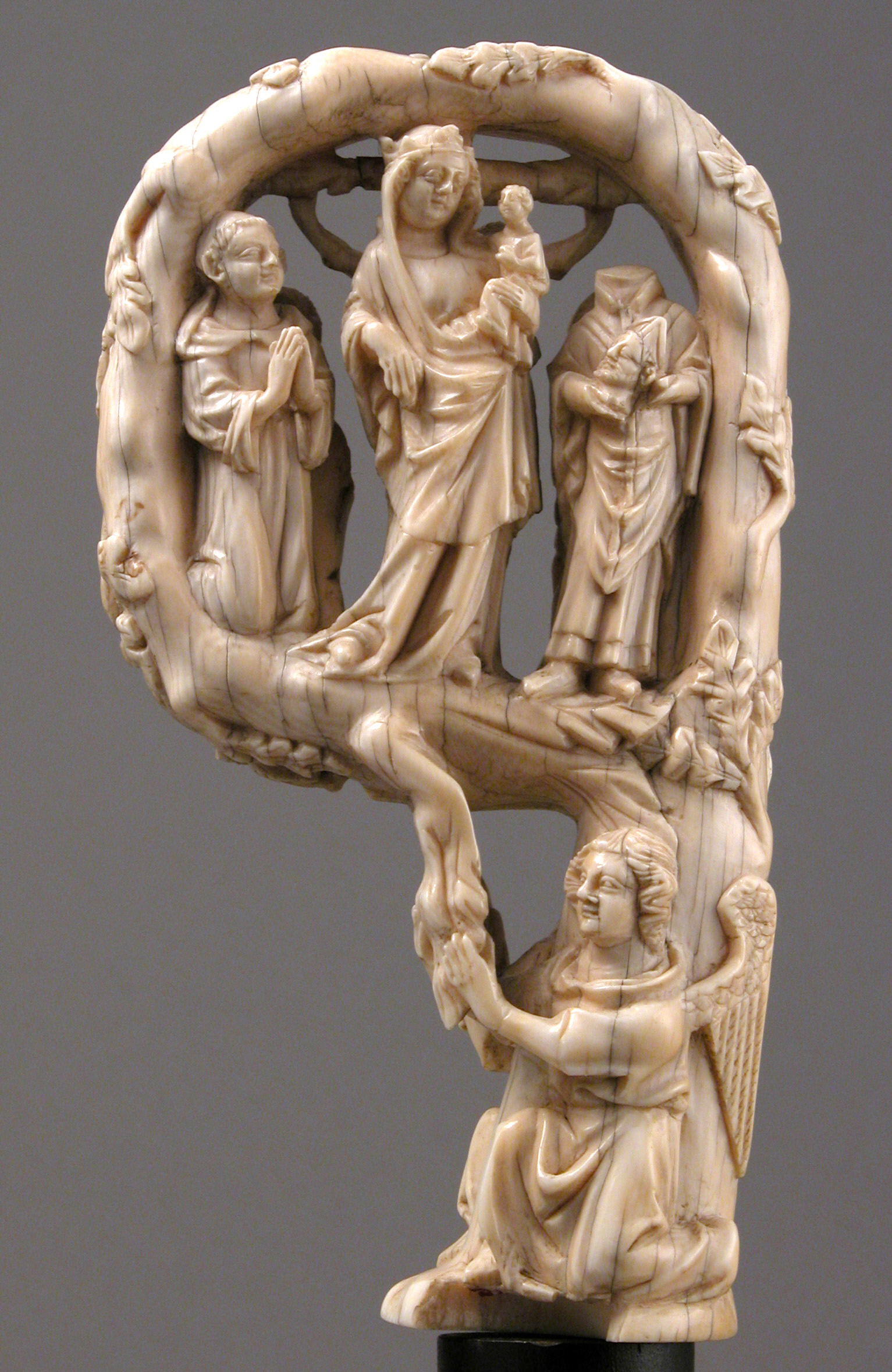
Crozier Head with Crucifixion, Virgin and Child, and Saint Denis
Doctrinal reflection
This French ivory crozier head, dated to approximately AD 1350 and now in the Metropolitan Museum of Art (Gift of J. Pierpont Morgan, 1917), represents a compact but theologically layered program characteristic of high Gothic episcopal liturgical objects. Carved from elephant ivory, the volute form—standard for Western episcopal staves from the Carolingian period onward—houses three distinct devotional registers that together articulate the pastoral identity of a bishop's office. The Crucifixion scene, the primary christological image, depicts Christ on the cross in the elongated, expressive Gothic manner prevalent in mid-fourteenth-century French carving, evoking John 19:28-30. Flanking or subsidiary to this, the Virgin and Child (a Hodegetria-influenced Western variant) operates within the Marian intercessory theology that dominated Gothic episcopal art; the type is an art-historical category rooted in Ephesian conciliar tradition (AD 431) and is not a biblical designation. The inclusion of Saint Denis is significant: Dionysius of Paris, martyred traditionally in the third century AD on the hill of Montmartre, was the apostolic patron of the French crown and church, his cult centered at the royal abbey of Saint-Denis. His identity as a cephalophore—carrying his severed head—is a hagiographic tradition, not documented in Scripture; the identification with Dionysius the Areopagite (Acts 17:34) is a medieval fusion now rejected by scholarly consensus. The crozier's three-part program—redemption, mediatrix-type intercessor (understood here as art-historical label), and national apostolic patron—constitutes a coherent statement of French episcopal authority and devotional culture at the court Gothic moment. Ivory carving of this quality was concentrated in Parisian workshops. Sources: Randall, Images in Ivory (1993); Koechlin, Les ivoires gothiques français (1924); Williamson, Gothic Ivory Carving in England (2010).