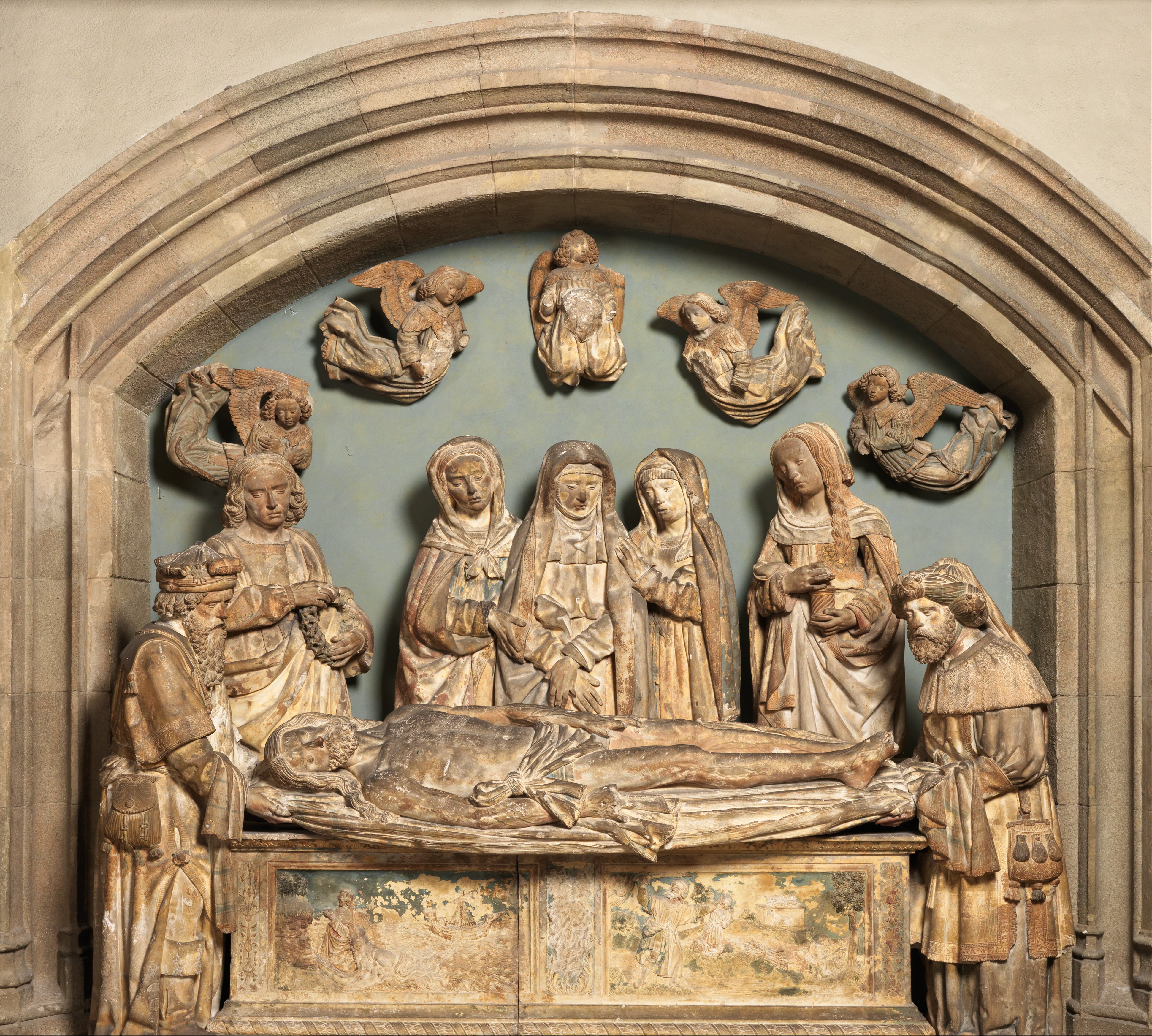
Entombment of Christ
Doctrinal reflection
This French limestone sculpture depicting the Entombment of Christ dates to approximately AD 1515 and belongs to the late medieval sculptural tradition known as the 'mise en tombeau' — a devotional ensemble type that proliferated across France from the late fifteenth century onward. The work retains traces of original polychromy, indicating that its visual impact depended substantially on painted surface articulation rather than stone alone. The Entombment scene is not a single narrative moment recorded in the four Gospels but a composite devotional construction: John 19:38–42 describes Joseph of Arimathea and Nicodemus preparing the body with spices and linen wrappings and laying it in a new tomb; the synoptics record the presence of several women, including Mary Magdalene (Matthew 27:61; Mark 15:47). The grouping typically arranged in French examples includes Joseph of Arimathea, Nicodemus, the Virgin Mary, Mary Magdalene, John the Evangelist, and additional holy women — a roster that blends Gospel testimony with medieval tradition. The Marian posture of lamentation draws on the Stabat Mater literary tradition and the broader Andachtsbild devotional image type rather than direct scriptural description. The iconographic program emphasizes the full humanity of the dead Christ against Chalcedonian Christology (AD 451), which insisted on two natures. The Met acquired the work through the J. Pierpont Morgan gift of 1916. French regional limestone Entombment groups of this period represent a significant chapter in late Gothic sculptural production, bridging Burgundian influence and emerging Renaissance classicism in figural articulation. Sources: Grodecki, Louis, et al., 'Gothic Art,' Abrams; Metropolitan Museum of Art Bulletin; Williamson, Paul, 'Gothic Sculpture 1140–1300,' Yale University Press.