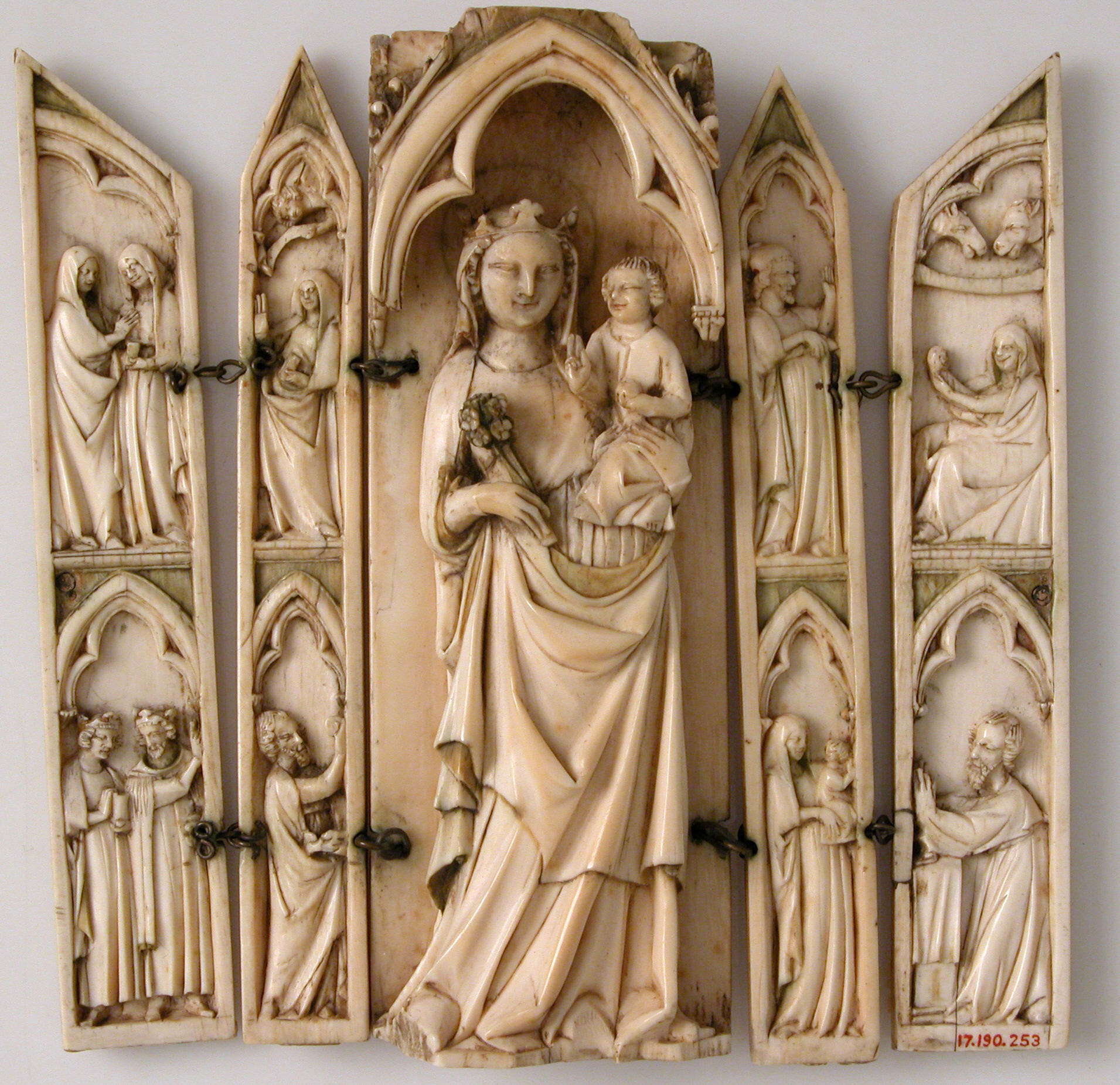
Folding Shrine with Virgin and Child
Doctrinal reflection
This portable folding shrine, fashioned from elephant ivory with traces of polychromy and original metal mounts, dates to fourteenth-century AD France and belongs to a flourishing Parisian or northern French workshop tradition that supplied elite devotional objects across Europe. The object's triptych or diptych format — wings folding over a central tableau — is characteristic of high Gothic private piety, enabling a lay owner to open and close a personal sacred space. The central image almost certainly presents Mary enthroned or standing with the Christ child, a compositional type the medieval West rendered through the theological category of Theotokos ('God-bearer'), a title formalized at the Council of Ephesus in AD 431 and here expressed in the visual idiom of Gothic court style: elongated S-curve posture, refined drapery, and aristocratic tenderness between mother and child. That Theotokos formulation is conciliar doctrine, not a biblical category; the artwork embodies it as devotional program, not scriptural claim. Wing panels in such shrines typically carry attendant figures — angels, apostles, or narrative scenes from the infancy cycle — some drawn from the apocryphal Protoevangelium of James, which medieval iconographic tradition treated as authoritative though it carries no canonical standing. The polychromy, now fragmentary, would have animated the figures with gold, blue, and red, intensifying the object's function within a culture of icon-veneration documented as historical practice. The Morgan provenance places this piece among the great early twentieth-century acquisitions that anchored the Met's medieval holdings. Ivory carving of this quality reflects the consolidation of secular and ecclesiastical patronage in Gothic France. Sources: Danielle Gaborit-Chopin, Ivoires médiévaux (Réunion des musées nationaux); Peter Barnet, ed., Images in Ivory (Detroit Institute of Arts, 1997); Koechlin, Les ivoires gothiques français (1924).