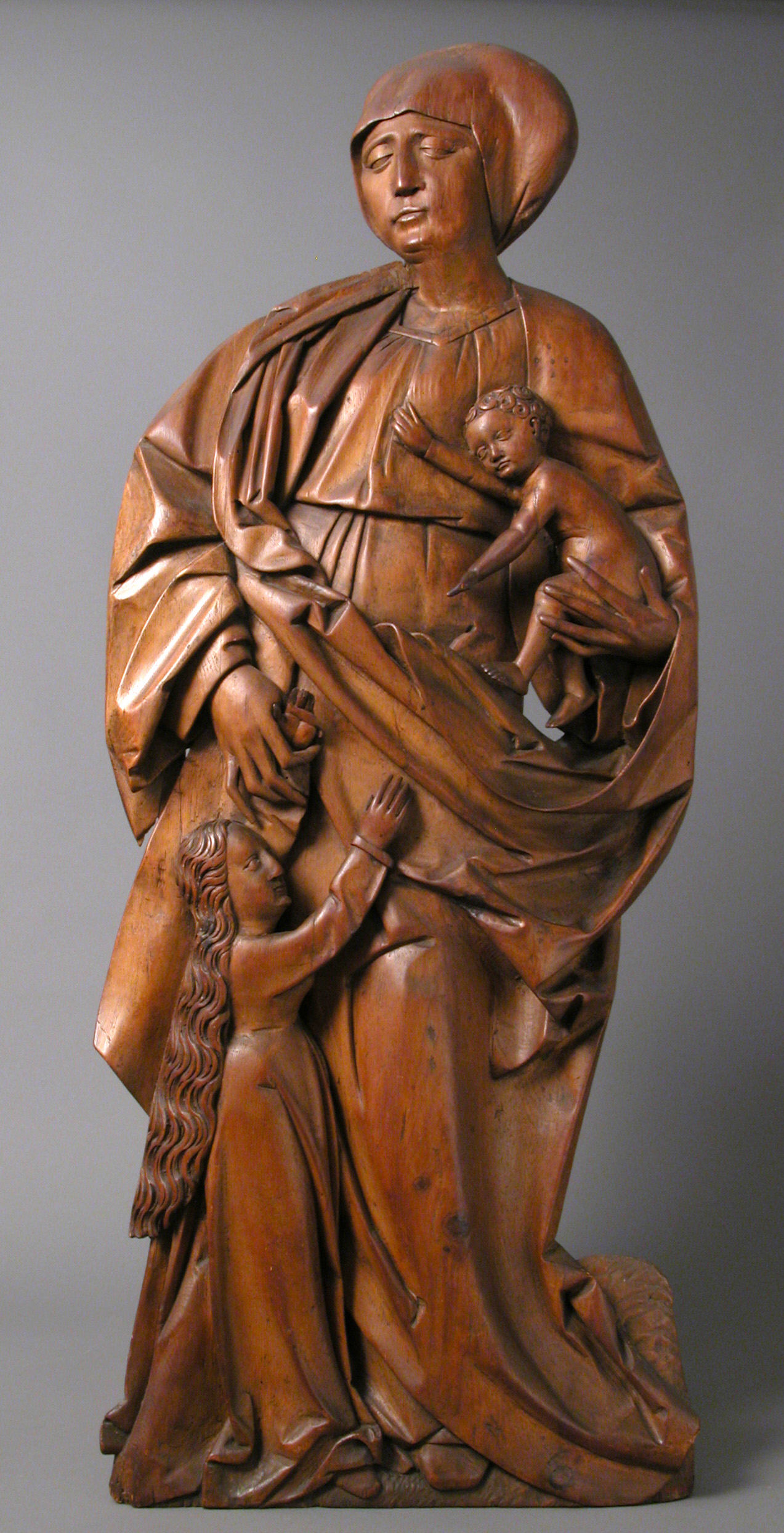
Saint Anne with the Virgin and Child
Doctrinal reflection
This limewood relief, dated to approximately AD 1520 and attributed to a German workshop, depicts the devotional grouping known as the Anna Selbdritt — a compositional type that presents Anne, Mary, and the Christ Child as a unified trio. The type enjoyed extraordinary popularity in late medieval Germany, reaching its peak roughly between AD 1470 and AD 1530, before Reformation critiques sharply curtailed it. Technically, the work exemplifies the refined wood-carving tradition of southern Germany, where limewood (Tilia) was the preferred medium for its fine, even grain, allowing virtuosic undercutting and naturalistic drapery. The theological program embedded in the Anna Selbdritt is layered and historically specific: it visualizes the doctrine of the Immaculate Conception — a disputed scholastic position, not a biblical teaching — by tracing the sanctified lineage through which Christ entered humanity. Anne herself is not named in any canonical Scripture; her figure derives entirely from the second-century apocryphal Protoevangelium of James, which Gospel Life Ministries notes must never be conflated with the biblical record. The cult of Anne expanded dramatically in the fifteenth century, receiving formal liturgical sanction and drawing figures such as Martin Luther (who took a vow to Saint Anne in AD 1505) before his break with that tradition. Iconographically, Anne is typically the largest figure, cradling or supervising Mary, who in turn holds or tends the Christ Child, staging a visual hierarchy of sacred generation. Scholarly analysis focuses on workshop attribution, patronage context within late Gothic German piety, and the relief's relationship to contemporary prints circulating through the Dürer network. Sources: Sixten Ringbom, 'Icon to Narrative' (1965); Jeffrey Hamburger, 'The Visual and the Visionary' (1998); Metropolitan Museum of Art Bulletin.