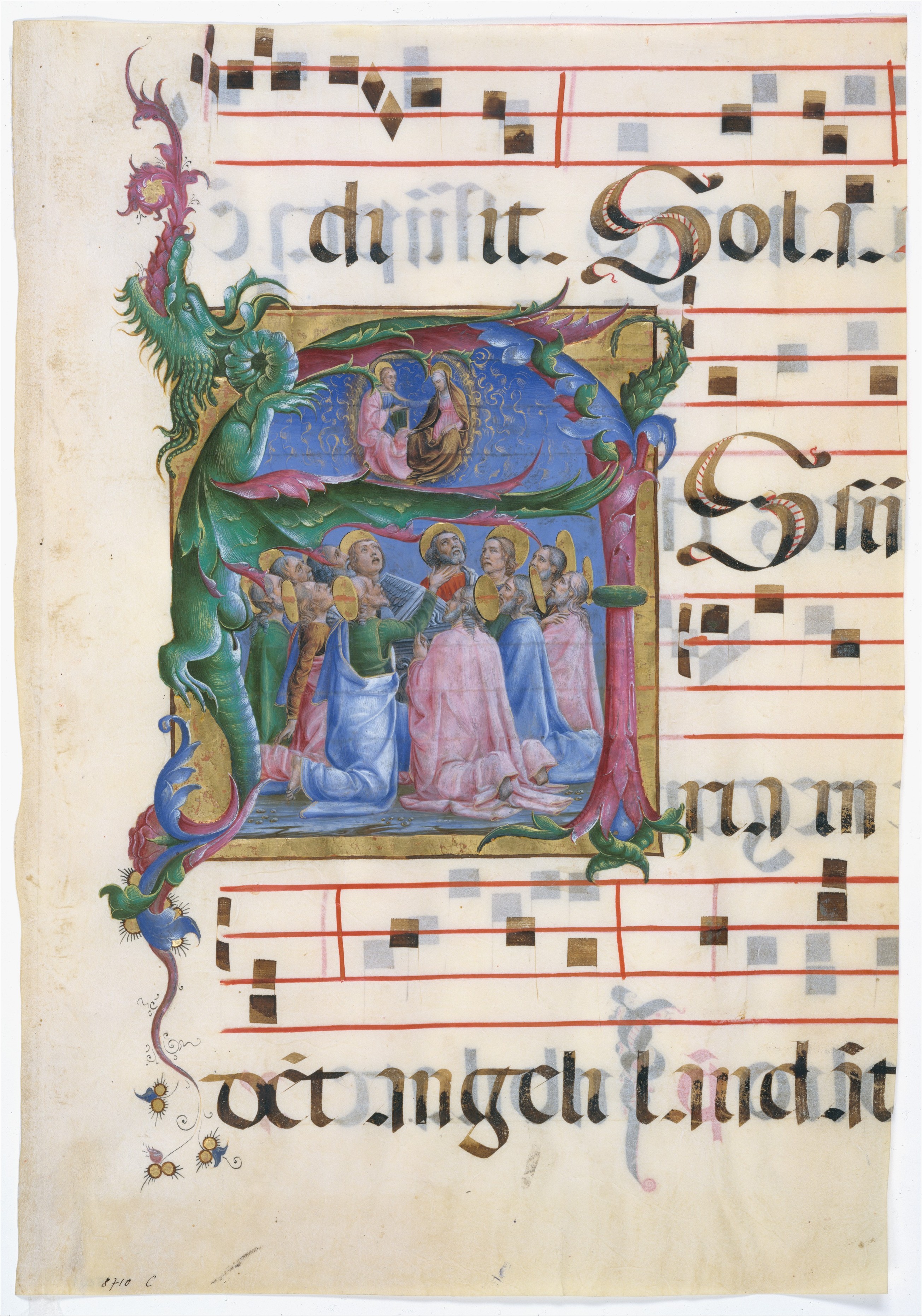
Manuscript Illumination with the Assumption of the Virgin in an Initial A, from an Antiphonary
Doctrinal reflection
This manuscript cutting presents an illuminated initial 'A' enclosing a depiction of the Assumption of the Virgin, excised from an antiphonary produced in Italy between approximately 1450 and 1460 AD. The work is executed in tempera, ink, and gold on parchment, situating it within the refined tradition of Italian late-medieval choir book illumination. Antiphonaries containing the liturgical chants for the feast of the Assumption (August 15) frequently opened relevant sections with historiated initials illustrating the feast's central mystery. The initial 'A' almost certainly introduced the antiphon 'Assumpta est Maria in caelum,' the incipit of the Office for the feast. Iconographically, the Assumption scene would conventionally depict the Virgin in mandorla form, elevated by angels, sometimes with the apostles below gesturing upward toward the empty tomb—a compositional formula consolidated in Italian illumination through Florentine, Sienese, and Lombard workshops throughout the Trecento and Quattrocento. The use of burnished gold leaf enhances the hieratic luminosity appropriate to a liturgical object intended for communal choir use. The cutting's provenance within the Metropolitan Museum's collection (Rogers Fund, 1911) reflects the widespread dispersal of Italian choirbooks in the nineteenth and early twentieth centuries as collectors and institutions acquired individual cuttings of art-historical value. While technically Italian rather than strictly Byzantine, the Marian theological program—affirming the bodily glorification of the Theotokos—shares iconographic ancestry with Byzantine Koimesis tradition, though the Western Assumption differs doctrinally and compositionally. Scholarly assessment places this work within the broader corpus of mid-fifteenth-century Italian antiphonary illumination. Sources: Speculum; The Burlington Magazine; Metropolitan Museum Journal.