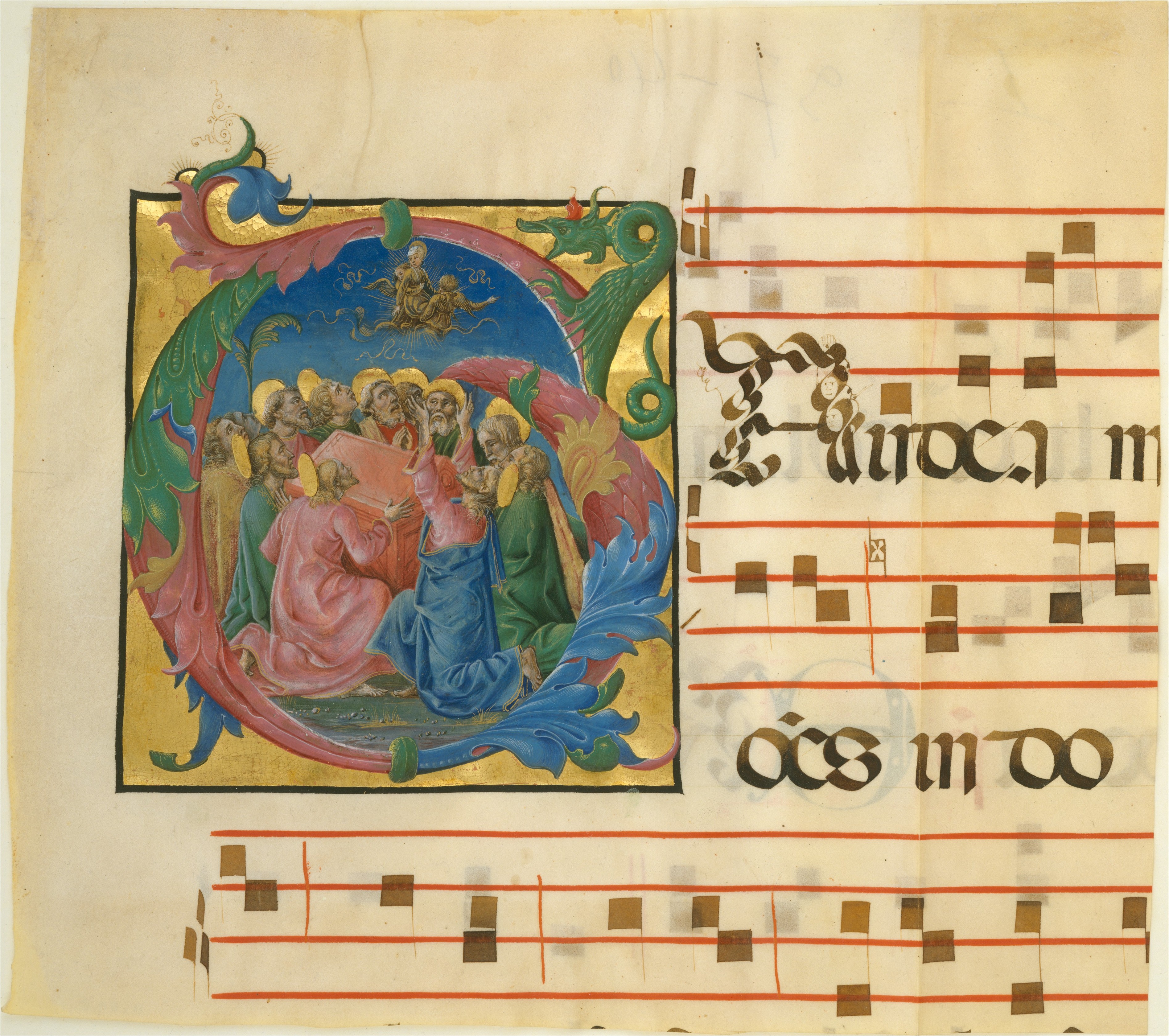
Manuscript Illumination with the Assumption of the Virgin in an Initial G, from a Gradual
Doctrinal reflection
This manuscript cutting presents the Assumption of the Virgin set within a historiated initial 'G,' excised from a Gradual produced in Italy between 1450 and 1460 AD. The letter G almost certainly introduced the introit 'Gaudeamus omnes in Domino,' the proper chant for Marian feasts including the Assumption (August 15), situating the image firmly within the liturgical calendar of the Latin rite. Executed in tempera, ink, and gold on parchment, the cutting exemplifies the sophisticated Italian manuscript illumination of the mid-fifteenth century AD, a period when Humanist patronage and Northern European influence jointly transformed the decorative and figurative conventions of the medium. The Assumption itself—depicting Mary carried heavenward, typically supported by angels and surrounded by a mandorla—draws on the apocryphal Transitus Mariae tradition rather than any single canonical text, though it is typologically anchored in imagery evocative of Revelation 12 and Psalm 45. The gold ground and delicate tempera modeling suggest production in a northern Italian center, possibly Lombardy or the Veneto, where workshops produced large-format choirbooks for ecclesiastical patrons. The cutting's survival as an isolated leaf reflects the widespread dispersal of Italian choir books from the late eighteenth century onward, complicating precise localization and attribution. Iconographically, the mandorla-framed Virgin in glory prefigures the formal definition of the dogma (1950 AD) but had long been established in Italian visual culture. The Rogers Fund acquisition of 1911 places the work among the Metropolitan Museum's foundational medieval holdings. Sources: Speculum; Arte Medievale; Metropolitan Museum Journal.