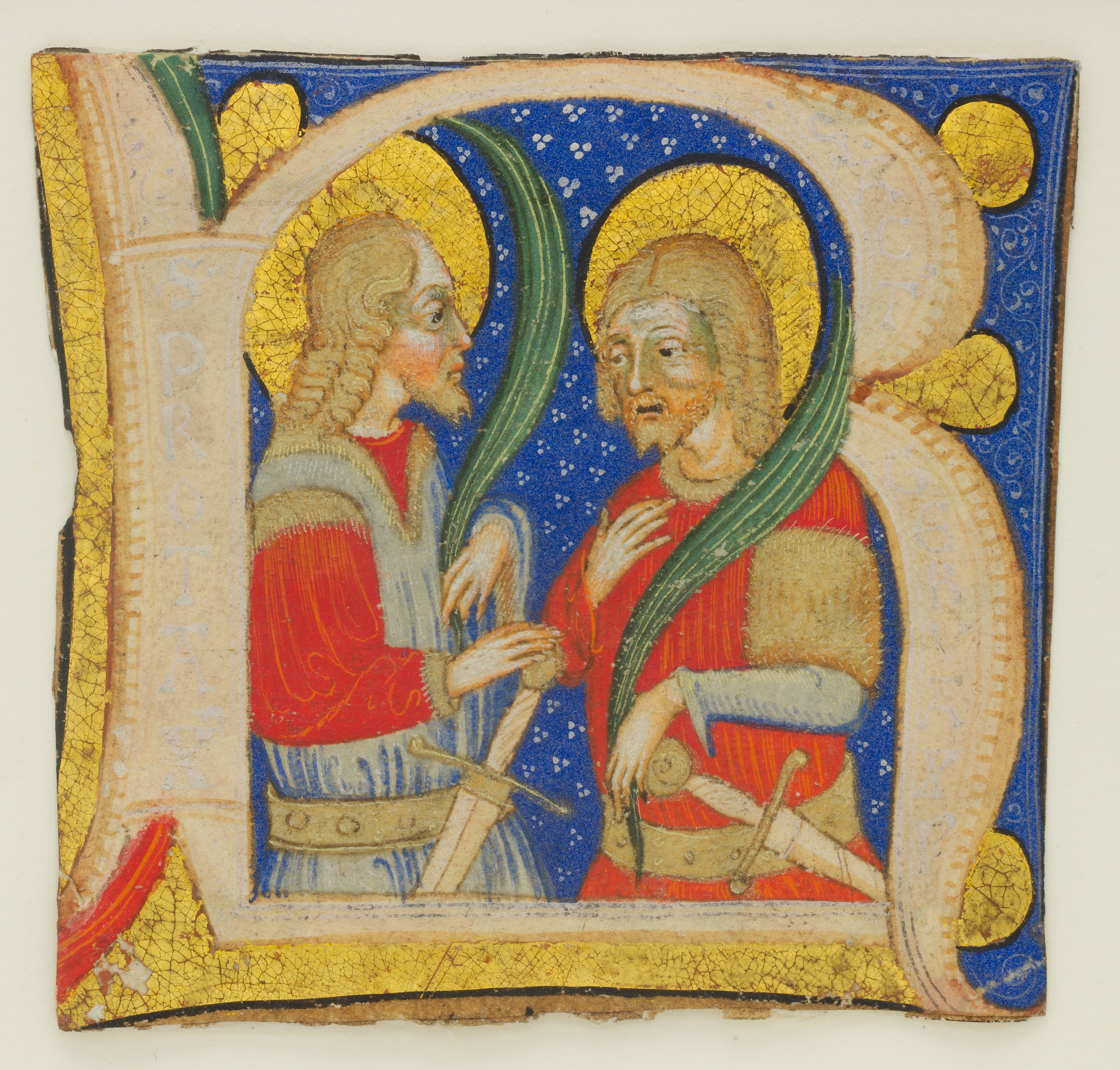
Manuscript Leaf Cutting showing an Illuminated Initial R with St. Protasius and St. Gervasius
Doctrinal reflection
This manuscript leaf cutting, preserved in the Medieval Art collection of the Metropolitan Museum of Art (Gift of Bashford Dean, 1923), represents a mid-15th-century Italian illuminated initial R, likely excised from a breviary. Executed in tempera, gold, and ink on parchment, the work depicts Saints Protasius and Gervasius, the Milanese proto-martyrs whose remains were famously discovered by Bishop Ambrose of Milan in AD 386—an event that significantly shaped Western hagiographic tradition. The illuminated initial format situates this cutting within the established Italian tradition of liturgical book decoration, wherein historiated initials integrated figural programs directly into the textual apparatus of the Divine Office. The choice of these particular saints suggests a possible Milanese or north Italian provenance, as Gervasius and Protasius held particular regional veneration in Lombardy. Stylistically, mid-15th-century Italian breviaries from this period reflect the transitional moment between International Gothic conventions and early Renaissance naturalism, visible in the refined figure treatment and burnished gold leaf ground typical of Lombard or Venetian ateliers. The cutting's removal from its original codex, a practice common among 19th- and early 20th-century collectors, obscures precise localization, though the medium and iconographic program align with north Italian workshop production. Bashford Dean's collection, better known for arms and armor, included select medieval objects now distributed across Metropolitan holdings. The entry represents the broader scholarly challenge of reconstructing dismembered manuscripts and reconstituting their liturgical and codicological contexts. Sources: Speculum: A Journal of Medieval Studies; The Burlington Magazine.