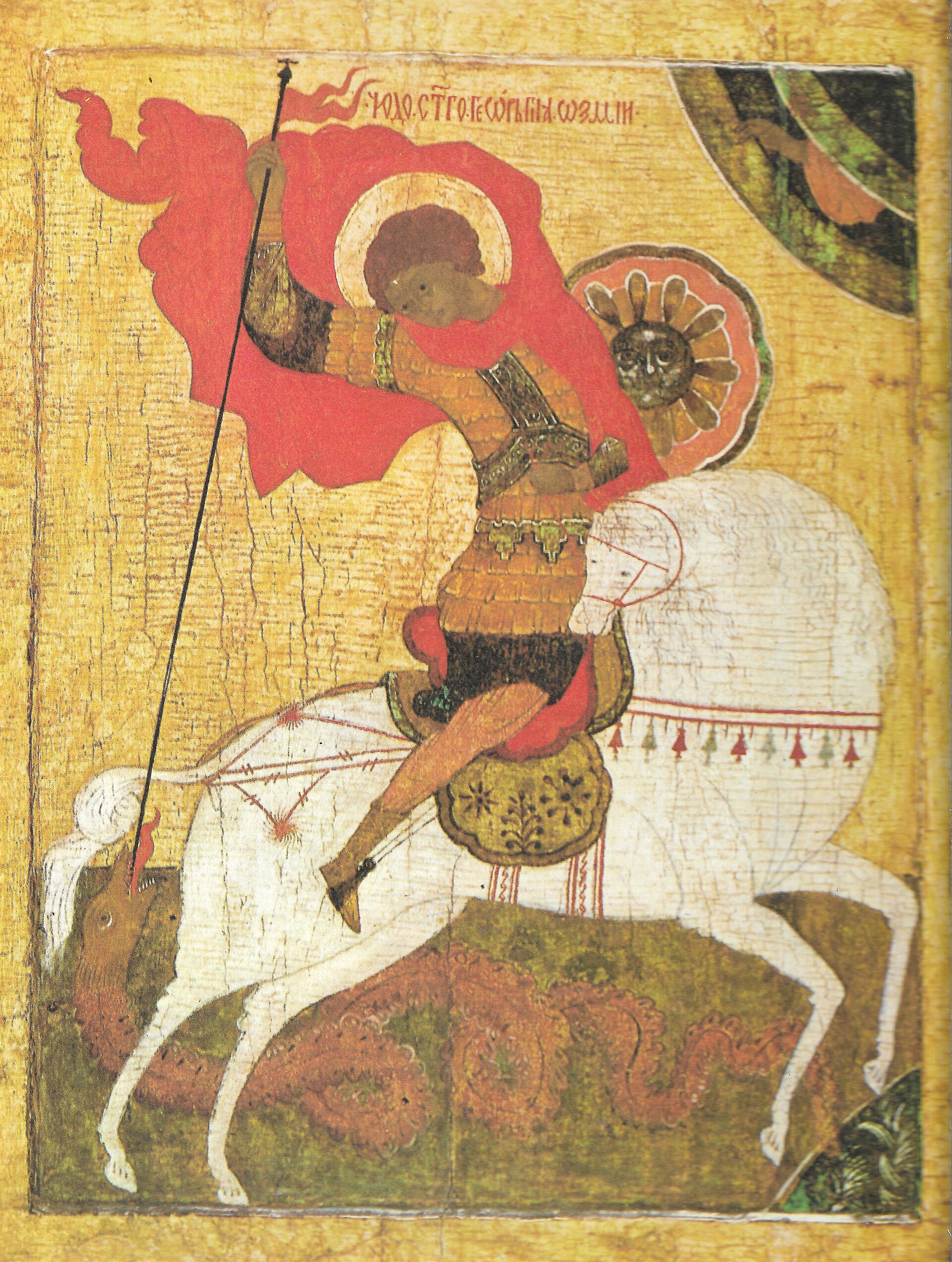
The Miracle of Saint George and the Dragon (Novgorod)
Doctrinal reflection
This fifteenth-century AD icon from the Novgorod school, now housed in the Tretyakov Gallery, Moscow, depicts the Miracle of Saint George and the Dragon, one of the most celebrated compositions in the Russian medieval icon-painting tradition. Executed in tempera on a wooden panel, the work exemplifies the Novgorod aesthetic: bold, high-contrast chromatic planes, a flattened pictorial space, and an energetic, almost calligraphic contour line that lends the composition its characteristic heraldic intensity. The saint appears mounted on a white horse rendered in simplified, near-geometric form, his lance driving downward into the serpentine body of the dragon beneath the horse's hooves. A mandorla or divine hand may appear in the upper register, signaling celestial mandate for George's action. The theological program positions the warrior-saint as an instrument of divine victory over demonic evil, a reading reinforced by the image's visual debt to apocalyptic imagery—specifically the warfare between heavenly and infernal forces described in Revelation 12. The figure of the princess, present in some versions of the legend, may appear in the background, representing the Church or humanity delivered from destruction. Iconographically, the composition belongs to a long Byzantino-Slavic tradition traceable to middle Byzantine prototypes, yet the Novgorod school refines these models into an assertive, quasi-emblematic format that prioritizes legibility and symbolic force over narrative complexity. Scholars have noted the icon's resonance with Novgorodian civic identity, given George's role as a patron of military and political authority. Sources: Lazarev, V.N., Novgorodian Icon Painting (1969); Weitzmann, K., The Icon (1978); Onasch, K. & Schnieper, A., Icons: The Fascination and the Reality (1995).