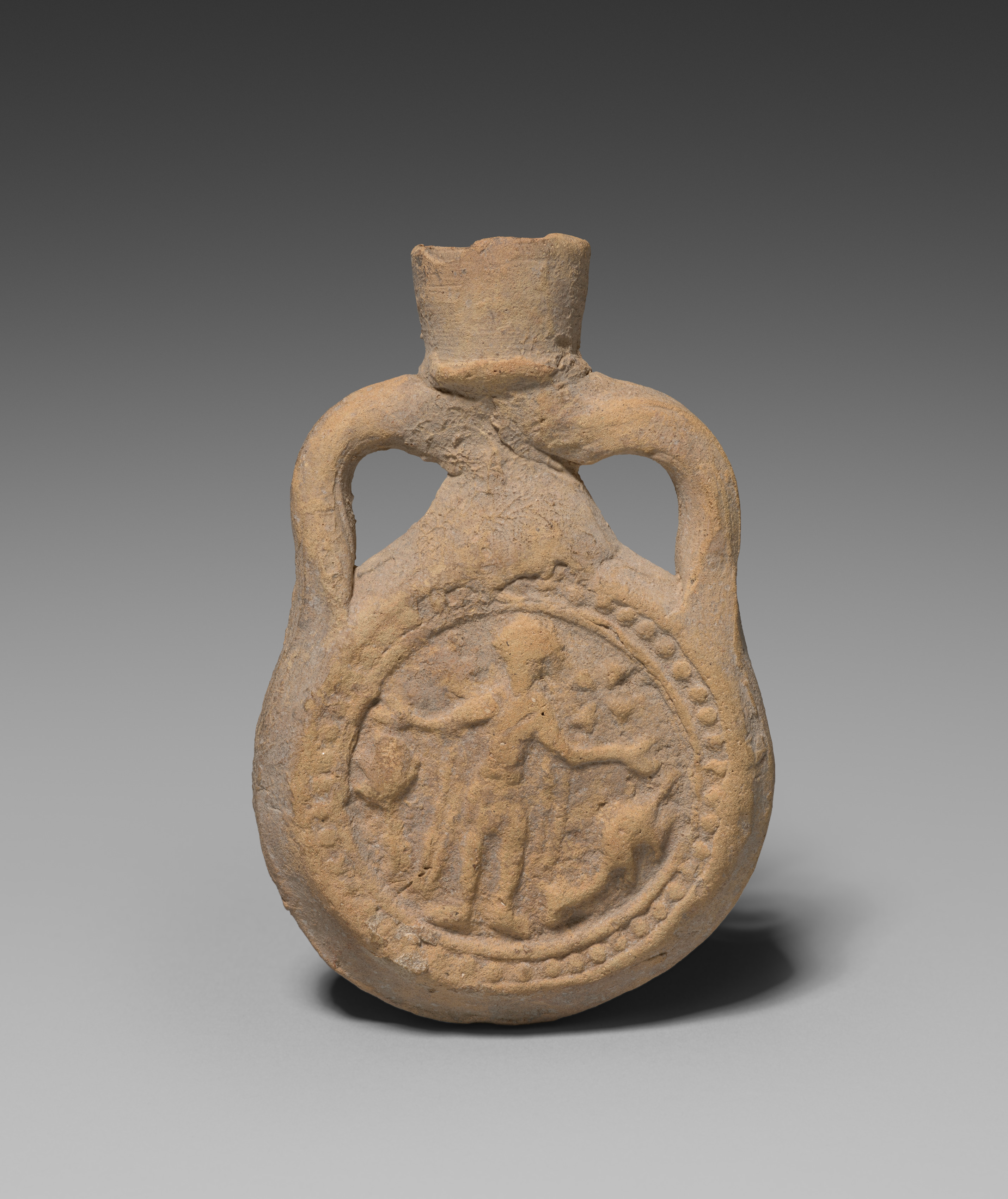
Pilgrim's Flask with Saint Menas
Doctrinal reflection
The Pilgrim's Flask with Saint Menas represents a significant category of early Christian devotional material culture produced in Egypt during the fifth and sixth centuries AD, broadly contemporary with the florescence of the Abu Mena pilgrimage complex situated southwest of Alexandria in the Libyan desert. Manufactured from terracotta—likely in workshops clustered near the martyrion itself—these ampullae (eulogia flasks) functioned as portable reliquaries of contact, typically filled with oil drawn from the lamp perpetually burning over the saint's tomb, or occasionally with sanctified water. The iconographic program is highly standardized: Saint Menas is conventionally depicted as an orant figure flanked by two kneeling camels, an image that conflates hagiographic narrative with regional identity and serves as a visual guarantor of the vessel's authenticity. Menas, venerated as a soldier-martyr of the Diocletianic persecution, attracted one of late antiquity's most cosmopolitan pilgrimage networks, and surviving flasks have been recovered across the Mediterranean basin, attesting to the wide diffusion of Alexandrian devotional culture. Scholarly attention has focused on these objects as evidence for the intersection of pilgrimage economy, relic theology, and workshop standardization. The Cleveland example participates in a corpus studied extensively through archaeological excavation at Abu Mena, UNESCO-listed though now endangered. The flasks do not fall neatly within Byzantine icon or mosaic traditions but represent a parallel, largely Coptic devotional stream with strong formal continuities to contemporaneous Justinianic sacred imagery. Sources: Gawdat Gabra and Gertrud J. M. van Loon, eds., The Treasures of Coptic Art (2006); Journal of Coptic Studies; Dumbarton Oaks Papers.