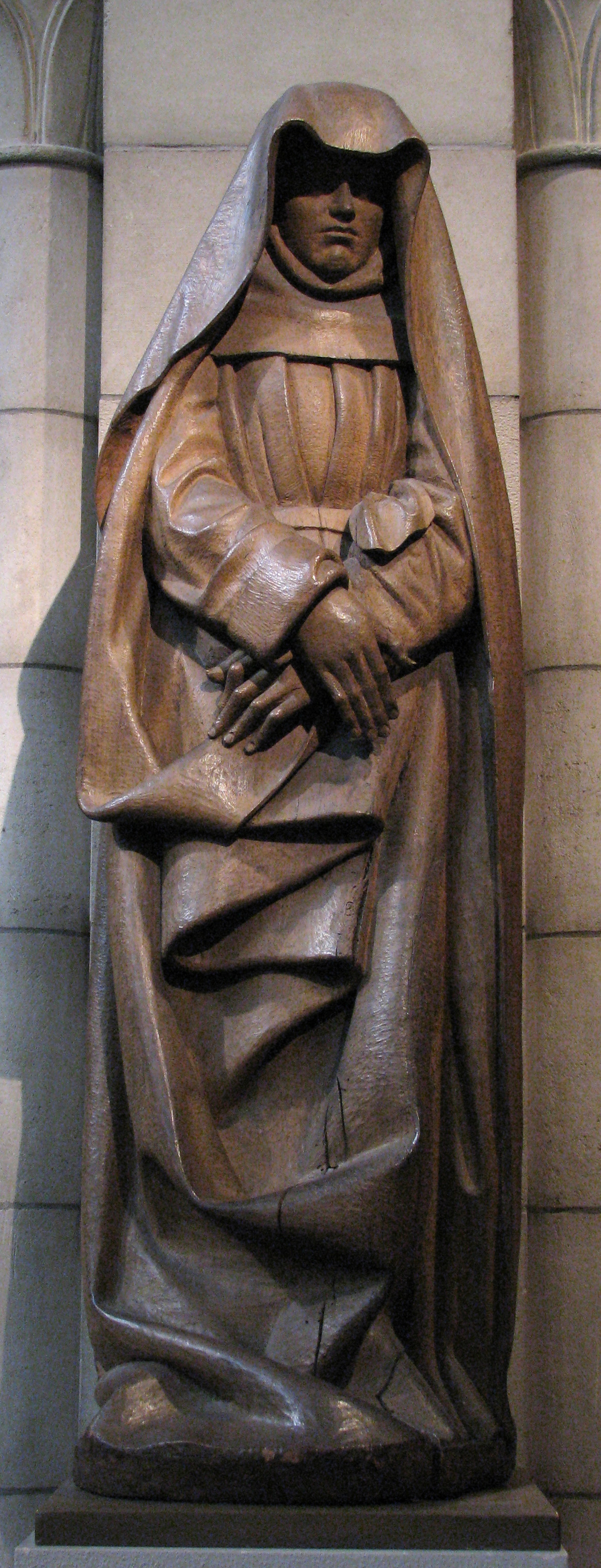
Mourning Virgin from a Crucifixion Group
Doctrinal reflection
This entry presents a classificatory problem for the Scriptorium archive: the object in question—a French walnut wall statue of a Mourning Virgin from a Crucifixion Group, dated 1450–75 AD and held in the Metropolitan Museum of Art (Gift of J. Pierpont Morgan, 1916)—is a Western European Gothic sculptural work, not a Byzantine artifact. It falls outside the canonical media and geographic scope of Byzantine art historical analysis (mosaic, fresco, panel icon, or illuminated manuscript produced within the Byzantine cultural sphere). The iconographic type of the Mater Dolorosa flanking a Crucifixion group does share deep roots with Byzantine Threnos and Stavros imagery, and French Gothic workshops absorbed Eastern Passion iconography via Crusader contact and ivory carving traditions. However, the medium (polychrome walnut sculpture), provenance (France), and date (mid-to-late fifteenth century AD) place this firmly within Latin Western devotional art. The schema fields below are completed as best approximations: the 'era' is rendered as 'late' given the temporal overlap with the Palaiologan period (pre-1453), the medium is approximated as 'icon' in the sense of a devotional image, and the theological program centers on Passion Christology and Marian compassio. Scholarly caution is warranted against forcing this object into a Byzantine analytical framework. Researchers should consult literature on Franco-Flemish Gothic sculpture and Passion group ensembles rather than Byzantine icon studies. Sources: Metropolitan Museum of Art Bulletin; Forsyth, I.H., The Throne of Wisdom: Wood Sculptures of the Madonna in Romanesque France (Princeton, 1972); Hamburger, J.F., The Visual and the Visionary (Zone Books, 1998).