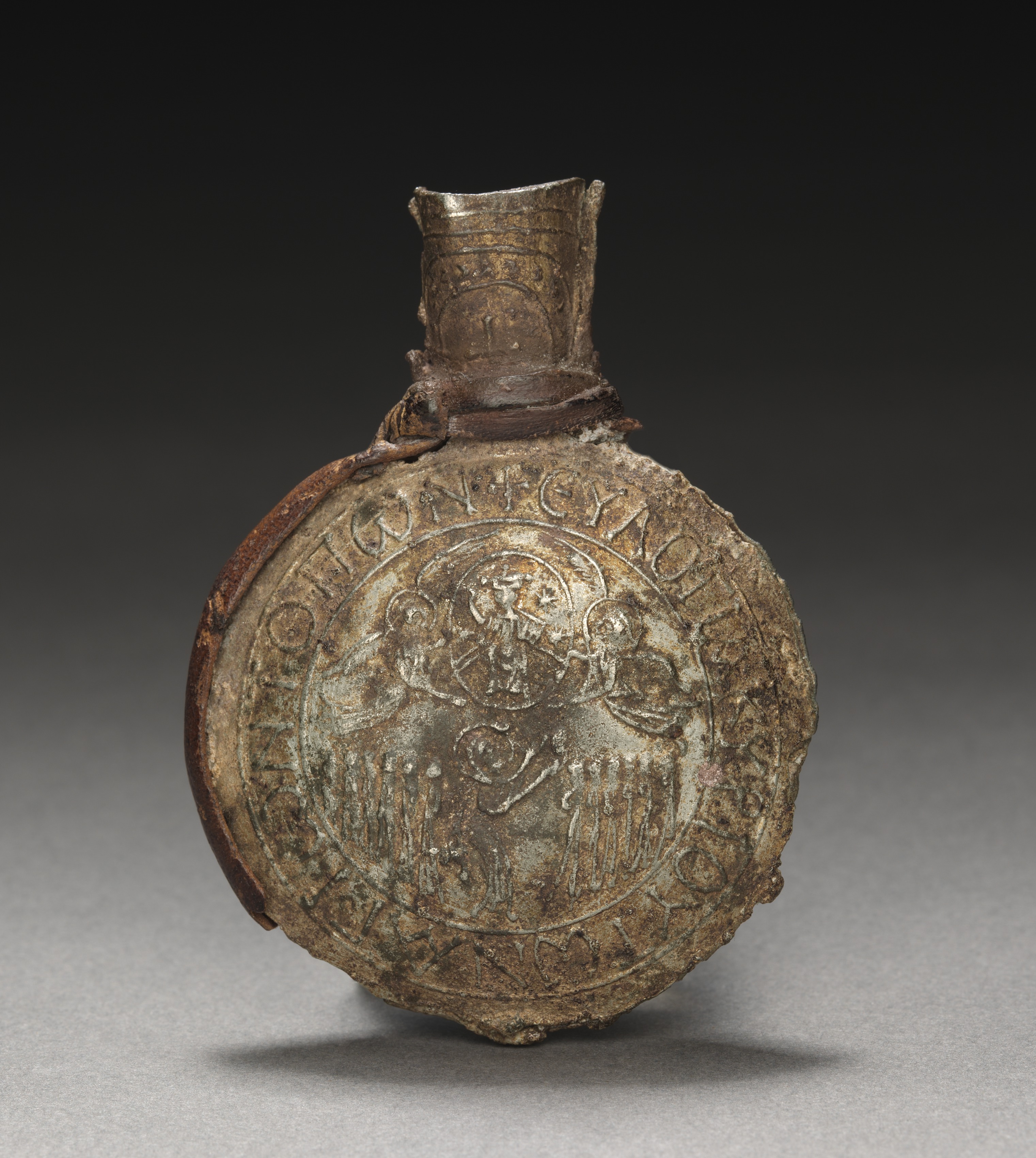
Pilgrim's Ampulla with the Ascension (back)
Doctrinal reflection
This pilgrim's ampulla, dated to approximately 600 AD and associated with Palestinian production of the early Byzantine period, represents a category of devotional metalwork intrinsically linked to the theology of the loca sancta. Cast in a tin-lead alloy, the vessel's back face bears a depiction of the Ascension of Christ, while the front carries the Crucifixion—a pairing that frames the soteriological arc from sacrificial death to glorified exaltation. The ampulla belongs to the so-called 'Monza-Bobbio' group, named for two Italian sites where caches of comparable examples were recovered, suggesting active pilgrimage networks connecting Palestine to the Latin West in the late sixth and early seventh centuries AD. The Ascension scene typically follows a well-established compositional formula: Christ enthroned within a mandorla or carried upward, flanked by angels, with the Virgin orant at center and the apostolic college arrayed below—a scheme attested across contemporaneous ivories, textiles, and monumental mosaics. Theologically, the image functions not merely as narrative illustration but as a contact relic: the oil or water sanctified by proximity to the holy site was understood to transmit the power (dynamis) of that place, and the impressed sacred image amplified this efficacy. This reflects the early Christian and early Byzantine conviction, articulated by figures such as John of Damascus in the following century, that images participate materially in the sacred reality they represent. The ampulla at the Cleveland Museum of Art thus constitutes evidence for both pilgrimage economy and the early theology of images preceding the Iconoclast controversy. Sources: Grabar, André, Ampoules de Terre Sainte (1958); Vikan, Gary, Byzantine Pilgrimage Art (1982); Dumbarton Oaks Papers.